

surface crossing has a linear rather than conical character. Furthermore, the adiabatic LR-TD-DFT method experiences severe convergence problems in the vicinity
of the crossing point which prevented us from obtaining a reasonable S 0 –S 1 energy
difference plot along a loop around the MECI. Nevertheless, the curves in Fig. 8
corroborate the fact that the adiabatic LR-TD-DFT method is incapable of yielding
the correct topography of the S 0 /S 1 crossing point and that the other two DFT
methods, SSR and SF, are thus preferred for studying the non-adiabatic dynamics of
the excited state of PSB3 and related molecules.
4.3 Ketene
Ketene displays an S 0 /S 1 CI along the C–C–O bending mode which, as first
analyzed by Yarkony [97], originates from a crossing between the
1 A’ and
1 A”
electronic states. This crossing is linear under the C s symmetry constraint; however,
it becomes conical when the symmetry restriction is lifted, as there emerges another
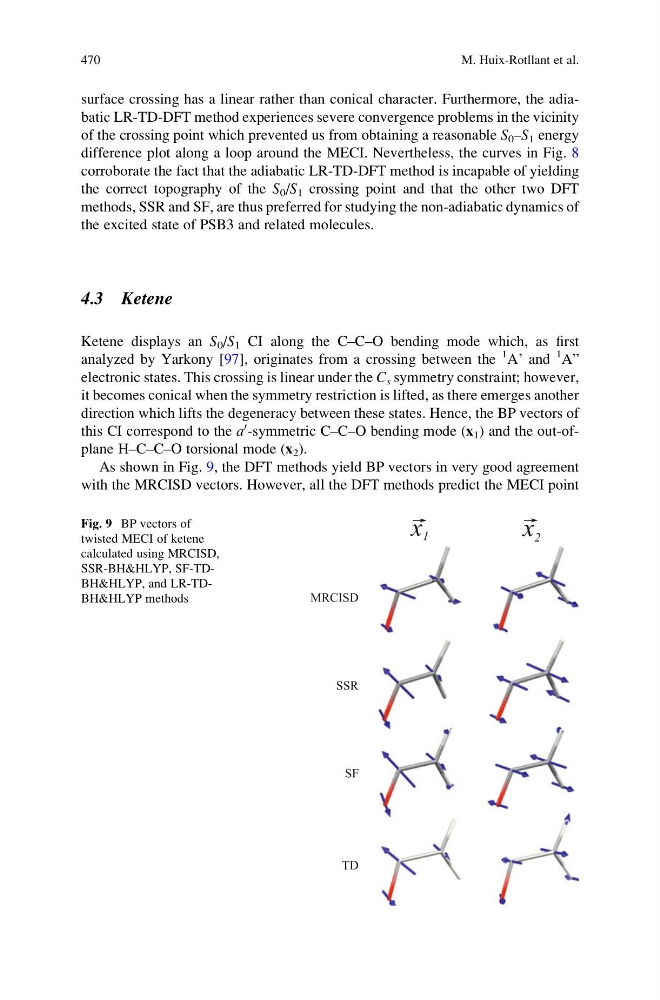
direction which lifts the degeneracy between these states. Hence, the BP vectors of
this CI correspond to the a
0 -symmetric C–C–O bending mode (x 1 ) and the out-ofplane H–C–C–O torsional mode (x 2 ).
As shown in Fig. 9, the DFT methods yield BP vectors in very good agreement
with the MRCISD vectors. However, all the DFT methods predict the MECI point
Fig. 9 BP vectors of
twisted MECI of ketene
calculated using MRCISD,
SSR-BH&HLYP, SF-TDBH&HLYP, and LR-TDBH&HLYP methods
470
M. Huix-Rotllant et al.
of the crossing point which prevented us from obtaining a reasonable S 0 –S 1 energy
difference plot along a loop around the MECI. Nevertheless, the curves in Fig. 8
corroborate the fact that the adiabatic LR-TD-DFT method is incapable of yielding
the correct topography of the S 0 /S 1 crossing point and that the other two DFT
methods, SSR and SF, are thus preferred for studying the non-adiabatic dynamics of
the excited state of PSB3 and related molecules.
4.3 Ketene
Ketene displays an S 0 /S 1 CI along the C–C–O bending mode which, as first
analyzed by Yarkony [97], originates from a crossing between the
1 A’ and
1 A”
electronic states. This crossing is linear under the C s symmetry constraint; however,
it becomes conical when the symmetry restriction is lifted, as there emerges another
direction which lifts the degeneracy between these states. Hence, the BP vectors of
this CI correspond to the a
0 -symmetric C–C–O bending mode (x 1 ) and the out-ofplane H–C–C–O torsional mode (x 2 ).
As shown in Fig. 9, the DFT methods yield BP vectors in very good agreement
with the MRCISD vectors. However, all the DFT methods predict the MECI point
Fig. 9 BP vectors of
twisted MECI of ketene
calculated using MRCISD,
SSR-BH&HLYP, SF-TDBH&HLYP, and LR-TDBH&HLYP methods
470
M. Huix-Rotllant et al.