

along the x 2 direction as predicted by adiabatic LR-TD-DFT is inconsistent with the
SSR and SF PESs. It appears as though the S 0 state is unaware of the proximity to
the S 1 state. The SSR and SF methods yield some interaction between these states
which is reflected in the shapes of the S 0 and S 1 PESs; the latter appear to be
(approximately) symmetrically split around some median level, whereas no such
(quasi) symmetric splitting can be seen in the adiabatic LR-TD-DFT PESs; see the
lower right panel of Fig. 5. Thus, adiabatic LR-TD-DFT predicts a linear S 0 /S 1 PES
crossing, as expected from the vanishing off-diagonal matrix element in (1); hence,
only one degree of freedom is sufficient to make the PESs cross, which leads to the
M À 1 dimensionality of the crossing seam in adiabatic LR-TD-DFT [40, 41, 43].
These observations are corroborated by the plot in Fig. 6, which shows the S 0 –S 1
energy difference along a loop with a radius of 0.002 Å around the MECI point. The
SSR and SF energy differences always remain finite which means that there is a
finite gap at all geometries which lift the degeneracy of the S 0 and S 1 states at the
MECI point. By contrast, the adiabatic LR-TD-DFT energy difference curve
crosses the zero level twice when going around the loop. It is also noteworthy
that the shape of the energy difference curve as produced by adiabatic LR-TD-DFT
is markedly different from those of the other two methods. The angle θ that
parameterizes the loop is taken from the direction of the x 1 vector. This implies
that the coupling between the S 0 and S 1 states should vanish at the points θ ¼ 0
and
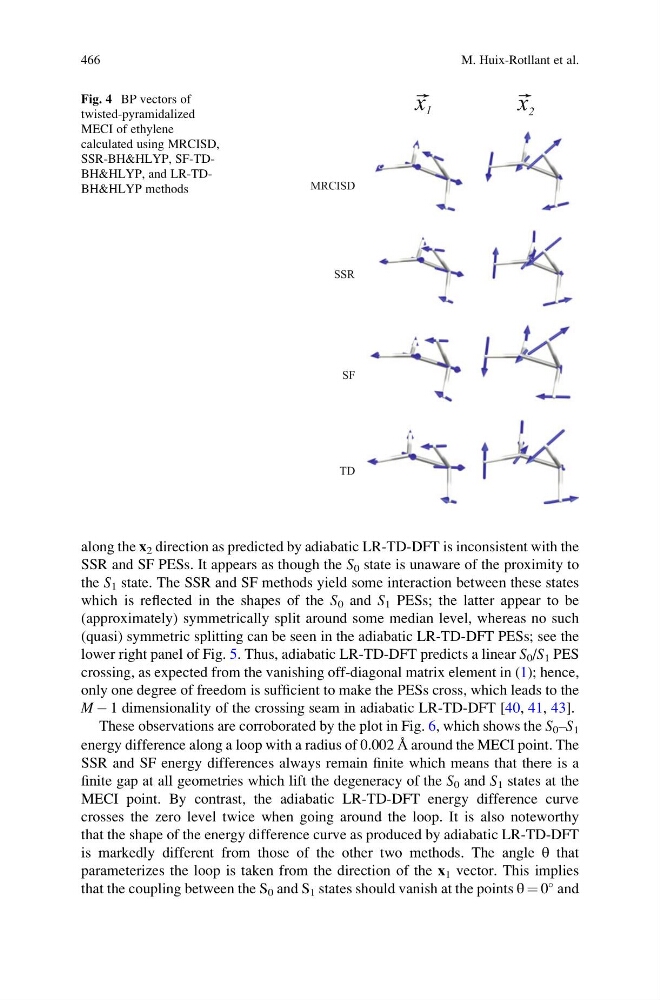
Fig. 4 BP vectors of
twisted-pyramidalized
MECI of ethylene
calculated using MRCISD,
SSR-BH&HLYP, SF-TDBH&HLYP, and LR-TDBH&HLYP methods
466
M. Huix-Rotllant et al.
SSR and SF PESs. It appears as though the S 0 state is unaware of the proximity to
the S 1 state. The SSR and SF methods yield some interaction between these states
which is reflected in the shapes of the S 0 and S 1 PESs; the latter appear to be
(approximately) symmetrically split around some median level, whereas no such
(quasi) symmetric splitting can be seen in the adiabatic LR-TD-DFT PESs; see the
lower right panel of Fig. 5. Thus, adiabatic LR-TD-DFT predicts a linear S 0 /S 1 PES
crossing, as expected from the vanishing off-diagonal matrix element in (1); hence,
only one degree of freedom is sufficient to make the PESs cross, which leads to the
M À 1 dimensionality of the crossing seam in adiabatic LR-TD-DFT [40, 41, 43].
These observations are corroborated by the plot in Fig. 6, which shows the S 0 –S 1
energy difference along a loop with a radius of 0.002 Å around the MECI point. The
SSR and SF energy differences always remain finite which means that there is a
finite gap at all geometries which lift the degeneracy of the S 0 and S 1 states at the
MECI point. By contrast, the adiabatic LR-TD-DFT energy difference curve
crosses the zero level twice when going around the loop. It is also noteworthy
that the shape of the energy difference curve as produced by adiabatic LR-TD-DFT
is markedly different from those of the other two methods. The angle θ that
parameterizes the loop is taken from the direction of the x 1 vector. This implies
that the coupling between the S 0 and S 1 states should vanish at the points θ ¼ 0
and
Fig. 4 BP vectors of
twisted-pyramidalized
MECI of ethylene
calculated using MRCISD,
SSR-BH&HLYP, SF-TDBH&HLYP, and LR-TDBH&HLYP methods
466
M. Huix-Rotllant et al.