

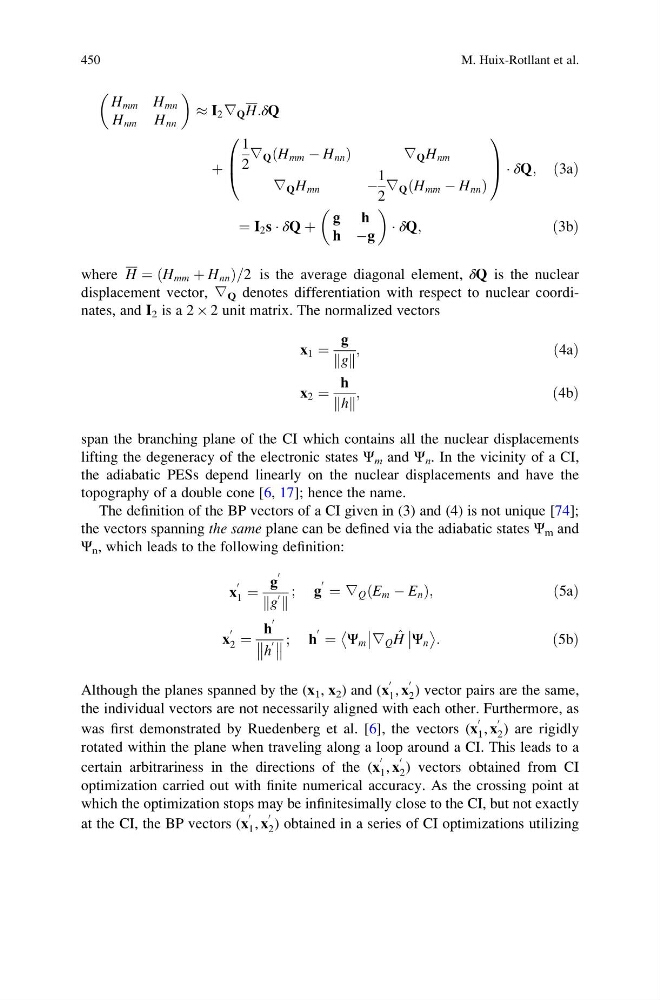
H mm H mn
H nm H nn
% I 2 ∇ Q H:δQ
þ
1
2
∇ Q H mm À H nn
ð
Þ
∇ Q H nm
∇ Q H mn
À
1
2
∇ Q H mm À H nn
ð
Þ
0
B
@
1
C
A Á δQ; ð3aÞ
¼ I 2 s Á δQ þ
g h
h Àg
Á δQ;
ð3bÞ
where H ¼ H mm þ H nn
ð
Þ =2 is the average diagonal element, δQ is the nuclear
displacement vector, ∇ Q denotes differentiation with respect to nuclear coordinates, and I 2 is a 2 Â 2 unit matrix. The normalized vectors
x 1 ¼
g
g
k k
;
ð4aÞ
x 2 ¼
h
h
k k
;
ð4bÞ
span the branching plane of the CI which contains all the nuclear displacements
lifting the degeneracy of the electronic states Ψ m and Ψ n . In the vicinity of a CI,
the adiabatic PESs depend linearly on the nuclear displacements and have the
topography of a double cone [6, 17]; hence the name.
The definition of the BP vectors of a CI given in (3) and (4) is not unique [74];
the vectors spanning the same plane can be defined via the adiabatic states Ψ m and
Ψ n , which leads to the following definition:
x
0
1 ¼
g
0
g
0
k k
; g
0 ¼ ∇ Q E m À E n
ð
Þ ;
ð5aÞ
x
0
2 ¼
h
0
h
0
; h
0 ¼ Ψ m
∇ Q ^
H
Ψ n
:
ð5bÞ
Although the planes spanned by the (x 1 , x 2 ) and (x
0
1 , x
0
2 ) vector pairs are the same,
the individual vectors are not necessarily aligned with each other. Furthermore, as
was first demonstrated by Ruedenberg et al. [6], the vectors (x
0
1 , x
0
2 ) are rigidly
rotated within the plane when traveling along a loop around a CI. This leads to a
certain arbitrariness in the directions of the (x
0
1 , x
0
2 ) vectors obtained from CI
optimization carried out with finite numerical accuracy. As the crossing point at
which the optimization stops may be infinitesimally close to the CI, but not exactly
at the CI, the BP vectors (x
0
1 , x
0
2 ) obtained in a series of CI optimizations utilizing
450
M. Huix-Rotllant et al.
H nm H nn
% I 2 ∇ Q H:δQ
þ
1
2
∇ Q H mm À H nn
ð
Þ
∇ Q H nm
∇ Q H mn
À
1
2
∇ Q H mm À H nn
ð
Þ
0
B
@
1
C
A Á δQ; ð3aÞ
¼ I 2 s Á δQ þ
g h
h Àg
Á δQ;
ð3bÞ
where H ¼ H mm þ H nn
ð
Þ =2 is the average diagonal element, δQ is the nuclear
displacement vector, ∇ Q denotes differentiation with respect to nuclear coordinates, and I 2 is a 2 Â 2 unit matrix. The normalized vectors
x 1 ¼
g
g
k k
;
ð4aÞ
x 2 ¼
h
h
k k
;
ð4bÞ
span the branching plane of the CI which contains all the nuclear displacements
lifting the degeneracy of the electronic states Ψ m and Ψ n . In the vicinity of a CI,
the adiabatic PESs depend linearly on the nuclear displacements and have the
topography of a double cone [6, 17]; hence the name.
The definition of the BP vectors of a CI given in (3) and (4) is not unique [74];
the vectors spanning the same plane can be defined via the adiabatic states Ψ m and
Ψ n , which leads to the following definition:
x
0
1 ¼
g
0
g
0
k k
; g
0 ¼ ∇ Q E m À E n
ð
Þ ;
ð5aÞ
x
0
2 ¼
h
0
h
0
; h
0 ¼ Ψ m
∇ Q ^
H
Ψ n
:
ð5bÞ
Although the planes spanned by the (x 1 , x 2 ) and (x
0
1 , x
0
2 ) vector pairs are the same,
the individual vectors are not necessarily aligned with each other. Furthermore, as
was first demonstrated by Ruedenberg et al. [6], the vectors (x
0
1 , x
0
2 ) are rigidly
rotated within the plane when traveling along a loop around a CI. This leads to a
certain arbitrariness in the directions of the (x
0
1 , x
0
2 ) vectors obtained from CI
optimization carried out with finite numerical accuracy. As the crossing point at
which the optimization stops may be infinitesimally close to the CI, but not exactly
at the CI, the BP vectors (x
0
1 , x
0
2 ) obtained in a series of CI optimizations utilizing
450
M. Huix-Rotllant et al.