

(MECI) and its relative energy, we focus on the BP of the intersection and compare
the BP vectors obtained in the DFT calculations with the corresponding MRCISDderived vectors [59]. When benchmarking the DFT methods, we address a set of
CIs of diverse topography occurring in unsaturated molecules during double-bond
torsion; however, the conclusions drawn from these benchmarks should remain
valid for other CIs as well, such as those in cyclic molecules or in nucleobases. The
reason why we focus on relatively small molecules is that it would be extremely
difficult to carry out MRCISD calculations with good-quality basis sets for larger
molecules.
2 Conical Intersections
CIs are manifolds of points at which there is a real crossing (degeneracy) between
two (or more) adiabatic Born–Oppenheimer PESs of electronic states of the same
spatial and spin symmetry. The fundamental conditions for the occurrence of such
intersections have been known since the early days of quantum mechanics [15,
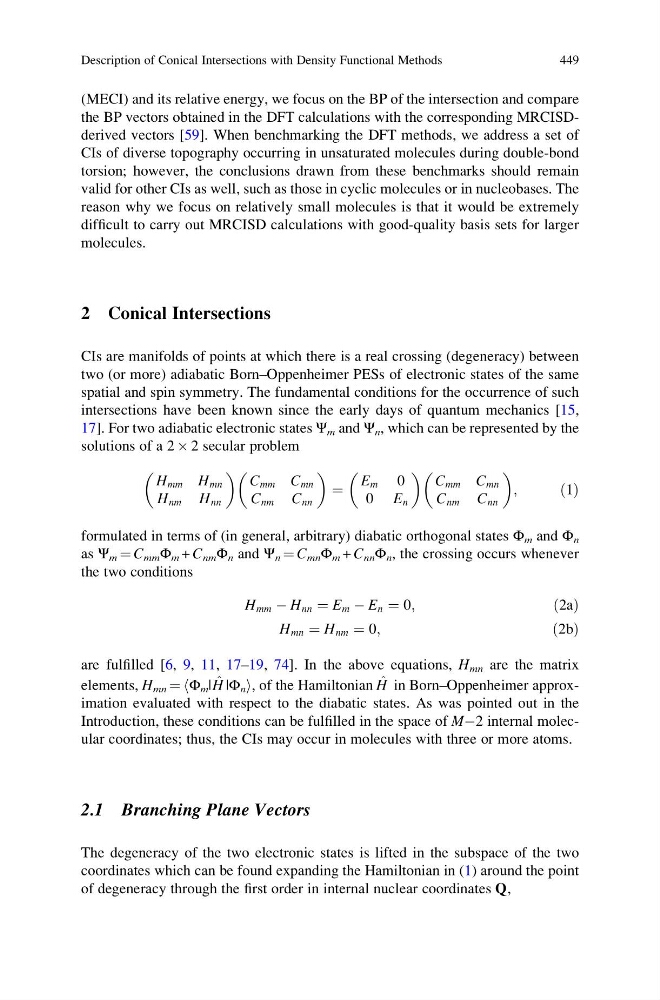
17]. For two adiabatic electronic states Ψ m and Ψ n , which can be represented by the
solutions of a 2 Â 2 secular problem
H mm H mn
H nm H nn
C mm C mn
C nm C nn
¼
E m 0
0 E n
C mm C mn
C nm C nn
;
ð1Þ
formulated in terms of (in general, arbitrary) diabatic orthogonal states Φ m and Φ n
as Ψ m ¼ C mm Φ m + C nm Φ n and Ψ n ¼ C mn Φ m + C nn Φ n , the crossing occurs whenever
the two conditions
H mm À H nn ¼ E m À E n ¼ 0;
ð2aÞ
H mn ¼ H nm ¼ 0;
ð2bÞ
are fulfilled [6, 9, 11, 17–19, 74]. In the above equations, H mn are the matrix
elements, H mn ¼ hΦ m | ^
H |Φ n i, of the Hamiltonian ^
H in Born–Oppenheimer approximation evaluated with respect to the diabatic states. As was pointed out in the
Introduction, these conditions can be fulfilled in the space of MÀ2 internal molecular coordinates; thus, the CIs may occur in molecules with three or more atoms.
2.1 Branching Plane Vectors
The degeneracy of the two electronic states is lifted in the subspace of the two
coordinates which can be found expanding the Hamiltonian in (1) around the point
of degeneracy through the first order in internal nuclear coordinates Q,
Description of Conical Intersections with Density Functional Methods
449
the BP vectors obtained in the DFT calculations with the corresponding MRCISDderived vectors [59]. When benchmarking the DFT methods, we address a set of
CIs of diverse topography occurring in unsaturated molecules during double-bond
torsion; however, the conclusions drawn from these benchmarks should remain
valid for other CIs as well, such as those in cyclic molecules or in nucleobases. The
reason why we focus on relatively small molecules is that it would be extremely
difficult to carry out MRCISD calculations with good-quality basis sets for larger
molecules.
2 Conical Intersections
CIs are manifolds of points at which there is a real crossing (degeneracy) between
two (or more) adiabatic Born–Oppenheimer PESs of electronic states of the same
spatial and spin symmetry. The fundamental conditions for the occurrence of such
intersections have been known since the early days of quantum mechanics [15,
17]. For two adiabatic electronic states Ψ m and Ψ n , which can be represented by the
solutions of a 2 Â 2 secular problem
H mm H mn
H nm H nn
C mm C mn
C nm C nn
¼
E m 0
0 E n
C mm C mn
C nm C nn
;
ð1Þ
formulated in terms of (in general, arbitrary) diabatic orthogonal states Φ m and Φ n
as Ψ m ¼ C mm Φ m + C nm Φ n and Ψ n ¼ C mn Φ m + C nn Φ n , the crossing occurs whenever
the two conditions
H mm À H nn ¼ E m À E n ¼ 0;
ð2aÞ
H mn ¼ H nm ¼ 0;
ð2bÞ
are fulfilled [6, 9, 11, 17–19, 74]. In the above equations, H mn are the matrix
elements, H mn ¼ hΦ m | ^
H |Φ n i, of the Hamiltonian ^
H in Born–Oppenheimer approximation evaluated with respect to the diabatic states. As was pointed out in the
Introduction, these conditions can be fulfilled in the space of MÀ2 internal molecular coordinates; thus, the CIs may occur in molecules with three or more atoms.
2.1 Branching Plane Vectors
The degeneracy of the two electronic states is lifted in the subspace of the two
coordinates which can be found expanding the Hamiltonian in (1) around the point
of degeneracy through the first order in internal nuclear coordinates Q,
Description of Conical Intersections with Density Functional Methods
449