

4 Surface-Hopping/DFT Implementations
One of the reasons for the popularity of the surface hopping method is that its
implementation is straightforward. This has given rise to several home-made
private codes to simulate SH/DFT [62, 63, 81, 129]. There are also a few general
programs of public access (either commercial or non-commercial) with SH/DFT
capability, including Newton-X [130, 131], PYXAID [61, 132], Turbomole [78],
and CPMD (www.cpmd.org).
The main difference between the several implementations of SH/DFT is exactly
which DFT method is being used for computing the electronic-structure quantities.
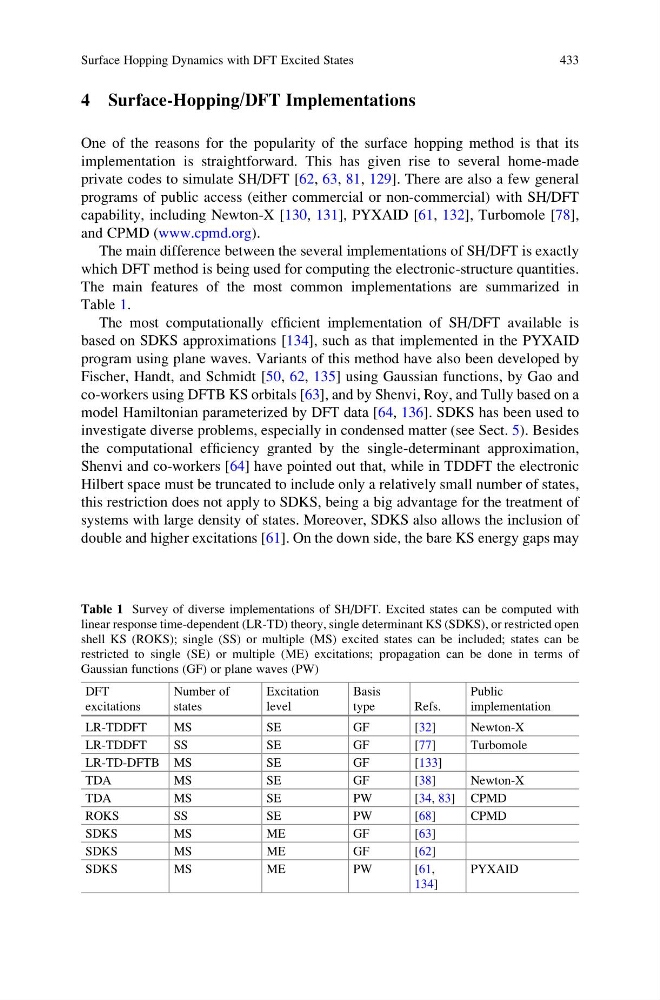
The main features of the most common implementations are summarized in
Table 1.
The most computationally efficient implementation of SH/DFT available is
based on SDKS approximations [134], such as that implemented in the PYXAID
program using plane waves. Variants of this method have also been developed by
Fischer, Handt, and Schmidt [50, 62, 135] using Gaussian functions, by Gao and
co-workers using DFTB KS orbitals [63], and by Shenvi, Roy, and Tully based on a
model Hamiltonian parameterized by DFT data [64, 136]. SDKS has been used to
investigate diverse problems, especially in condensed matter (see Sect. 5). Besides
the computational efficiency granted by the single-determinant approximation,
Shenvi and co-workers [64] have pointed out that, while in TDDFT the electronic
Hilbert space must be truncated to include only a relatively small number of states,
this restriction does not apply to SDKS, being a big advantage for the treatment of
systems with large density of states. Moreover, SDKS also allows the inclusion of
double and higher excitations [61]. On the down side, the bare KS energy gaps may
Table 1 Survey of diverse implementations of SH/DFT. Excited states can be computed with
linear response time-dependent (LR-TD) theory, single determinant KS (SDKS), or restricted open
shell KS (ROKS); single (SS) or multiple (MS) excited states can be included; states can be
restricted to single (SE) or multiple (ME) excitations; propagation can be done in terms of
Gaussian functions (GF) or plane waves (PW)
DFT
excitations
Number of
states
Excitation
level
Basis
type
Refs.
Public
implementation
LR-TDDFT
MS
SE
GF
[32]
Newton-X
LR-TDDFT
SS
SE
GF
[77]
Turbomole
LR-TD-DFTB MS
SE
GF
[133]
TDA
MS
SE
GF
[38]
Newton-X
TDA
MS
SE
PW
[34, 83] CPMD
ROKS
SS
SE
PW
[68]
CPMD
SDKS
MS
ME
GF
[63]
SDKS
MS
ME
GF
[62]
SDKS
MS
ME
PW
[61,
134]
PYXAID
Surface Hopping Dynamics with DFT Excited States
433
One of the reasons for the popularity of the surface hopping method is that its
implementation is straightforward. This has given rise to several home-made
private codes to simulate SH/DFT [62, 63, 81, 129]. There are also a few general
programs of public access (either commercial or non-commercial) with SH/DFT
capability, including Newton-X [130, 131], PYXAID [61, 132], Turbomole [78],
and CPMD (www.cpmd.org).
The main difference between the several implementations of SH/DFT is exactly
which DFT method is being used for computing the electronic-structure quantities.
The main features of the most common implementations are summarized in
Table 1.
The most computationally efficient implementation of SH/DFT available is
based on SDKS approximations [134], such as that implemented in the PYXAID
program using plane waves. Variants of this method have also been developed by
Fischer, Handt, and Schmidt [50, 62, 135] using Gaussian functions, by Gao and
co-workers using DFTB KS orbitals [63], and by Shenvi, Roy, and Tully based on a
model Hamiltonian parameterized by DFT data [64, 136]. SDKS has been used to
investigate diverse problems, especially in condensed matter (see Sect. 5). Besides
the computational efficiency granted by the single-determinant approximation,
Shenvi and co-workers [64] have pointed out that, while in TDDFT the electronic
Hilbert space must be truncated to include only a relatively small number of states,
this restriction does not apply to SDKS, being a big advantage for the treatment of
systems with large density of states. Moreover, SDKS also allows the inclusion of
double and higher excitations [61]. On the down side, the bare KS energy gaps may
Table 1 Survey of diverse implementations of SH/DFT. Excited states can be computed with
linear response time-dependent (LR-TD) theory, single determinant KS (SDKS), or restricted open
shell KS (ROKS); single (SS) or multiple (MS) excited states can be included; states can be
restricted to single (SE) or multiple (ME) excitations; propagation can be done in terms of
Gaussian functions (GF) or plane waves (PW)
DFT
excitations
Number of
states
Excitation
level
Basis
type
Refs.
Public
implementation
LR-TDDFT
MS
SE
GF
[32]
Newton-X
LR-TDDFT
SS
SE
GF
[77]
Turbomole
LR-TD-DFTB MS
SE
GF
[133]
TDA
MS
SE
GF
[38]
Newton-X
TDA
MS
SE
PW
[34, 83] CPMD
ROKS
SS
SE
PW
[68]
CPMD
SDKS
MS
ME
GF
[63]
SDKS
MS
ME
GF
[62]
SDKS
MS
ME
PW
[61,
134]
PYXAID
Surface Hopping Dynamics with DFT Excited States
433