

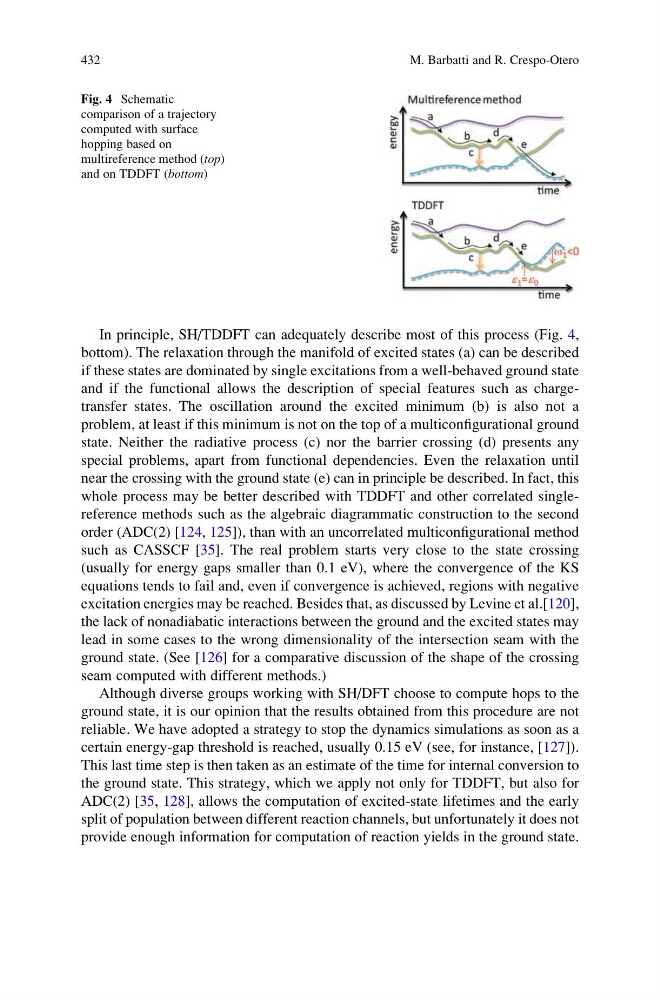
In principle, SH/TDDFT can adequately describe most of this process (Fig. 4,
bottom). The relaxation through the manifold of excited states (a) can be described
if these states are dominated by single excitations from a well-behaved ground state
and if the functional allows the description of special features such as chargetransfer states. The oscillation around the excited minimum (b) is also not a
problem, at least if this minimum is not on the top of a multiconfigurational ground
state. Neither the radiative process (c) nor the barrier crossing (d) presents any
special problems, apart from functional dependencies. Even the relaxation until
near the crossing with the ground state (e) can in principle be described. In fact, this
whole process may be better described with TDDFT and other correlated singlereference methods such as the algebraic diagrammatic construction to the second
order (ADC(2) [124, 125]), than with an uncorrelated multiconfigurational method
such as CASSCF [35]. The real problem starts very close to the state crossing
(usually for energy gaps smaller than 0.1 eV), where the convergence of the KS
equations tends to fail and, even if convergence is achieved, regions with negative
excitation energies may be reached. Besides that, as discussed by Levine et al.[120],
the lack of nonadiabatic interactions between the ground and the excited states may
lead in some cases to the wrong dimensionality of the intersection seam with the
ground state. (See [126] for a comparative discussion of the shape of the crossing
seam computed with different methods.)
Although diverse groups working with SH/DFT choose to compute hops to the
ground state, it is our opinion that the results obtained from this procedure are not
reliable. We have adopted a strategy to stop the dynamics simulations as soon as a
certain energy-gap threshold is reached, usually 0.15 eV (see, for instance, [127]).
This last time step is then taken as an estimate of the time for internal conversion to
the ground state. This strategy, which we apply not only for TDDFT, but also for
ADC(2) [35, 128], allows the computation of excited-state lifetimes and the early
split of population between different reaction channels, but unfortunately it does not
provide enough information for computation of reaction yields in the ground state.
Fig. 4 Schematic
comparison of a trajectory
computed with surface
hopping based on
multireference method (top)
and on TDDFT (bottom)
432
M. Barbatti and R. Crespo-Otero
bottom). The relaxation through the manifold of excited states (a) can be described
if these states are dominated by single excitations from a well-behaved ground state
and if the functional allows the description of special features such as chargetransfer states. The oscillation around the excited minimum (b) is also not a
problem, at least if this minimum is not on the top of a multiconfigurational ground
state. Neither the radiative process (c) nor the barrier crossing (d) presents any
special problems, apart from functional dependencies. Even the relaxation until
near the crossing with the ground state (e) can in principle be described. In fact, this
whole process may be better described with TDDFT and other correlated singlereference methods such as the algebraic diagrammatic construction to the second
order (ADC(2) [124, 125]), than with an uncorrelated multiconfigurational method
such as CASSCF [35]. The real problem starts very close to the state crossing
(usually for energy gaps smaller than 0.1 eV), where the convergence of the KS
equations tends to fail and, even if convergence is achieved, regions with negative
excitation energies may be reached. Besides that, as discussed by Levine et al.[120],
the lack of nonadiabatic interactions between the ground and the excited states may
lead in some cases to the wrong dimensionality of the intersection seam with the
ground state. (See [126] for a comparative discussion of the shape of the crossing
seam computed with different methods.)
Although diverse groups working with SH/DFT choose to compute hops to the
ground state, it is our opinion that the results obtained from this procedure are not
reliable. We have adopted a strategy to stop the dynamics simulations as soon as a
certain energy-gap threshold is reached, usually 0.15 eV (see, for instance, [127]).
This last time step is then taken as an estimate of the time for internal conversion to
the ground state. This strategy, which we apply not only for TDDFT, but also for
ADC(2) [35, 128], allows the computation of excited-state lifetimes and the early
split of population between different reaction channels, but unfortunately it does not
provide enough information for computation of reaction yields in the ground state.
Fig. 4 Schematic
comparison of a trajectory
computed with surface
hopping based on
multireference method (top)
and on TDDFT (bottom)
432
M. Barbatti and R. Crespo-Otero