

cases are reduced to derivatives of KS orbitals, which can be inexpensively
computed by finite differences during dynamics propagation.
For a discussion about the computation of the nonadiabatic couplings with
ROKS, see [90]. For a discussion about computation of these couplings with
REKS, see [91].
3.3 Critical Appraisal
One of the main challenges in excited-state dynamics simulations is that trajectories
span large regions of the configuration space. Thus, the electronic structure method
used to compute energies, energy gradients, couplings, and other properties should
be able to deal with the large variety of electronic densities induced by different
conformations.
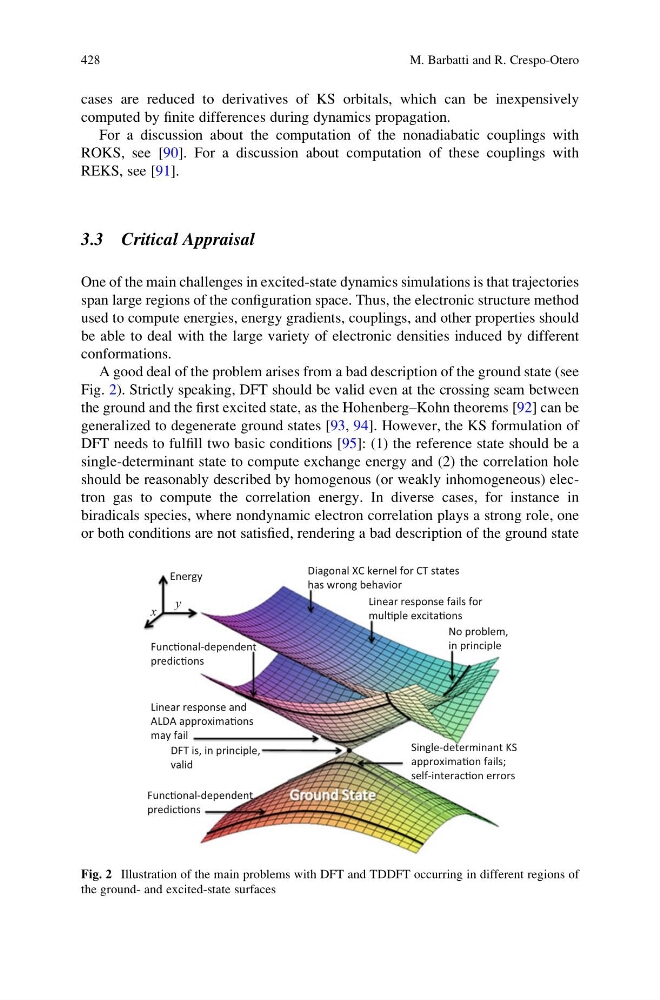
A good deal of the problem arises from a bad description of the ground state (see
Fig. 2). Strictly speaking, DFT should be valid even at the crossing seam between
the ground and the first excited state, as the Hohenberg–Kohn theorems [92] can be
generalized to degenerate ground states [93, 94]. However, the KS formulation of
DFT needs to fulfill two basic conditions [95]: (1) the reference state should be a
single-determinant state to compute exchange energy and (2) the correlation hole
should be reasonably described by homogenous (or weakly inhomogeneous) electron gas to compute the correlation energy. In diverse cases, for instance in
biradicals species, where nondynamic electron correlation plays a strong role, one
or both conditions are not satisfied, rendering a bad description of the ground state
Diagonal XC kernel for CT states
has wrong behavior
Single-determinant KS
approximaƟon fails;
self-interacƟon errors
Linear response and
ALDA approximaƟons
may fail
No problem,
in principle
FuncƟonal-dependent
predicƟons
DFT is, in principle,
valid
FuncƟonal-dependent
predicƟons
Energy
x
y
Linear response fails for
mulƟple excitaƟons
Fig. 2 Illustration of the main problems with DFT and TDDFT occurring in different regions of
the ground- and excited-state surfaces
428
M. Barbatti and R. Crespo-Otero
computed by finite differences during dynamics propagation.
For a discussion about the computation of the nonadiabatic couplings with
ROKS, see [90]. For a discussion about computation of these couplings with
REKS, see [91].
3.3 Critical Appraisal
One of the main challenges in excited-state dynamics simulations is that trajectories
span large regions of the configuration space. Thus, the electronic structure method
used to compute energies, energy gradients, couplings, and other properties should
be able to deal with the large variety of electronic densities induced by different
conformations.
A good deal of the problem arises from a bad description of the ground state (see
Fig. 2). Strictly speaking, DFT should be valid even at the crossing seam between
the ground and the first excited state, as the Hohenberg–Kohn theorems [92] can be
generalized to degenerate ground states [93, 94]. However, the KS formulation of
DFT needs to fulfill two basic conditions [95]: (1) the reference state should be a
single-determinant state to compute exchange energy and (2) the correlation hole
should be reasonably described by homogenous (or weakly inhomogeneous) electron gas to compute the correlation energy. In diverse cases, for instance in
biradicals species, where nondynamic electron correlation plays a strong role, one
or both conditions are not satisfied, rendering a bad description of the ground state
Diagonal XC kernel for CT states
has wrong behavior
Single-determinant KS
approximaƟon fails;
self-interacƟon errors
Linear response and
ALDA approximaƟons
may fail
No problem,
in principle
FuncƟonal-dependent
predicƟons
DFT is, in principle,
valid
FuncƟonal-dependent
predicƟons
Energy
x
y
Linear response fails for
mulƟple excitaƟons
Fig. 2 Illustration of the main problems with DFT and TDDFT occurring in different regions of
the ground- and excited-state surfaces
428
M. Barbatti and R. Crespo-Otero