

between the ground and the first excited states [82] and also between excited states
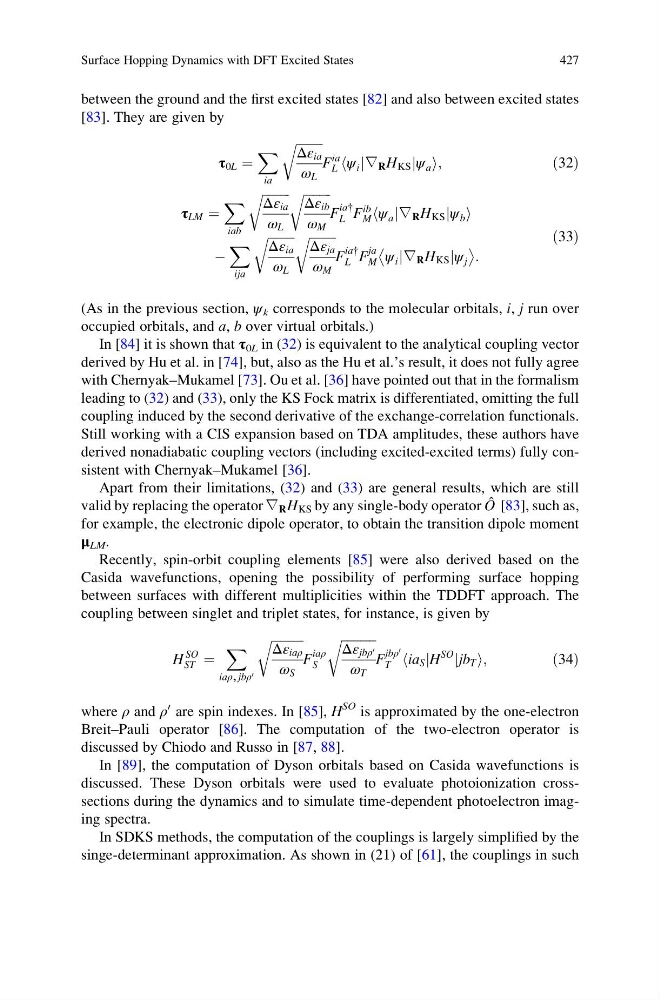
[83]. They are given by
τ 0L ¼
X
ia
ffiffiffiffiffiffiffiffi ffi
Δε ia
ω L
r
F
ia
L ψ i ∇ R H KS
j
j ψ a
h
i ;
ð32Þ
τ LM ¼
X
iab
ffiffiffiffiffiffiffiffi ffi
Δε ia
ω L
r
ffiffiffiffiffiffiffiffi ffi
Δε ib
ω M
r
F
ia{
L F
ib
M ψ a ∇ R H KS
j
j ψ b
h
i
À
X
ija
ffiffiffiffiffiffiffiffi ffi
Δε ia
ω L
r
ffiffiffiffiffiffiffiffi ffi
Δε ja
ω M
r
F
ia{
L F
ja
M ψ i ∇ R H KS
j
j ψ j
:
ð33Þ
(As in the previous section, ψ k corresponds to the molecular orbitals, i, j run over
occupied orbitals, and a, b over virtual orbitals.)
In [84] it is shown that τ 0L in (32) is equivalent to the analytical coupling vector
derived by Hu et al. in [74], but, also as the Hu et al.’s result, it does not fully agree
with Chernyak–Mukamel [73]. Ou et al. [36] have pointed out that in the formalism
leading to (32) and (33), only the KS Fock matrix is differentiated, omitting the full
coupling induced by the second derivative of the exchange-correlation functionals.
Still working with a CIS expansion based on TDA amplitudes, these authors have
derived nonadiabatic coupling vectors (including excited-excited terms) fully consistent with Chernyak–Mukamel [36].
Apart from their limitations, (32) and (33) are general results, which are still
valid by replacing the operator ∇ R H KS by any single-body operator O ˆ [83], such as,
for example, the electronic dipole operator, to obtain the transition dipole moment
μ LM .
Recently, spin-orbit coupling elements [85] were also derived based on the
Casida wavefunctions, opening the possibility of performing surface hopping
between surfaces with different multiplicities within the TDDFT approach. The
coupling between singlet and triplet states, for instance, is given by
H
SO
ST ¼
X
iaρ, jbρ 0
ffiffiffiffiffiffiffiffiffiffi ffi
Δε iaρ
ω S
r
F
iaρ
S
ffiffiffiffiffiffiffiffiffiffiffi
Δε jbρ 0
ω T
r
F
jbρ
0
T
ia S
h jH
SO jb T
j i;
ð34Þ
where ρ and ρ
0 are spin indexes. In [85], H
SO is approximated by the one-electron
Breit–Pauli operator [86]. The computation of the two-electron operator is
discussed by Chiodo and Russo in [87, 88].
In [89], the computation of Dyson orbitals based on Casida wavefunctions is
discussed. These Dyson orbitals were used to evaluate photoionization crosssections during the dynamics and to simulate time-dependent photoelectron imaging spectra.
In SDKS methods, the computation of the couplings is largely simplified by the
singe-determinant approximation. As shown in (21) of [61], the couplings in such
Surface Hopping Dynamics with DFT Excited States
427
[83]. They are given by
τ 0L ¼
X
ia
ffiffiffiffiffiffiffiffi ffi
Δε ia
ω L
r
F
ia
L ψ i ∇ R H KS
j
j ψ a
h
i ;
ð32Þ
τ LM ¼
X
iab
ffiffiffiffiffiffiffiffi ffi
Δε ia
ω L
r
ffiffiffiffiffiffiffiffi ffi
Δε ib
ω M
r
F
ia{
L F
ib
M ψ a ∇ R H KS
j
j ψ b
h
i
À
X
ija
ffiffiffiffiffiffiffiffi ffi
Δε ia
ω L
r
ffiffiffiffiffiffiffiffi ffi
Δε ja
ω M
r
F
ia{
L F
ja
M ψ i ∇ R H KS
j
j ψ j
:
ð33Þ
(As in the previous section, ψ k corresponds to the molecular orbitals, i, j run over
occupied orbitals, and a, b over virtual orbitals.)
In [84] it is shown that τ 0L in (32) is equivalent to the analytical coupling vector
derived by Hu et al. in [74], but, also as the Hu et al.’s result, it does not fully agree
with Chernyak–Mukamel [73]. Ou et al. [36] have pointed out that in the formalism
leading to (32) and (33), only the KS Fock matrix is differentiated, omitting the full
coupling induced by the second derivative of the exchange-correlation functionals.
Still working with a CIS expansion based on TDA amplitudes, these authors have
derived nonadiabatic coupling vectors (including excited-excited terms) fully consistent with Chernyak–Mukamel [36].
Apart from their limitations, (32) and (33) are general results, which are still
valid by replacing the operator ∇ R H KS by any single-body operator O ˆ [83], such as,
for example, the electronic dipole operator, to obtain the transition dipole moment
μ LM .
Recently, spin-orbit coupling elements [85] were also derived based on the
Casida wavefunctions, opening the possibility of performing surface hopping
between surfaces with different multiplicities within the TDDFT approach. The
coupling between singlet and triplet states, for instance, is given by
H
SO
ST ¼
X
iaρ, jbρ 0
ffiffiffiffiffiffiffiffiffiffi ffi
Δε iaρ
ω S
r
F
iaρ
S
ffiffiffiffiffiffiffiffiffiffiffi
Δε jbρ 0
ω T
r
F
jbρ
0
T
ia S
h jH
SO jb T
j i;
ð34Þ
where ρ and ρ
0 are spin indexes. In [85], H
SO is approximated by the one-electron
Breit–Pauli operator [86]. The computation of the two-electron operator is
discussed by Chiodo and Russo in [87, 88].
In [89], the computation of Dyson orbitals based on Casida wavefunctions is
discussed. These Dyson orbitals were used to evaluate photoionization crosssections during the dynamics and to simulate time-dependent photoelectron imaging spectra.
In SDKS methods, the computation of the couplings is largely simplified by the
singe-determinant approximation. As shown in (21) of [61], the couplings in such
Surface Hopping Dynamics with DFT Excited States
427