

In this example, SOC has been included only for the computation of the
absorption spectra and has been neglected for the determination of the emission
wavelengths reported in Table 5. The nearly pure triplet character of the “spinorbit” states and the negligible singlet/triplet mixing in these molecules justify this
choice [75].
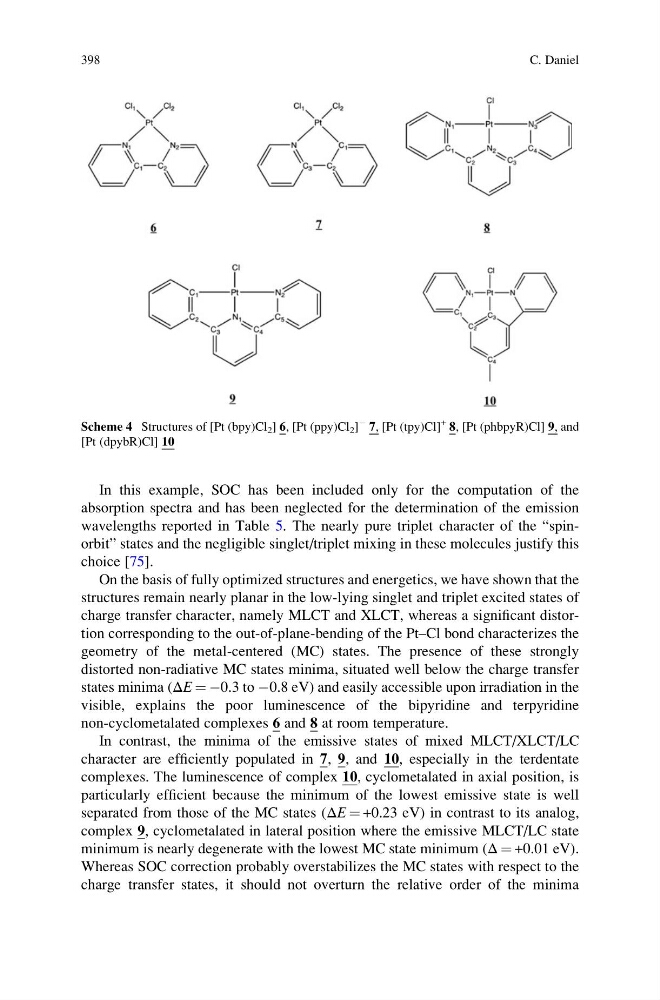
On the basis of fully optimized structures and energetics, we have shown that the
structures remain nearly planar in the low-lying singlet and triplet excited states of
charge transfer character, namely MLCT and XLCT, whereas a significant distortion corresponding to the out-of-plane-bending of the Pt–Cl bond characterizes the
geometry of the metal-centered (MC) states. The presence of these strongly
distorted non-radiative MC states minima, situated well below the charge transfer
states minima (ΔE ¼ À0.3 to À0.8 eV) and easily accessible upon irradiation in the
visible, explains the poor luminescence of the bipyridine and terpyridine
non-cyclometalated complexes 6 and 8 at room temperature.
In contrast, the minima of the emissive states of mixed MLCT/XLCT/LC
character are efficiently populated in 7, 9, and 10, especially in the terdentate
complexes. The luminescence of complex 10, cyclometalated in axial position, is
particularly efficient because the minimum of the lowest emissive state is well
separated from those of the MC states (ΔE ¼ +0.23 eV) in contrast to its analog,
complex 9, cyclometalated in lateral position where the emissive MLCT/LC state
minimum is nearly degenerate with the lowest MC state minimum (Δ ¼ +0.01 eV).
Whereas SOC correction probably overstabilizes the MC states with respect to the
charge transfer states, it should not overturn the relative order of the minima
Scheme 4 Structures of [Pt (bpy)Cl 2 ] 6, [Pt (ppy)Cl 2 ]
À 7, [Pt (tpy)Cl]
+ 8, [Pt (phbpyR)Cl] 9, and
[Pt (dpybR)Cl] 10
398
C. Daniel
absorption spectra and has been neglected for the determination of the emission
wavelengths reported in Table 5. The nearly pure triplet character of the “spinorbit” states and the negligible singlet/triplet mixing in these molecules justify this
choice [75].
On the basis of fully optimized structures and energetics, we have shown that the
structures remain nearly planar in the low-lying singlet and triplet excited states of
charge transfer character, namely MLCT and XLCT, whereas a significant distortion corresponding to the out-of-plane-bending of the Pt–Cl bond characterizes the
geometry of the metal-centered (MC) states. The presence of these strongly
distorted non-radiative MC states minima, situated well below the charge transfer
states minima (ΔE ¼ À0.3 to À0.8 eV) and easily accessible upon irradiation in the
visible, explains the poor luminescence of the bipyridine and terpyridine
non-cyclometalated complexes 6 and 8 at room temperature.
In contrast, the minima of the emissive states of mixed MLCT/XLCT/LC
character are efficiently populated in 7, 9, and 10, especially in the terdentate
complexes. The luminescence of complex 10, cyclometalated in axial position, is
particularly efficient because the minimum of the lowest emissive state is well
separated from those of the MC states (ΔE ¼ +0.23 eV) in contrast to its analog,
complex 9, cyclometalated in lateral position where the emissive MLCT/LC state
minimum is nearly degenerate with the lowest MC state minimum (Δ ¼ +0.01 eV).
Whereas SOC correction probably overstabilizes the MC states with respect to the
charge transfer states, it should not overturn the relative order of the minima
Scheme 4 Structures of [Pt (bpy)Cl 2 ] 6, [Pt (ppy)Cl 2 ]
À 7, [Pt (tpy)Cl]
+ 8, [Pt (phbpyR)Cl] 9, and
[Pt (dpybR)Cl] 10
398
C. Daniel