

localized on a single ligand. The zero-field splitting (ZFS) spin sub-levels and their
spontaneous emission characteristics have been obtained at some intermediate
geometry between S 0 and T 1 structures because of the anharmonicity of the
potential associated with T 1 . The large SOC between T 1 and the S 5 singlet MLCT
state together with large dipole interactions between S 5 and S 0 are responsible for
the intense phosphorescence of the reference complex [Ir (ppy) 3 ]. The ZFS
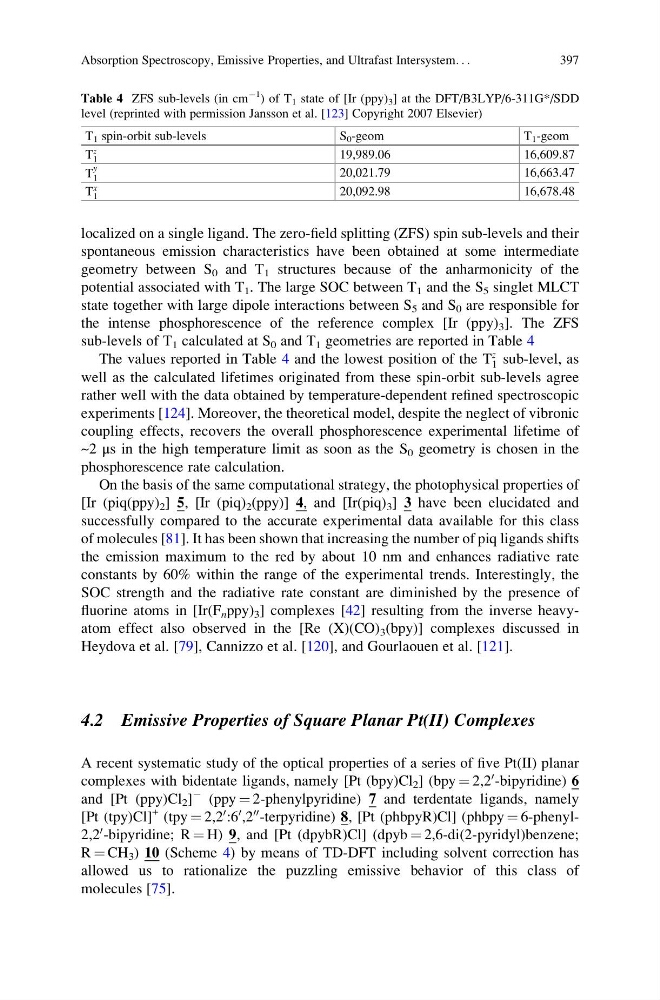
sub-levels of T 1 calculated at S 0 and T 1 geometries are reported in Table 4
The values reported in Table 4 and the lowest position of the T
z
1 sub-level, as
well as the calculated lifetimes originated from these spin-orbit sub-levels agree
rather well with the data obtained by temperature-dependent refined spectroscopic
experiments [124]. Moreover, the theoretical model, despite the neglect of vibronic
coupling effects, recovers the overall phosphorescence experimental lifetime of
~2 μs in the high temperature limit as soon as the S 0 geometry is chosen in the
phosphorescence rate calculation.
On the basis of the same computational strategy, the photophysical properties of
[Ir (piq(ppy) 2 ] 5, [Ir (piq) 2 (ppy)] 4, and [Ir(piq) 3 ] 3 have been elucidated and
successfully compared to the accurate experimental data available for this class
of molecules [81]. It has been shown that increasing the number of piq ligands shifts
the emission maximum to the red by about 10 nm and enhances radiative rate
constants by 60% within the range of the experimental trends. Interestingly, the
SOC strength and the radiative rate constant are diminished by the presence of
fluorine atoms in [Ir(F n ppy) 3 ] complexes [42] resulting from the inverse heavyatom effect also observed in the [Re (X)(CO) 3 (bpy)] complexes discussed in
Heydova et al. [79], Cannizzo et al. [120], and Gourlaouen et al. [121].
4.2 Emissive Properties of Square Planar Pt(II) Complexes
A recent systematic study of the optical properties of a series of five Pt(II) planar
complexes with bidentate ligands, namely [Pt (bpy)Cl 2 ] (bpy ¼ 2,2
0 -bipyridine) 6
and [Pt (ppy)Cl 2 ]
À (ppy ¼ 2-phenylpyridine) 7 and terdentate ligands, namely
[Pt (tpy)Cl]
+ (tpy ¼ 2,2
0 :6
0 ,2
00 -terpyridine) 8, [Pt (phbpyR)Cl] (phbpy ¼ 6-phenyl2,2
0 -bipyridine; R ¼ H) 9, and [Pt (dpybR)Cl] (dpyb ¼ 2,6-di(2-pyridyl)benzene;
R ¼ CH 3 ) 10 (Scheme 4) by means of TD-DFT including solvent correction has
allowed us to rationalize the puzzling emissive behavior of this class of
molecules [75].
Table 4 ZFS sub-levels (in cm
À1
) of T 1 state of [Ir (ppy) 3 ] at the DFT/B3LYP/6-311G*/SDD
level (reprinted with permission Jansson et al. [123] Copyright 2007 Elsevier)
T 1 spin-orbit sub-levels
S 0 -geom
T 1 -geom
T
z
1
19,989.06
16,609.87
T
y
1
20,021.79
16,663.47
T
x
1
20,092.98
16,678.48
Absorption Spectroscopy, Emissive Properties, and Ultrafast Intersystem. . .
397
spontaneous emission characteristics have been obtained at some intermediate
geometry between S 0 and T 1 structures because of the anharmonicity of the
potential associated with T 1 . The large SOC between T 1 and the S 5 singlet MLCT
state together with large dipole interactions between S 5 and S 0 are responsible for
the intense phosphorescence of the reference complex [Ir (ppy) 3 ]. The ZFS
sub-levels of T 1 calculated at S 0 and T 1 geometries are reported in Table 4
The values reported in Table 4 and the lowest position of the T
z
1 sub-level, as
well as the calculated lifetimes originated from these spin-orbit sub-levels agree
rather well with the data obtained by temperature-dependent refined spectroscopic
experiments [124]. Moreover, the theoretical model, despite the neglect of vibronic
coupling effects, recovers the overall phosphorescence experimental lifetime of
~2 μs in the high temperature limit as soon as the S 0 geometry is chosen in the
phosphorescence rate calculation.
On the basis of the same computational strategy, the photophysical properties of
[Ir (piq(ppy) 2 ] 5, [Ir (piq) 2 (ppy)] 4, and [Ir(piq) 3 ] 3 have been elucidated and
successfully compared to the accurate experimental data available for this class
of molecules [81]. It has been shown that increasing the number of piq ligands shifts
the emission maximum to the red by about 10 nm and enhances radiative rate
constants by 60% within the range of the experimental trends. Interestingly, the
SOC strength and the radiative rate constant are diminished by the presence of
fluorine atoms in [Ir(F n ppy) 3 ] complexes [42] resulting from the inverse heavyatom effect also observed in the [Re (X)(CO) 3 (bpy)] complexes discussed in
Heydova et al. [79], Cannizzo et al. [120], and Gourlaouen et al. [121].
4.2 Emissive Properties of Square Planar Pt(II) Complexes
A recent systematic study of the optical properties of a series of five Pt(II) planar
complexes with bidentate ligands, namely [Pt (bpy)Cl 2 ] (bpy ¼ 2,2
0 -bipyridine) 6
and [Pt (ppy)Cl 2 ]
À (ppy ¼ 2-phenylpyridine) 7 and terdentate ligands, namely
[Pt (tpy)Cl]
+ (tpy ¼ 2,2
0 :6
0 ,2
00 -terpyridine) 8, [Pt (phbpyR)Cl] (phbpy ¼ 6-phenyl2,2
0 -bipyridine; R ¼ H) 9, and [Pt (dpybR)Cl] (dpyb ¼ 2,6-di(2-pyridyl)benzene;
R ¼ CH 3 ) 10 (Scheme 4) by means of TD-DFT including solvent correction has
allowed us to rationalize the puzzling emissive behavior of this class of
molecules [75].
Table 4 ZFS sub-levels (in cm
À1
) of T 1 state of [Ir (ppy) 3 ] at the DFT/B3LYP/6-311G*/SDD
level (reprinted with permission Jansson et al. [123] Copyright 2007 Elsevier)
T 1 spin-orbit sub-levels
S 0 -geom
T 1 -geom
T
z
1
19,989.06
16,609.87
T
y
1
20,021.79
16,663.47
T
x
1
20,092.98
16,678.48
Absorption Spectroscopy, Emissive Properties, and Ultrafast Intersystem. . .
397