

3.1 ΔSCF-Based Methods
3.1.1 Different Core Hole Approximations
An X-ray photon usually excites a core electron leaving a core hole in the system.
Describing core holes properly is the primary task of resonant X-ray spectroscopy
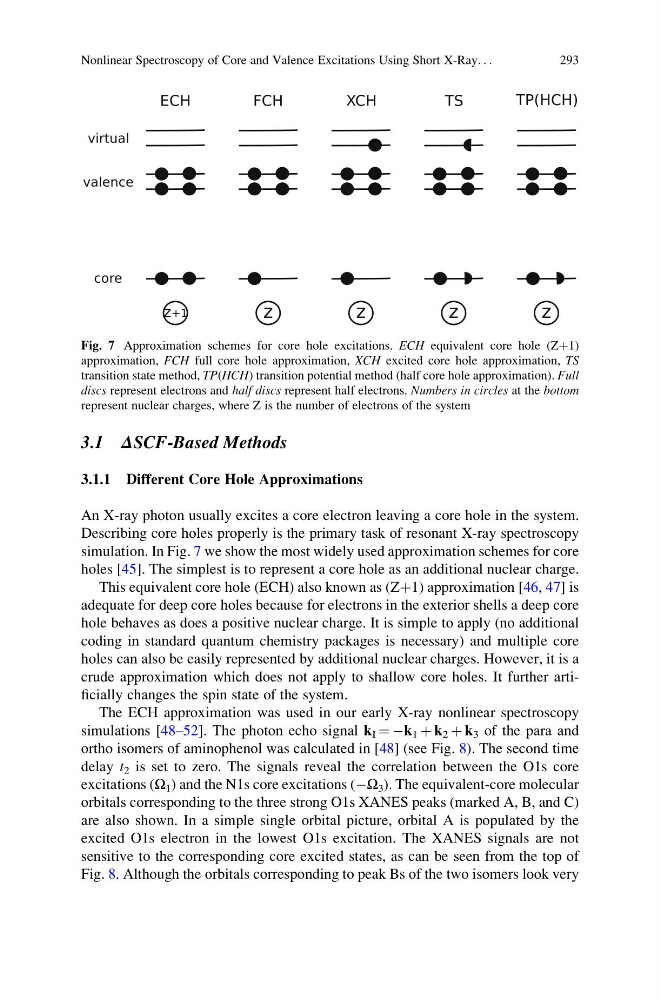
simulation. In Fig. 7 we show the most widely used approximation schemes for core
holes [45]. The simplest is to represent a core hole as an additional nuclear charge.
This equivalent core hole (ECH) also known as (Zþ1) approximation [46, 47] is
adequate for deep core holes because for electrons in the exterior shells a deep core
hole behaves as does a positive nuclear charge. It is simple to apply (no additional
coding in standard quantum chemistry packages is necessary) and multiple core
holes can also be easily represented by additional nuclear charges. However, it is a
crude approximation which does not apply to shallow core holes. It further artificially changes the spin state of the system.
The ECH approximation was used in our early X-ray nonlinear spectroscopy
simulations [48–52]. The photon echo signal k I ¼ Àk 1 þ k 2 þ k 3 of the para and
ortho isomers of aminophenol was calculated in [48] (see Fig. 8). The second time
delay t 2 is set to zero. The signals reveal the correlation between the O1s core
excitations (Ω 1 ) and the N1s core excitations (ÀΩ 3 ). The equivalent-core molecular
orbitals corresponding to the three strong O1s XANES peaks (marked A, B, and C)
are also shown. In a simple single orbital picture, orbital A is populated by the
excited O1s electron in the lowest O1s excitation. The XANES signals are not
sensitive to the corresponding core excited states, as can be seen from the top of
Fig. 8. Although the orbitals corresponding to peak Bs of the two isomers look very
Fig. 7 Approximation schemes for core hole excitations. ECH equivalent core hole (Zþ1)
approximation, FCH full core hole approximation, XCH excited core hole approximation, TS
transition state method, TP(HCH) transition potential method (half core hole approximation). Full
discs represent electrons and half discs represent half electrons. Numbers in circles at the bottom
represent nuclear charges, where Z is the number of electrons of the system
Nonlinear Spectroscopy of Core and Valence Excitations Using Short X-Ray. . .
293
3.1.1 Different Core Hole Approximations
An X-ray photon usually excites a core electron leaving a core hole in the system.
Describing core holes properly is the primary task of resonant X-ray spectroscopy
simulation. In Fig. 7 we show the most widely used approximation schemes for core
holes [45]. The simplest is to represent a core hole as an additional nuclear charge.
This equivalent core hole (ECH) also known as (Zþ1) approximation [46, 47] is
adequate for deep core holes because for electrons in the exterior shells a deep core
hole behaves as does a positive nuclear charge. It is simple to apply (no additional
coding in standard quantum chemistry packages is necessary) and multiple core
holes can also be easily represented by additional nuclear charges. However, it is a
crude approximation which does not apply to shallow core holes. It further artificially changes the spin state of the system.
The ECH approximation was used in our early X-ray nonlinear spectroscopy
simulations [48–52]. The photon echo signal k I ¼ Àk 1 þ k 2 þ k 3 of the para and
ortho isomers of aminophenol was calculated in [48] (see Fig. 8). The second time
delay t 2 is set to zero. The signals reveal the correlation between the O1s core
excitations (Ω 1 ) and the N1s core excitations (ÀΩ 3 ). The equivalent-core molecular
orbitals corresponding to the three strong O1s XANES peaks (marked A, B, and C)
are also shown. In a simple single orbital picture, orbital A is populated by the
excited O1s electron in the lowest O1s excitation. The XANES signals are not
sensitive to the corresponding core excited states, as can be seen from the top of
Fig. 8. Although the orbitals corresponding to peak Bs of the two isomers look very
Fig. 7 Approximation schemes for core hole excitations. ECH equivalent core hole (Zþ1)
approximation, FCH full core hole approximation, XCH excited core hole approximation, TS
transition state method, TP(HCH) transition potential method (half core hole approximation). Full
discs represent electrons and half discs represent half electrons. Numbers in circles at the bottom
represent nuclear charges, where Z is the number of electrons of the system
Nonlinear Spectroscopy of Core and Valence Excitations Using Short X-Ray. . .
293