

i
∂
∂t
ψ A r; t
ð Þ
ψ B r; t
ð Þ
!
¼
^
H A, A t
ð Þ ^
H A, B t
ð Þ
^
H B, A t
ð Þ ^
H B, B t
ð Þ
! ψ A r; t
ð Þ
ψ B r; t
ð Þ
!
;
ð56Þ
where ψ A (r,t) and ψ B (r,t) are the wavefunctions projected onto each separate
region. Here we consider the general case where the Hamiltonian is timedependent, and its components include two diagonal terms H ˆ
A,A (t) and H ˆ
B,B (t)
operating within each separate region and two coupling terms H ˆ
A,B (t) and H ˆ
B,A (t)
connecting the environment to the system.
To derive the embedded time-dependent equations we introduce the retarded
Green function G 0 for the reservoir, defined as
i
∂
∂t
À ^
H B, B t
ð Þ
!
G 0 r, r
0 , t, t
0
ð
Þ¼δ r À r
0
ð
Þδ t À t
0
ð
Þ;
ð57Þ
with boundary conditions G 0 (r,r
0 ,t
+
,t) ¼ Ài, G 0 (r,r
0 ,t,t
+ ) ¼ 0, and where t
+ represents a time approaching t from above. Because of the explicit time dependence of
H ˆ
B,B (t), it generally depends on both the time variables t and t
0 . We note however
that the solution greatly simplifies if we consider B to represent empty space. In this
case, G 0 (r,r
0 ,t,t
0 ) is the free propagator, which depends only on the time difference
t À t
0 and is known analytically.
Using G 0 (r,r
0 ,t,t
0 ) we can directly build the solution of the differential equations
in B. This corresponds to considering only the second row in (56), and results in
5
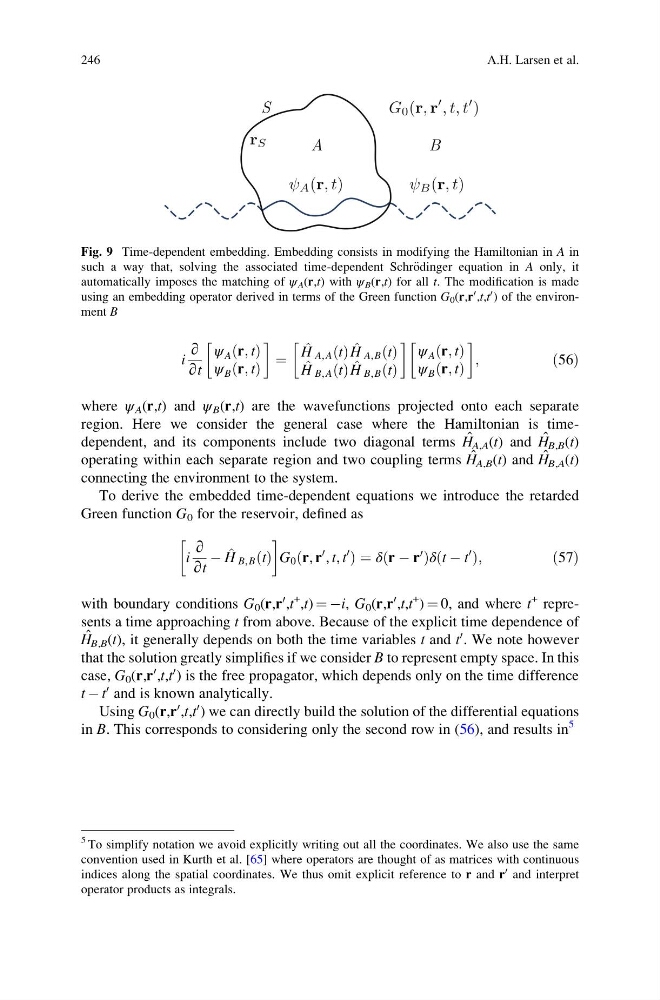
Fig. 9 Time-dependent embedding. Embedding consists in modifying the Hamiltonian in A in
such a way that, solving the associated time-dependent Schr€ odinger equation in A only, it
automatically imposes the matching of ψ A (r,t) with ψ B (r,t) for all t. The modification is made
using an embedding operator derived in terms of the Green function G 0 (r,r
0 ,t,t
0 ) of the environment B
5 To simplify notation we avoid explicitly writing out all the coordinates. We also use the same
convention used in Kurth et al. [65] where operators are thought of as matrices with continuous
indices along the spatial coordinates. We thus omit explicit reference to r and r
0 and interpret
operator products as integrals.
246
A.H. Larsen et al.
∂
∂t
ψ A r; t
ð Þ
ψ B r; t
ð Þ
!
¼
^
H A, A t
ð Þ ^
H A, B t
ð Þ
^
H B, A t
ð Þ ^
H B, B t
ð Þ
! ψ A r; t
ð Þ
ψ B r; t
ð Þ
!
;
ð56Þ
where ψ A (r,t) and ψ B (r,t) are the wavefunctions projected onto each separate
region. Here we consider the general case where the Hamiltonian is timedependent, and its components include two diagonal terms H ˆ
A,A (t) and H ˆ
B,B (t)
operating within each separate region and two coupling terms H ˆ
A,B (t) and H ˆ
B,A (t)
connecting the environment to the system.
To derive the embedded time-dependent equations we introduce the retarded
Green function G 0 for the reservoir, defined as
i
∂
∂t
À ^
H B, B t
ð Þ
!
G 0 r, r
0 , t, t
0
ð
Þ¼δ r À r
0
ð
Þδ t À t
0
ð
Þ;
ð57Þ
with boundary conditions G 0 (r,r
0 ,t
+
,t) ¼ Ài, G 0 (r,r
0 ,t,t
+ ) ¼ 0, and where t
+ represents a time approaching t from above. Because of the explicit time dependence of
H ˆ
B,B (t), it generally depends on both the time variables t and t
0 . We note however
that the solution greatly simplifies if we consider B to represent empty space. In this
case, G 0 (r,r
0 ,t,t
0 ) is the free propagator, which depends only on the time difference
t À t
0 and is known analytically.
Using G 0 (r,r
0 ,t,t
0 ) we can directly build the solution of the differential equations
in B. This corresponds to considering only the second row in (56), and results in
5
Fig. 9 Time-dependent embedding. Embedding consists in modifying the Hamiltonian in A in
such a way that, solving the associated time-dependent Schr€ odinger equation in A only, it
automatically imposes the matching of ψ A (r,t) with ψ B (r,t) for all t. The modification is made
using an embedding operator derived in terms of the Green function G 0 (r,r
0 ,t,t
0 ) of the environment B
5 To simplify notation we avoid explicitly writing out all the coordinates. We also use the same
convention used in Kurth et al. [65] where operators are thought of as matrices with continuous
indices along the spatial coordinates. We thus omit explicit reference to r and r
0 and interpret
operator products as integrals.
246
A.H. Larsen et al.