

photoionization or proton impact ionization. This last class of processes is sometimes called half-scattering processes because, from the point of view of the
electron, the scattering happens with another kind of particle. The main difference
between scattering and half-scattering processes is that the boundary conditions for
describing the half process are simpler because there is no need to inject charge but
only to absorb it. We must, however, note that if nonlinear effects are dominant, for
instance when strong laser fields are involved, this distinction is less clear and one
may also need to account for incoming electrons for half-scattering problems.
Below we review some of the most notable methods in the literature that have
been employed to address this problem. We anticipate that, in all the approaches we
discuss, the boundary conditions are implemented by modifying the Hamiltonian
with the addition of a complex term that explicitly breaks Hermiticity.
5.1 Transparent Boundary Conditions Using Green
Functions
Transparent boundary conditions include, by definition, all boundary conditions
that allow an exact solution of the open boundary problem. As such, they allow
electrons to move back and forth between A and B without reflection. We examine
below the class of boundary conditions that can be defined in terms of Green
functions. This is not the only possible solution, and other instances of transparent
boundaries can be constructed, for example, by using time dependent exterior
complex scaling or split propagation schemes as we show in Sects. 5.6 and 6.3,
respectively. So-called decimation techniques have also been employed to describe
transparent boundaries; see, for instance, Garcı ´a-Moliner and Flores [60] and
Kudrnovsky ´ et al. [61].
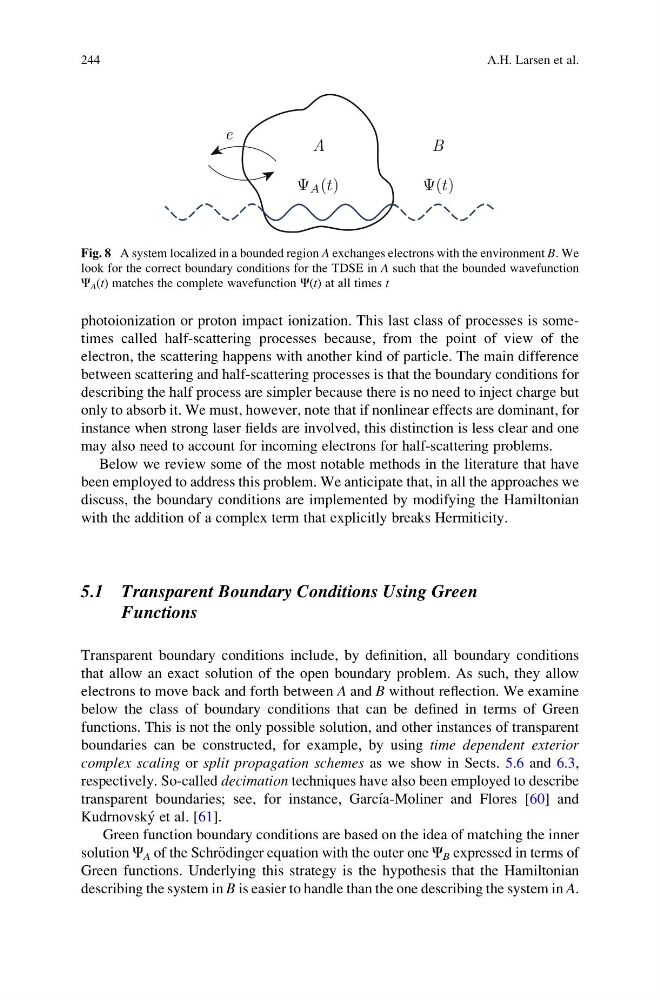
Green function boundary conditions are based on the idea of matching the inner
solution Ψ A of the Schr€ odinger equation with the outer one Ψ B expressed in terms of
Green functions. Underlying this strategy is the hypothesis that the Hamiltonian
describing the system in B is easier to handle than the one describing the system in A.
Fig. 8 A system localized in a bounded region A exchanges electrons with the environment B. We
look for the correct boundary conditions for the TDSE in A such that the bounded wavefunction
Ψ A (t) matches the complete wavefunction Ψ(t) at all times t
244
A.H. Larsen et al.
electron, the scattering happens with another kind of particle. The main difference
between scattering and half-scattering processes is that the boundary conditions for
describing the half process are simpler because there is no need to inject charge but
only to absorb it. We must, however, note that if nonlinear effects are dominant, for
instance when strong laser fields are involved, this distinction is less clear and one
may also need to account for incoming electrons for half-scattering problems.
Below we review some of the most notable methods in the literature that have
been employed to address this problem. We anticipate that, in all the approaches we
discuss, the boundary conditions are implemented by modifying the Hamiltonian
with the addition of a complex term that explicitly breaks Hermiticity.
5.1 Transparent Boundary Conditions Using Green
Functions
Transparent boundary conditions include, by definition, all boundary conditions
that allow an exact solution of the open boundary problem. As such, they allow
electrons to move back and forth between A and B without reflection. We examine
below the class of boundary conditions that can be defined in terms of Green
functions. This is not the only possible solution, and other instances of transparent
boundaries can be constructed, for example, by using time dependent exterior
complex scaling or split propagation schemes as we show in Sects. 5.6 and 6.3,
respectively. So-called decimation techniques have also been employed to describe
transparent boundaries; see, for instance, Garcı ´a-Moliner and Flores [60] and
Kudrnovsky ´ et al. [61].
Green function boundary conditions are based on the idea of matching the inner
solution Ψ A of the Schr€ odinger equation with the outer one Ψ B expressed in terms of
Green functions. Underlying this strategy is the hypothesis that the Hamiltonian
describing the system in B is easier to handle than the one describing the system in A.
Fig. 8 A system localized in a bounded region A exchanges electrons with the environment B. We
look for the correct boundary conditions for the TDSE in A such that the bounded wavefunction
Ψ A (t) matches the complete wavefunction Ψ(t) at all times t
244
A.H. Larsen et al.