

q-dependence in the screened interaction is mapped into the frequency dependence
of the xc kernel [89]. As a consequence, adiabatic xc kernels can be made to
produce a single bound exciton, but not an excitonic Rydberg series (at least, not
just with the head of the xc matrix) [18].
The question then arises how TDDFT can produce bound excitons at all, given
the fact that the xc and BSE coupling matrices are so drastically different. To
illustrate how this is possible, we now make a connection with the Wannier model
discussed in Sect. 2, and ask: what is the TDDFT and BSE analog of the Wannier
equation, (1)?
Let us consider, for simplicity, a two-band model in which there is only one
filled valence band (v) and one empty conduction band (c). We define an effective
two-body potential via the Fourier transform of the xc coupling matrix:
V
xc
eÀh ðR, R
0
Þ ¼
X
k, k 0 2BZ
e
ÀikÁR K
xc
vck, vck 0 e
ikÁR
0 ;
ð72Þ
where R, R
0 are direct lattice vectors. Because Wannier exciton radii extend over
many lattice constants, one may replace R by a continuous spatial variable r.
Assuming, furthermore, parabolic valence and conduction bands, and using the
effective-mass approximation, (40) becomes, after Fourier transformation,
∇
2
2m r
X r
ð Þ þ
ð
d
3 r
0 V
xc
eÀh ðr, r
0
ÞX r
0
ð Þ ¼ EX r
ð Þ;
ð73Þ
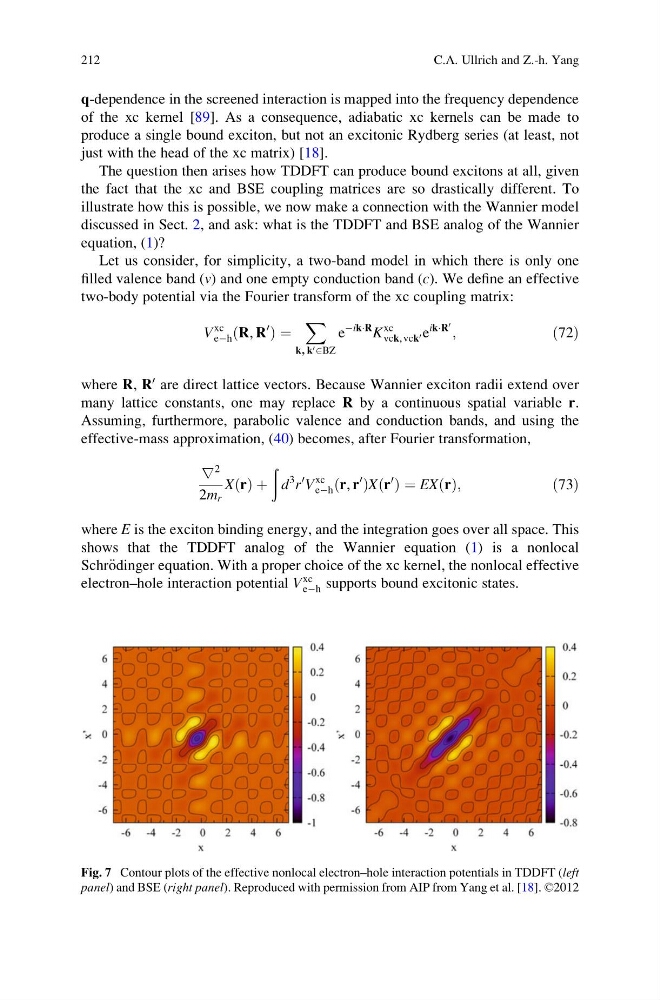
where E is the exciton binding energy, and the integration goes over all space. This
shows that the TDDFT analog of the Wannier equation (1) is a nonlocal
Schr€ odinger equation. With a proper choice of the xc kernel, the nonlocal effective
electron–hole interaction potential V
xc
eÀh supports bound excitonic states.
Fig. 7 Contour plots of the effective nonlocal electron–hole interaction potentials in TDDFT (left
panel) and BSE (right panel). Reproduced with permission from AIP from Yang et al. [18]. ©2012
212
C.A. Ullrich and Z.-h. Yang
of the xc kernel [89]. As a consequence, adiabatic xc kernels can be made to
produce a single bound exciton, but not an excitonic Rydberg series (at least, not
just with the head of the xc matrix) [18].
The question then arises how TDDFT can produce bound excitons at all, given
the fact that the xc and BSE coupling matrices are so drastically different. To
illustrate how this is possible, we now make a connection with the Wannier model
discussed in Sect. 2, and ask: what is the TDDFT and BSE analog of the Wannier
equation, (1)?
Let us consider, for simplicity, a two-band model in which there is only one
filled valence band (v) and one empty conduction band (c). We define an effective
two-body potential via the Fourier transform of the xc coupling matrix:
V
xc
eÀh ðR, R
0
Þ ¼
X
k, k 0 2BZ
e
ÀikÁR K
xc
vck, vck 0 e
ikÁR
0 ;
ð72Þ
where R, R
0 are direct lattice vectors. Because Wannier exciton radii extend over
many lattice constants, one may replace R by a continuous spatial variable r.
Assuming, furthermore, parabolic valence and conduction bands, and using the
effective-mass approximation, (40) becomes, after Fourier transformation,
∇
2
2m r
X r
ð Þ þ
ð
d
3 r
0 V
xc
eÀh ðr, r
0
ÞX r
0
ð Þ ¼ EX r
ð Þ;
ð73Þ
where E is the exciton binding energy, and the integration goes over all space. This
shows that the TDDFT analog of the Wannier equation (1) is a nonlocal
Schr€ odinger equation. With a proper choice of the xc kernel, the nonlocal effective
electron–hole interaction potential V
xc
eÀh supports bound excitonic states.
Fig. 7 Contour plots of the effective nonlocal electron–hole interaction potentials in TDDFT (left
panel) and BSE (right panel). Reproduced with permission from AIP from Yang et al. [18]. ©2012
212
C.A. Ullrich and Z.-h. Yang