

C stands for a vector of all CI coefficients and the minimization in the functional
(65) is carried out with respect to all vectors C corresponding to the assumed ansatz
for a wavefunction (64) which yield a given density matrix γ. Were the expansion in
(64) complete, the functional (65) would be exact, i.e., it would be equivalent to the
Levy functional (9). Otherwise, for truncated CI expansion, the functional is only
approximate. The strategy adopted in [41, 73–76] was to use a CI ansatz leading to a
“JK-only” approximation and to replace the whole set of the CI parameters by
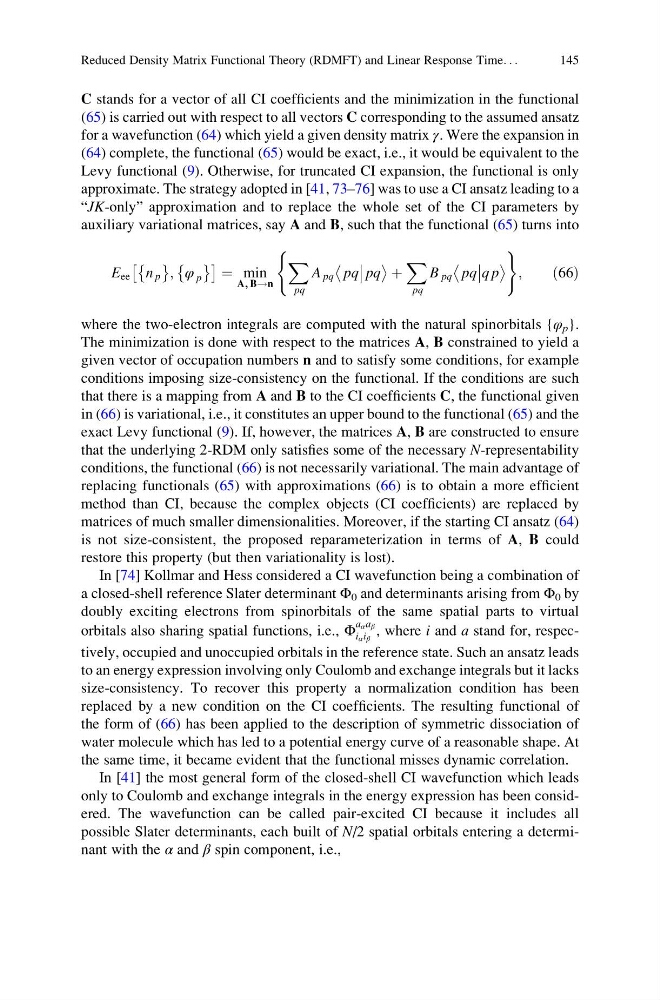
auxiliary variational matrices, say A and B, such that the functional (65) turns into
E ee n p
È É
; φ p
È É
Â
à ¼ min
A, B!n
X
pq
A pq pq
pq
þ
X
pq
B pq pq
q p
(
)
;
ð66Þ
where the two-electron integrals are computed with the natural spinorbitals {φ p }.
The minimization is done with respect to the matrices A, B constrained to yield a
given vector of occupation numbers n and to satisfy some conditions, for example
conditions imposing size-consistency on the functional. If the conditions are such
that there is a mapping from A and B to the CI coefficients C, the functional given
in (66) is variational, i.e., it constitutes an upper bound to the functional (65) and the
exact Levy functional (9). If, however, the matrices A, B are constructed to ensure
that the underlying 2-RDM only satisfies some of the necessary N-representability
conditions, the functional (66) is not necessarily variational. The main advantage of
replacing functionals (65) with approximations (66) is to obtain a more efficient
method than CI, because the complex objects (CI coefficients) are replaced by
matrices of much smaller dimensionalities. Moreover, if the starting CI ansatz (64)
is not size-consistent, the proposed reparameterization in terms of A, B could
restore this property (but then variationality is lost).
In [74] Kollmar and Hess considered a CI wavefunction being a combination of
a closed-shell reference Slater determinant Φ 0 and determinants arising from Φ 0 by
doubly exciting electrons from spinorbitals of the same spatial parts to virtual
orbitals also sharing spatial functions, i.e., Φ
a α a β
i α i β
, where i and a stand for, respectively, occupied and unoccupied orbitals in the reference state. Such an ansatz leads
to an energy expression involving only Coulomb and exchange integrals but it lacks
size-consistency. To recover this property a normalization condition has been
replaced by a new condition on the CI coefficients. The resulting functional of
the form of (66) has been applied to the description of symmetric dissociation of
water molecule which has led to a potential energy curve of a reasonable shape. At
the same time, it became evident that the functional misses dynamic correlation.
In [41] the most general form of the closed-shell CI wavefunction which leads
only to Coulomb and exchange integrals in the energy expression has been considered. The wavefunction can be called pair-excited CI because it includes all
possible Slater determinants, each built of N/2 spatial orbitals entering a determinant with the α and β spin component, i.e.,
Reduced Density Matrix Functional Theory (RDMFT) and Linear Response Time. . .
145
(65) is carried out with respect to all vectors C corresponding to the assumed ansatz
for a wavefunction (64) which yield a given density matrix γ. Were the expansion in
(64) complete, the functional (65) would be exact, i.e., it would be equivalent to the
Levy functional (9). Otherwise, for truncated CI expansion, the functional is only
approximate. The strategy adopted in [41, 73–76] was to use a CI ansatz leading to a
“JK-only” approximation and to replace the whole set of the CI parameters by
auxiliary variational matrices, say A and B, such that the functional (65) turns into
E ee n p
È É
; φ p
È É
Â
à ¼ min
A, B!n
X
pq
A pq pq
pq
þ
X
pq
B pq pq
q p
(
)
;
ð66Þ
where the two-electron integrals are computed with the natural spinorbitals {φ p }.
The minimization is done with respect to the matrices A, B constrained to yield a
given vector of occupation numbers n and to satisfy some conditions, for example
conditions imposing size-consistency on the functional. If the conditions are such
that there is a mapping from A and B to the CI coefficients C, the functional given
in (66) is variational, i.e., it constitutes an upper bound to the functional (65) and the
exact Levy functional (9). If, however, the matrices A, B are constructed to ensure
that the underlying 2-RDM only satisfies some of the necessary N-representability
conditions, the functional (66) is not necessarily variational. The main advantage of
replacing functionals (65) with approximations (66) is to obtain a more efficient
method than CI, because the complex objects (CI coefficients) are replaced by
matrices of much smaller dimensionalities. Moreover, if the starting CI ansatz (64)
is not size-consistent, the proposed reparameterization in terms of A, B could
restore this property (but then variationality is lost).
In [74] Kollmar and Hess considered a CI wavefunction being a combination of
a closed-shell reference Slater determinant Φ 0 and determinants arising from Φ 0 by
doubly exciting electrons from spinorbitals of the same spatial parts to virtual
orbitals also sharing spatial functions, i.e., Φ
a α a β
i α i β
, where i and a stand for, respectively, occupied and unoccupied orbitals in the reference state. Such an ansatz leads
to an energy expression involving only Coulomb and exchange integrals but it lacks
size-consistency. To recover this property a normalization condition has been
replaced by a new condition on the CI coefficients. The resulting functional of
the form of (66) has been applied to the description of symmetric dissociation of
water molecule which has led to a potential energy curve of a reasonable shape. At
the same time, it became evident that the functional misses dynamic correlation.
In [41] the most general form of the closed-shell CI wavefunction which leads
only to Coulomb and exchange integrals in the energy expression has been considered. The wavefunction can be called pair-excited CI because it includes all
possible Slater determinants, each built of N/2 spatial orbitals entering a determinant with the α and β spin component, i.e.,
Reduced Density Matrix Functional Theory (RDMFT) and Linear Response Time. . .
145