

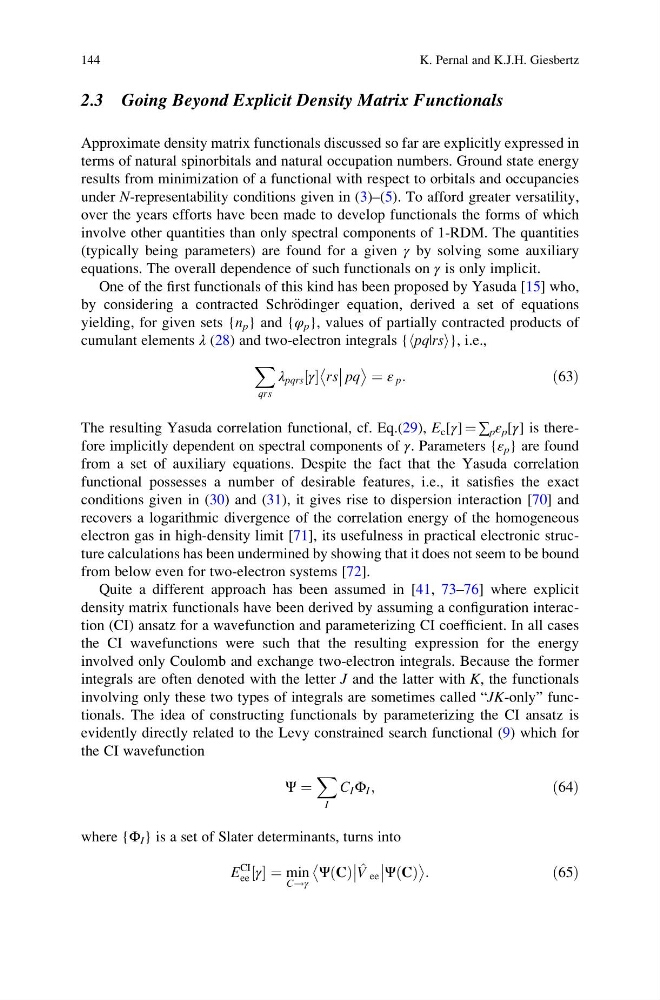
2.3 Going Beyond Explicit Density Matrix Functionals
Approximate density matrix functionals discussed so far are explicitly expressed in
terms of natural spinorbitals and natural occupation numbers. Ground state energy
results from minimization of a functional with respect to orbitals and occupancies
under N-representability conditions given in (3)–(5). To afford greater versatility,
over the years efforts have been made to develop functionals the forms of which
involve other quantities than only spectral components of 1-RDM. The quantities
(typically being parameters) are found for a given γ by solving some auxiliary
equations. The overall dependence of such functionals on γ is only implicit.
One of the first functionals of this kind has been proposed by Yasuda [15] who,
by considering a contracted Schr€ odinger equation, derived a set of equations
yielding, for given sets {n p } and {φ p }, values of partially contracted products of
cumulant elements λ (28) and two-electron integrals {hpq|rsi}, i.e.,
X
qrs
λ pqrs γ
½ rs
pq
¼ ε p :
ð63Þ
The resulting Yasuda correlation functional, cf. Eq.(29), E c [γ] ¼ ∑ p ε p [γ] is therefore implicitly dependent on spectral components of γ. Parameters {ε p } are found
from a set of auxiliary equations. Despite the fact that the Yasuda correlation
functional possesses a number of desirable features, i.e., it satisfies the exact
conditions given in (30) and (31), it gives rise to dispersion interaction [70] and
recovers a logarithmic divergence of the correlation energy of the homogeneous
electron gas in high-density limit [71], its usefulness in practical electronic structure calculations has been undermined by showing that it does not seem to be bound
from below even for two-electron systems [72].
Quite a different approach has been assumed in [41, 73–76] where explicit
density matrix functionals have been derived by assuming a configuration interaction (CI) ansatz for a wavefunction and parameterizing CI coefficient. In all cases
the CI wavefunctions were such that the resulting expression for the energy
involved only Coulomb and exchange two-electron integrals. Because the former
integrals are often denoted with the letter J and the latter with K, the functionals
involving only these two types of integrals are sometimes called “JK-only” functionals. The idea of constructing functionals by parameterizing the CI ansatz is
evidently directly related to the Levy constrained search functional (9) which for
the CI wavefunction
Ψ ¼
X
I
C I Φ I ;
ð64Þ
where {Φ I } is a set of Slater determinants, turns into
E
CI
ee γ
½ ¼ min
C!γ
Ψ C
ð Þ
^
V ee
Ψ C
ð Þ
:
ð65Þ
144
K. Pernal and K.J.H. Giesbertz
Approximate density matrix functionals discussed so far are explicitly expressed in
terms of natural spinorbitals and natural occupation numbers. Ground state energy
results from minimization of a functional with respect to orbitals and occupancies
under N-representability conditions given in (3)–(5). To afford greater versatility,
over the years efforts have been made to develop functionals the forms of which
involve other quantities than only spectral components of 1-RDM. The quantities
(typically being parameters) are found for a given γ by solving some auxiliary
equations. The overall dependence of such functionals on γ is only implicit.
One of the first functionals of this kind has been proposed by Yasuda [15] who,
by considering a contracted Schr€ odinger equation, derived a set of equations
yielding, for given sets {n p } and {φ p }, values of partially contracted products of
cumulant elements λ (28) and two-electron integrals {hpq|rsi}, i.e.,
X
qrs
λ pqrs γ
½ rs
pq
¼ ε p :
ð63Þ
The resulting Yasuda correlation functional, cf. Eq.(29), E c [γ] ¼ ∑ p ε p [γ] is therefore implicitly dependent on spectral components of γ. Parameters {ε p } are found
from a set of auxiliary equations. Despite the fact that the Yasuda correlation
functional possesses a number of desirable features, i.e., it satisfies the exact
conditions given in (30) and (31), it gives rise to dispersion interaction [70] and
recovers a logarithmic divergence of the correlation energy of the homogeneous
electron gas in high-density limit [71], its usefulness in practical electronic structure calculations has been undermined by showing that it does not seem to be bound
from below even for two-electron systems [72].
Quite a different approach has been assumed in [41, 73–76] where explicit
density matrix functionals have been derived by assuming a configuration interaction (CI) ansatz for a wavefunction and parameterizing CI coefficient. In all cases
the CI wavefunctions were such that the resulting expression for the energy
involved only Coulomb and exchange two-electron integrals. Because the former
integrals are often denoted with the letter J and the latter with K, the functionals
involving only these two types of integrals are sometimes called “JK-only” functionals. The idea of constructing functionals by parameterizing the CI ansatz is
evidently directly related to the Levy constrained search functional (9) which for
the CI wavefunction
Ψ ¼
X
I
C I Φ I ;
ð64Þ
where {Φ I } is a set of Slater determinants, turns into
E
CI
ee γ
½ ¼ min
C!γ
Ψ C
ð Þ
^
V ee
Ψ C
ð Þ
:
ð65Þ
144
K. Pernal and K.J.H. Giesbertz