

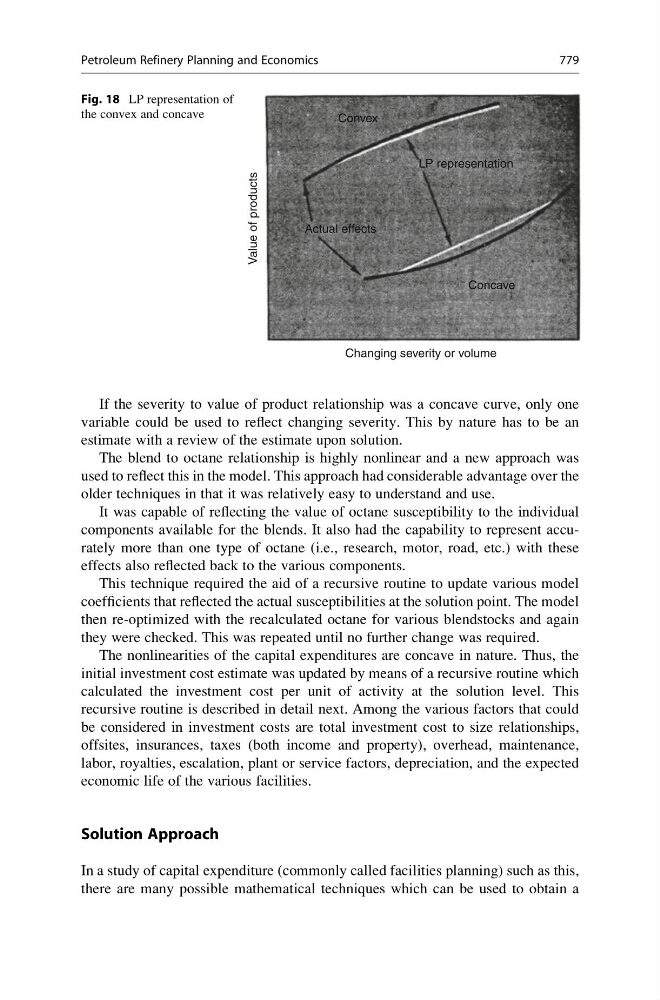
If the severity to value of product relationship was a concave curve, only one
variable could be used to reflect changing severity. This by nature has to be an
estimate with a review of the estimate upon solution.
The blend to octane relationship is highly nonlinear and a new approach was
used to reflect this in the model. This approach had considerable advantage over the
older techniques in that it was relatively easy to understand and use.
It was capable of reflecting the value of octane susceptibility to the individual
components available for the blends. It also had the capability to represent accurately more than one type of octane (i.e., research, motor, road, etc.) with these
effects also reflected back to the various components.
This technique required the aid of a recursive routine to update various model
coefficients that reflected the actual susceptibilities at the solution point. The model
then re-optimized with the recalculated octane for various blendstocks and again
they were checked. This was repeated until no further change was required.
The nonlinearities of the capital expenditures are concave in nature. Thus, the
initial investment cost estimate was updated by means of a recursive routine which
calculated the investment cost per unit of activity at the solution level. This
recursive routine is described in detail next. Among the various factors that could
be considered in investment costs are total investment cost to size relationships,
offsites, insurances, taxes (both income and property), overhead, maintenance,
labor, royalties, escalation, plant or service factors, depreciation, and the expected
economic life of the various facilities.
Solution Approach
In a study of capital expenditure (commonly called facilities planning) such as this,
there are many possible mathematical techniques which can be used to obtain a
Changing severity or volume
Concave
Convex
Actual effects
LP representation
Value of products
Fig. 18 LP representation of
the convex and concave
Petroleum Refinery Planning and Economics
779