

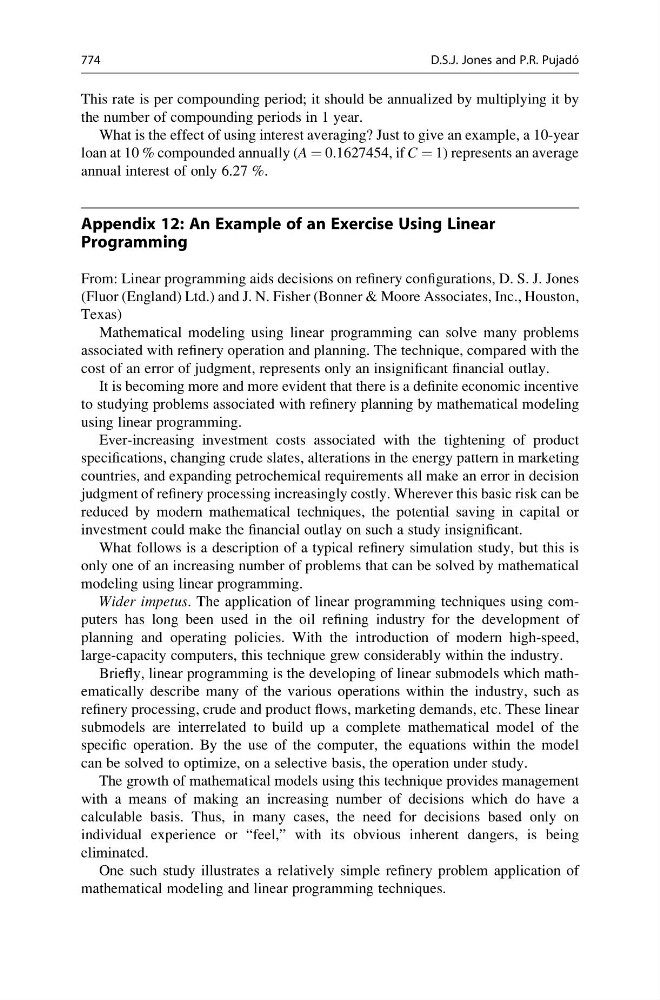
This rate is per compounding period; it should be annualized by multiplying it by
the number of compounding periods in 1 year.
What is the effect of using interest averaging? Just to give an example, a 10-year
loan at 10 % compounded annually (A = 0.1627454, if C = 1) represents an average
annual interest of only 6.27 %.
Appendix 12: An Example of an Exercise Using Linear
Programming
From: Linear programming aids decisions on refinery configurations, D. S. J. Jones
(Fluor (England) Ltd.) and J. N. Fisher (Bonner & Moore Associates, Inc., Houston,
Texas)
Mathematical modeling using linear programming can solve many problems
associated with refinery operation and planning. The technique, compared with the
cost of an error of judgment, represents only an insignificant financial outlay.
It is becoming more and more evident that there is a definite economic incentive
to studying problems associated with refinery planning by mathematical modeling
using linear programming.
Ever-increasing investment costs associated with the tightening of product
specifications, changing crude slates, alterations in the energy pattern in marketing
countries, and expanding petrochemical requirements all make an error in decision
judgment of refinery processing increasingly costly. Wherever this basic risk can be
reduced by modern mathematical techniques, the potential saving in capital or
investment could make the financial outlay on such a study insignificant.
What follows is a description of a typical refinery simulation study, but this is
only one of an increasing number of problems that can be solved by mathematical
modeling using linear programming.
Wider impetus. The application of linear programming techniques using computers has long been used in the oil refining industry for the development of
planning and operating policies. With the introduction of modern high-speed,
large-capacity computers, this technique grew considerably within the industry.
Briefly, linear programming is the developing of linear submodels which mathematically describe many of the various operations within the industry, such as
refinery processing, crude and product flows, marketing demands, etc. These linear
submodels are interrelated to build up a complete mathematical model of the
specific operation. By the use of the computer, the equations within the model
can be solved to optimize, on a selective basis, the operation under study.
The growth of mathematical models using this technique provides management
with a means of making an increasing number of decisions which do have a
calculable basis. Thus, in many cases, the need for decisions based only on
individual experience or “feel,” with its obvious inherent dangers, is being
eliminated.
One such study illustrates a relatively simple refinery problem application of
mathematical modeling and linear programming techniques.
774
D.S.J. Jones and P.R. Pujado ´