

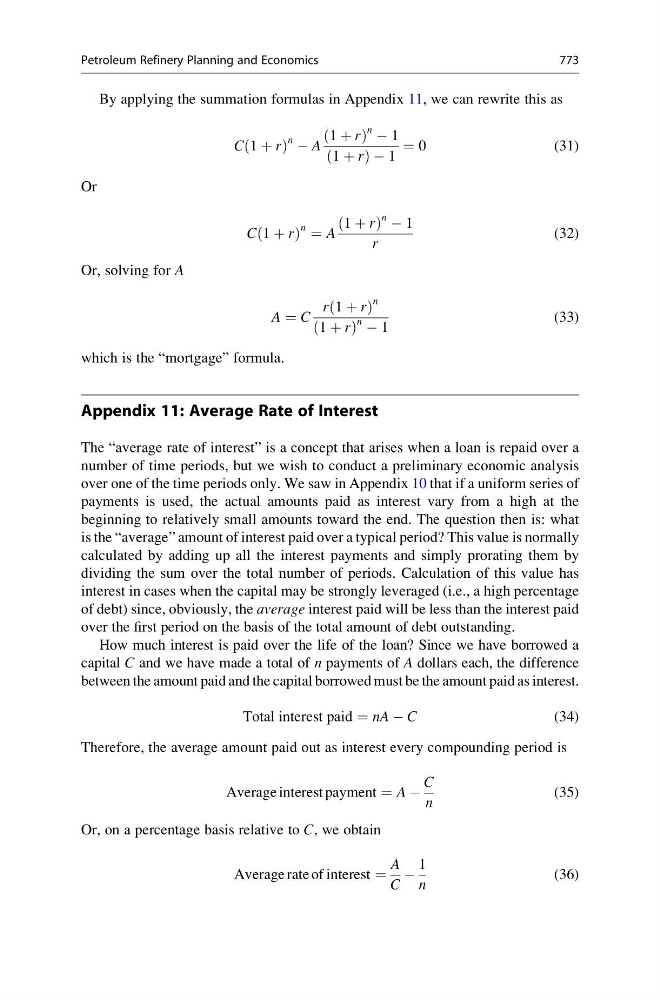
By applying the summation formulas in Appendix 11, we can rewrite this as
C 1 þ r
ð
Þ
n À A
1 þ r
ð
Þ
n À 1
1 þ r
ð
ÞÀ1
¼ 0
(31)
Or
C 1 þ r
ð
Þ
n ¼ A
1 þ r
ð
Þ
n À 1
r
(32)
Or, solving for A
A ¼ C
r 1 þ r
ð
Þ
n
1 þ r
ð
Þ
n À 1
(33)
which is the “mortgage” formula.
Appendix 11: Average Rate of Interest
The “average rate of interest” is a concept that arises when a loan is repaid over a
number of time periods, but we wish to conduct a preliminary economic analysis
over one of the time periods only. We saw in Appendix 10 that if a uniform series of
payments is used, the actual amounts paid as interest vary from a high at the
beginning to relatively small amounts toward the end. The question then is: what
is the “average” amount of interest paid over a typical period? This value is normally
calculated by adding up all the interest payments and simply prorating them by
dividing the sum over the total number of periods. Calculation of this value has
interest in cases when the capital may be strongly leveraged (i.e., a high percentage
of debt) since, obviously, the average interest paid will be less than the interest paid
over the first period on the basis of the total amount of debt outstanding.
How much interest is paid over the life of the loan? Since we have borrowed a
capital C and we have made a total of n payments of A dollars each, the difference
between the amount paid and the capital borrowed must be the amount paid as interest.
Total interest paid ¼ nA À C
(34)
Therefore, the average amount paid out as interest every compounding period is
Average interest payment ¼ A À
C
n
(35)
Or, on a percentage basis relative to C, we obtain
Average rate of interest ¼
A
C
À
1
n
(36)
Petroleum Refinery Planning and Economics
773
C 1 þ r
ð
Þ
n À A
1 þ r
ð
Þ
n À 1
1 þ r
ð
ÞÀ1
¼ 0
(31)
Or
C 1 þ r
ð
Þ
n ¼ A
1 þ r
ð
Þ
n À 1
r
(32)
Or, solving for A
A ¼ C
r 1 þ r
ð
Þ
n
1 þ r
ð
Þ
n À 1
(33)
which is the “mortgage” formula.
Appendix 11: Average Rate of Interest
The “average rate of interest” is a concept that arises when a loan is repaid over a
number of time periods, but we wish to conduct a preliminary economic analysis
over one of the time periods only. We saw in Appendix 10 that if a uniform series of
payments is used, the actual amounts paid as interest vary from a high at the
beginning to relatively small amounts toward the end. The question then is: what
is the “average” amount of interest paid over a typical period? This value is normally
calculated by adding up all the interest payments and simply prorating them by
dividing the sum over the total number of periods. Calculation of this value has
interest in cases when the capital may be strongly leveraged (i.e., a high percentage
of debt) since, obviously, the average interest paid will be less than the interest paid
over the first period on the basis of the total amount of debt outstanding.
How much interest is paid over the life of the loan? Since we have borrowed a
capital C and we have made a total of n payments of A dollars each, the difference
between the amount paid and the capital borrowed must be the amount paid as interest.
Total interest paid ¼ nA À C
(34)
Therefore, the average amount paid out as interest every compounding period is
Average interest payment ¼ A À
C
n
(35)
Or, on a percentage basis relative to C, we obtain
Average rate of interest ¼
A
C
À
1
n
(36)
Petroleum Refinery Planning and Economics
773