

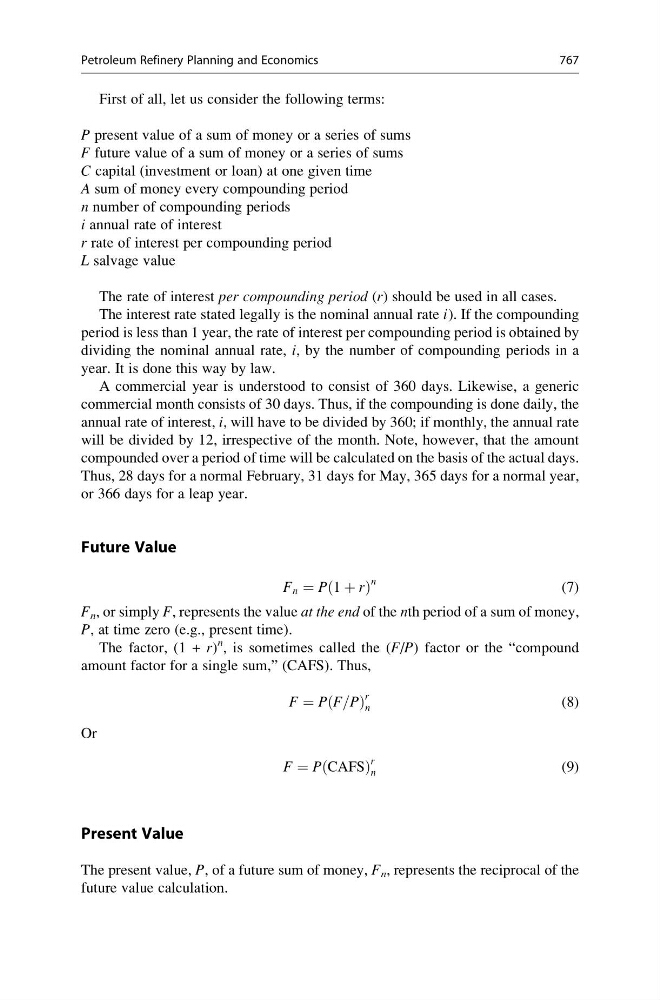
First of all, let us consider the following terms:
P present value of a sum of money or a series of sums
F future value of a sum of money or a series of sums
C capital (investment or loan) at one given time
A sum of money every compounding period
n number of compounding periods
i annual rate of interest
r rate of interest per compounding period
L salvage value
The rate of interest per compounding period (r) should be used in all cases.
The interest rate stated legally is the nominal annual rate i). If the compounding
period is less than 1 year, the rate of interest per compounding period is obtained by
dividing the nominal annual rate, i, by the number of compounding periods in a
year. It is done this way by law.
A commercial year is understood to consist of 360 days. Likewise, a generic
commercial month consists of 30 days. Thus, if the compounding is done daily, the
annual rate of interest, i, will have to be divided by 360; if monthly, the annual rate
will be divided by 12, irrespective of the month. Note, however, that the amount
compounded over a period of time will be calculated on the basis of the actual days.
Thus, 28 days for a normal February, 31 days for May, 365 days for a normal year,
or 366 days for a leap year.
Future Value
F n ¼ P 1 þ r
ð
Þ
n
(7)
F n , or simply F, represents the value at the end of the nth period of a sum of money,
P, at time zero (e.g., present time).
The factor, (1 + r)
n , is sometimes called the (F/P) factor or the “compound
amount factor for a single sum,” (CAFS). Thus,
F ¼ P F=P
ð
Þ
r
n
(8)
Or
F ¼ P CAFS
ð
Þ
r
n
(9)
Present Value
The present value, P, of a future sum of money, F n , represents the reciprocal of the
future value calculation.
Petroleum Refinery Planning and Economics
767