

of finished products is met. In modern refinery practice, much of the plant control is
achieved using “in-line” analyzers tied to control system computers. These computers automatically adjust plant conditions to meet the set product quality criteria.
A similar “in-line” analysis is used for blending run-down streams for finished
products. Invariably, though, laboratory testing is still used to “spot-check” plant
intermediate product quality, and laboratory testing is always used as a final check
on finished product quality.
Appendix 1: Typical Gasoline and Diesel Fuel Specifications
in Europe and the United States
Some gasoline and diesel fuel specifications are moving targets in that they get
updated on a more or less regular basis. The following attempts to summarize some
of its most salient characteristics as of early 2014.
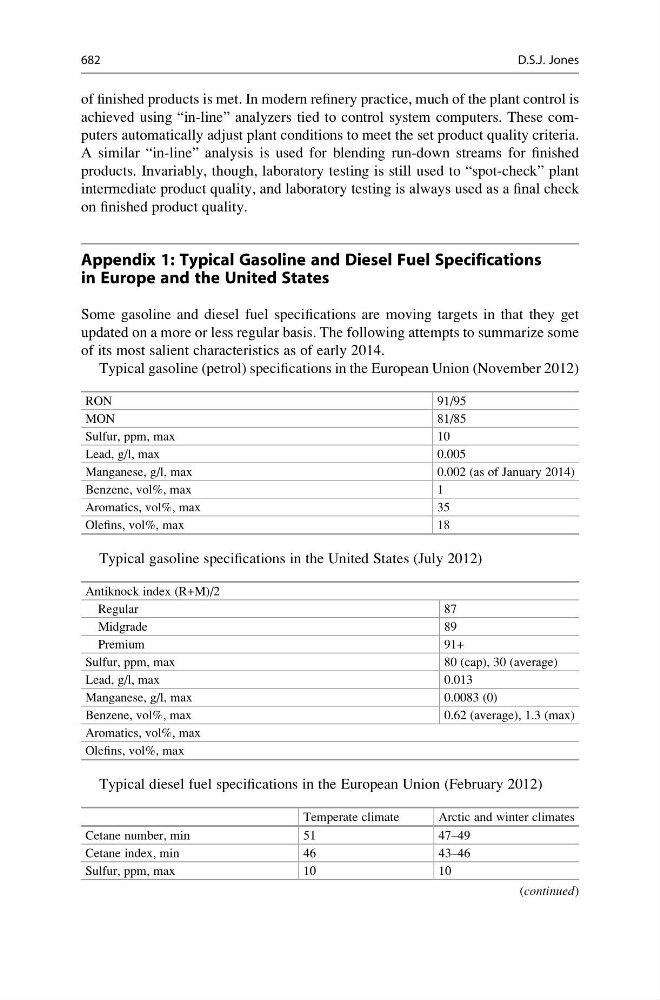
Typical gasoline (petrol) specifications in the European Union (November 2012)
RON
91/95
MON
81/85
Sulfur, ppm, max
10
Lead, g/l, max
0.005
Manganese, g/l, max
0.002 (as of January 2014)
Benzene, vol%, max
1
Aromatics, vol%, max
35
Olefins, vol%, max
18
Typical gasoline specifications in the United States (July 2012)
Antiknock index (R+M)/2
Regular
87
Midgrade
89
Premium
91+
Sulfur, ppm, max
80 (cap), 30 (average)
Lead, g/l, max
0.013
Manganese, g/l, max
0.0083 (0)
Benzene, vol%, max
0.62 (average), 1.3 (max)
Aromatics, vol%, max
Olefins, vol%, max
Typical diesel fuel specifications in the European Union (February 2012)
Temperate climate
Arctic and winter climates
Cetane number, min
51
47–49
Cetane index, min
46
43–46
Sulfur, ppm, max
10
10
(continued)
682
D.S.J. Jones