

sample size for direct combustion is 10–15 g; if the predicted sulfur content is
below 0.05 % for a predicted sulfur content of 0.05–0.4 %, the sample size should
be 5–10 g.
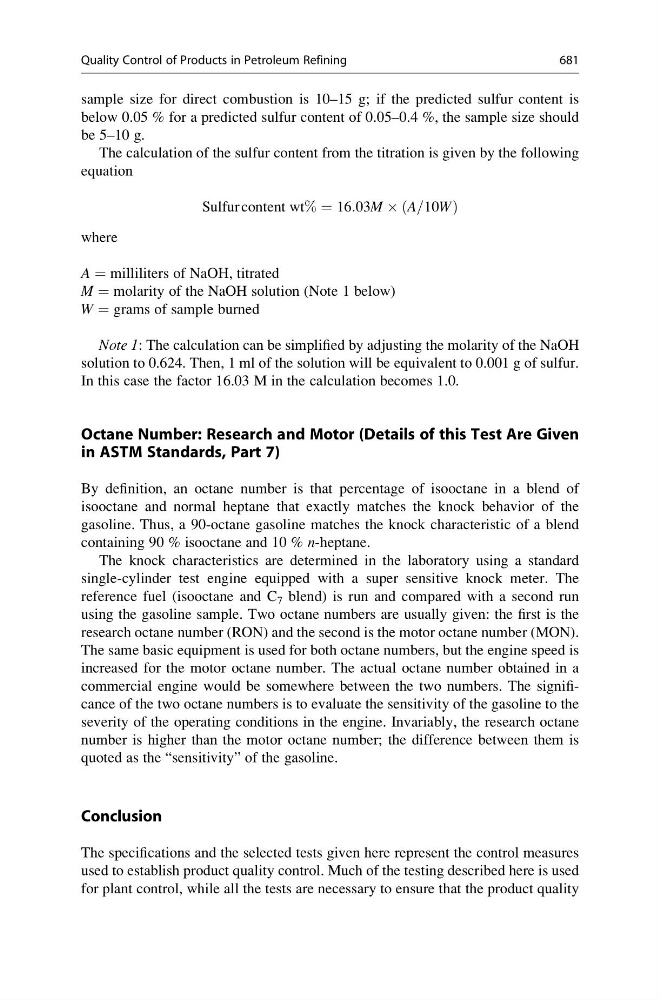
The calculation of the sulfur content from the titration is given by the following
equation
Sulfur content wt% ¼ 16:03M Â A=10W
ð
Þ
where
A = milliliters of NaOH, titrated
M = molarity of the NaOH solution (Note 1 below)
W = grams of sample burned
Note 1: The calculation can be simplified by adjusting the molarity of the NaOH
solution to 0.624. Then, 1 ml of the solution will be equivalent to 0.001 g of sulfur.
In this case the factor 16.03 M in the calculation becomes 1.0.
Octane Number: Research and Motor (Details of this Test Are Given
in ASTM Standards, Part 7)
By definition, an octane number is that percentage of isooctane in a blend of
isooctane and normal heptane that exactly matches the knock behavior of the
gasoline. Thus, a 90-octane gasoline matches the knock characteristic of a blend
containing 90 % isooctane and 10 % n-heptane.
The knock characteristics are determined in the laboratory using a standard
single-cylinder test engine equipped with a super sensitive knock meter. The
reference fuel (isooctane and C 7 blend) is run and compared with a second run
using the gasoline sample. Two octane numbers are usually given: the first is the
research octane number (RON) and the second is the motor octane number (MON).
The same basic equipment is used for both octane numbers, but the engine speed is
increased for the motor octane number. The actual octane number obtained in a
commercial engine would be somewhere between the two numbers. The significance of the two octane numbers is to evaluate the sensitivity of the gasoline to the
severity of the operating conditions in the engine. Invariably, the research octane
number is higher than the motor octane number; the difference between them is
quoted as the “sensitivity” of the gasoline.
Conclusion
The specifications and the selected tests given here represent the control measures
used to establish product quality control. Much of the testing described here is used
for plant control, while all the tests are necessary to ensure that the product quality
Quality Control of Products in Petroleum Refining
681