

LPG
This category includes the normal specifications for propane and butane LPG. The
detailed requirements for LPG are specified in ASTM D1835. Regular issues are
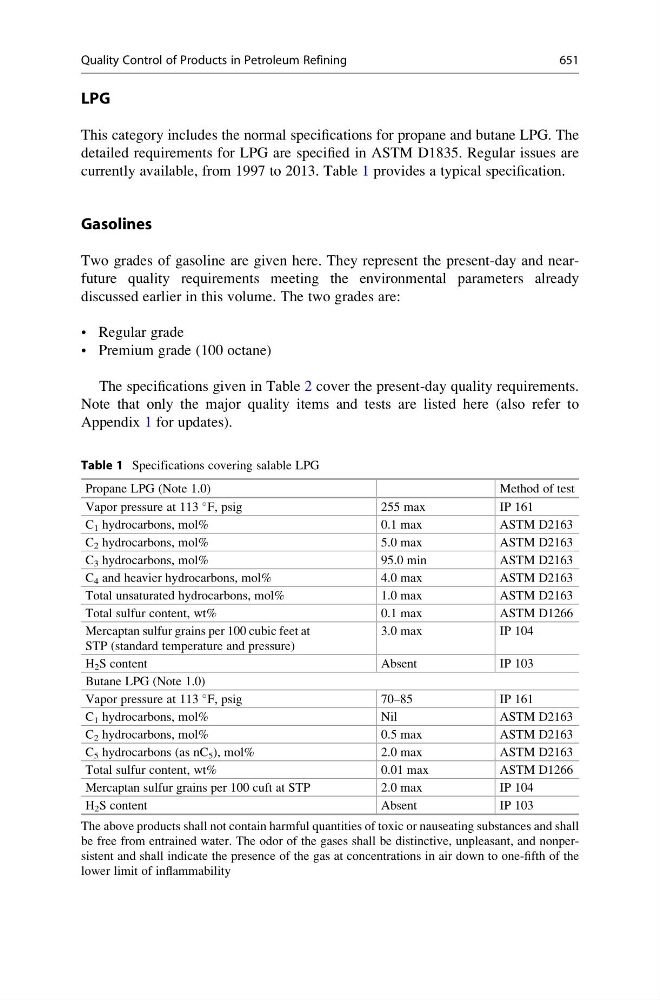
currently available, from 1997 to 2013. Table 1 provides a typical specification.
Gasolines
Two grades of gasoline are given here. They represent the present-day and nearfuture quality requirements meeting the environmental parameters already
discussed earlier in this volume. The two grades are:
• Regular grade
• Premium grade (100 octane)
The specifications given in Table 2 cover the present-day quality requirements.
Note that only the major quality items and tests are listed here (also refer to
Appendix 1 for updates).
Table 1 Specifications covering salable LPG
Propane LPG (Note 1.0)
Method of test
Vapor pressure at 113
F, psig
255 max
IP 161
C 1 hydrocarbons, mol%
0.1 max
ASTM D2163
C 2 hydrocarbons, mol%
5.0 max
ASTM D2163
C 3 hydrocarbons, mol%
95.0 min
ASTM D2163
C 4 and heavier hydrocarbons, mol%
4.0 max
ASTM D2163
Total unsaturated hydrocarbons, mol%
1.0 max
ASTM D2163
Total sulfur content, wt%
0.1 max
ASTM D1266
Mercaptan sulfur grains per 100 cubic feet at
STP (standard temperature and pressure)
3.0 max
IP 104
H 2 S content
Absent
IP 103
Butane LPG (Note 1.0)
Vapor pressure at 113
F, psig
70–85
IP 161
C 1 hydrocarbons, mol%
Nil
ASTM D2163
C 2 hydrocarbons, mol%
0.5 max
ASTM D2163
C 5 hydrocarbons (as nC 5 ), mol%
2.0 max
ASTM D2163
Total sulfur content, wt%
0.01 max
ASTM D1266
Mercaptan sulfur grains per 100 cuft at STP
2.0 max
IP 104
H 2 S content
Absent
IP 103
The above products shall not contain harmful quantities of toxic or nauseating substances and shall
be free from entrained water. The odor of the gases shall be distinctive, unpleasant, and nonpersistent and shall indicate the presence of the gas at concentrations in air down to one-fifth of the
lower limit of inflammability
Quality Control of Products in Petroleum Refining
651