

Basic monitoring of a membrane unit would consist of periodically calculating
the hydrogen recovery percentage and trending the product hydrogen contaminants.
Feed composition and potential carryover should also be tracked routinely. Membrane system vendors would provide additional support for analyzing system
performance.
Membrane systems for hydrogen recovery are offered by several suppliers,
including Air Liquide (MEDAL™), Air Products (PRIZM™), and UOP
(Polysep™). Industrial gas suppliers will also install and operate membrane systems at a refinery in something akin to an over-the-fence arrangement.
Cryogenic Recovery
Hydrogen can be recovered cryogenically from various refinery gases and olefins
cracking gases. It is normally a by-product of recovering other, more valuable
materials, such as ethylene. Industrial gas suppliers and others will install, own, and
operate cryogenic recovery units in an over-the-fence arrangement.
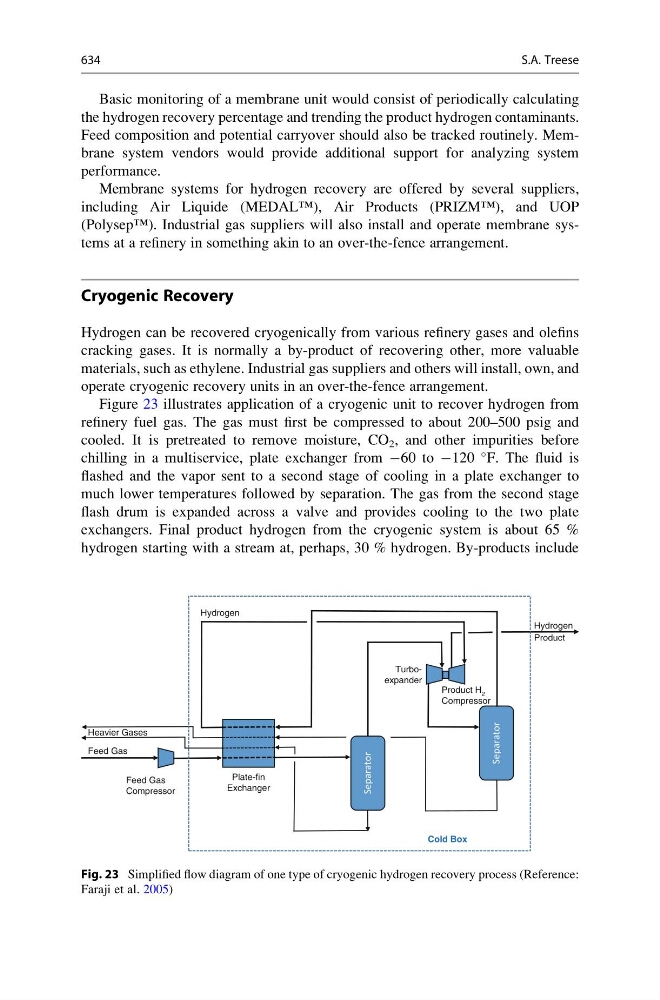
Figure 23 illustrates application of a cryogenic unit to recover hydrogen from
refinery fuel gas. The gas must first be compressed to about 200–500 psig and
cooled. It is pretreated to remove moisture, CO 2 , and other impurities before
chilling in a multiservice, plate exchanger from À60 to À120
F. The fluid is
flashed and the vapor sent to a second stage of cooling in a plate exchanger to
much lower temperatures followed by separation. The gas from the second stage
flash drum is expanded across a valve and provides cooling to the two plate
exchangers. Final product hydrogen from the cryogenic system is about 65 %
hydrogen starting with a stream at, perhaps, 30 % hydrogen. By-products include
Hydrogen
Hydrogen
Product
Turboexpander
Product H 2
Compressor
Heavier Gases
Feed Gas
Feed Gas
Compressor
Plate-fin
Exchanger
Cold Box
Separator
Separator
Fig. 23 Simplified flow diagram of one type of cryogenic hydrogen recovery process (Reference:
Faraji et al. 2005)
634
S.A. Treese