

Detailed discussion on troubleshooting more complex issues is beyond the scope
of this book. PSA unit vendors are usually more than happy to help in troubleshooting. As noted above, a periodic (annual) review of the unit operation by the
PSA vendor is advisable to identify problems that are not obvious.
Membranes
Advances in technology have made membranes a viable hydrogen recovery option
for several types of systems. The discussion of the applications for membranes and
the typical process flow in hydrogen recovery service is in the section “Refinery Gas
Recovery.” Membrane capacities over 60 MMscfd of feed are possible because of
the modular nature of the process. These units are, in fact, usually supplied as
prefabricated modules.
Reviewing the flow sheet in Fig. 20 above, compressed, high-pressure raw gas
(preferably >1,000 psig) passes through a knockout drum or coalescer to eliminate
any possible liquids in the feed. The clean raw gas is then fed to a bank of several
membranes housed in tubes, all operating in parallel. Hydrogen diffuses through the
membranes to the low-pressure side and exits (permeate). The impurities remain on
the high-pressure side and exit (residue).
Product hydrogen permeate from a membrane will range from 80 % to 98 %
purity, with 65–95 % recovery. Feed hydrogen for a membrane unit can range from
15 % to 80 % hydrogen purity, although purity greater than 70 % is best.
The most common membranes for hydrogen are hollow fibers or wound sheets
of thin polyaramide or polyimide on a support material. The membrane selectively allows the smallest molecules to pass; so hydrogen gets through preferentially. The membrane materials are fairly resistant to damage from most
chemicals they may encounter, but eventually are damaged to the point of
requiring replacement.
Other membrane materials, including inorganics, are in development.
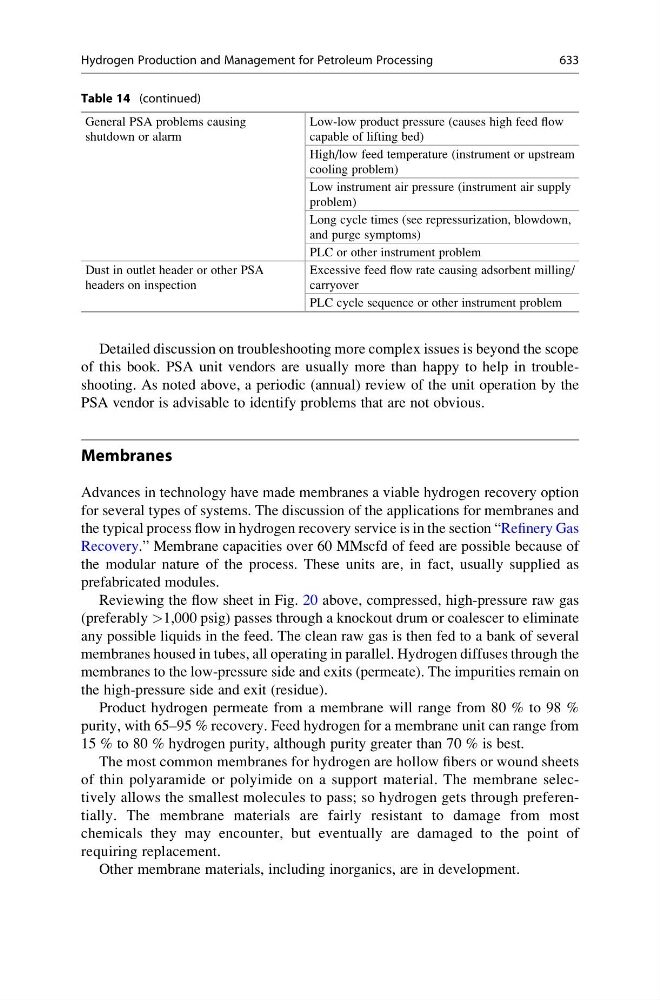
Table 14 (continued)
General PSA problems causing
shutdown or alarm
Low-low product pressure (causes high feed flow
capable of lifting bed)
High/low feed temperature (instrument or upstream
cooling problem)
Low instrument air pressure (instrument air supply
problem)
Long cycle times (see repressurization, blowdown,
and purge symptoms)
PLC or other instrument problem
Dust in outlet header or other PSA
headers on inspection
Excessive feed flow rate causing adsorbent milling/
carryover
PLC cycle sequence or other instrument problem
Hydrogen Production and Management for Petroleum Processing
633