

Producing the Olefin Feedstock
The source of olefins in a refinery configuration is from either the FCCU, a thermal
cracker, or a steam cracker. The olefins produced as a gas are ethylene, propylene,
and the C 4 s, such as butylenes, butadiene, etc. Liquid olefinic products from these
units are normally hydrotreated to make reformer feedstock and thus the BTX feed.
All products, of course, are treated for sulfur control and cleaned up before leaving
the refinery as petrochemical feedstock. The specifications for these products are
stringent and usually the “clean-up” plants are dedicated to the treatment of these
products.
Olefins are used mostly in the production of polymers such as the vinyl polymers
(vinyl chloride, vinyl acetate, and the like), polyethylene products, and polypropylene products. The heavier C 4 s are a major constituent in the production of
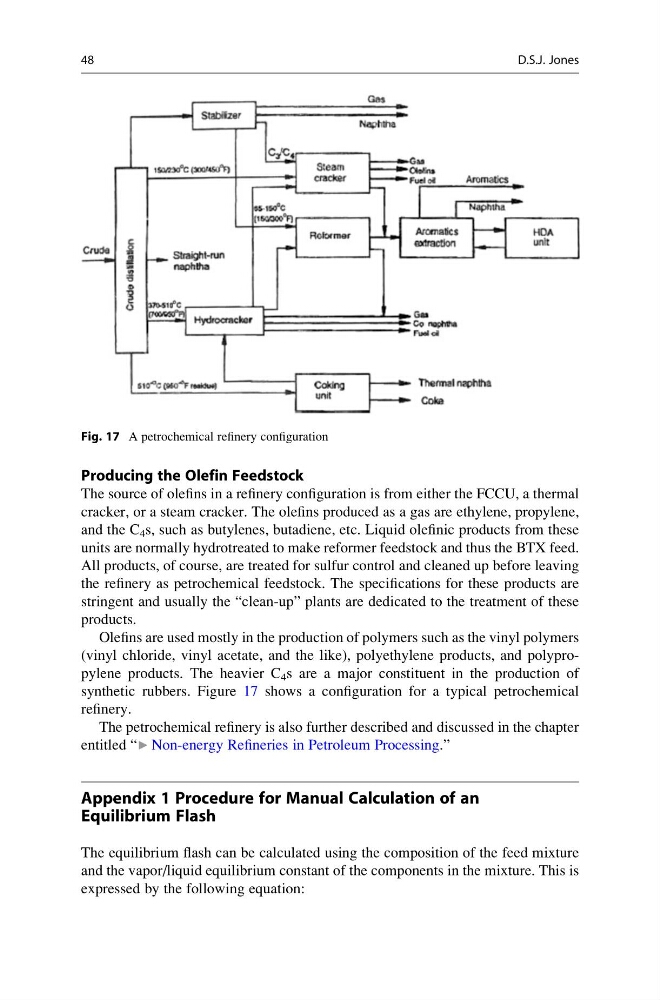
synthetic rubbers. Figure 17 shows a configuration for a typical petrochemical
refinery.
The petrochemical refinery is also further described and discussed in the chapter
entitled “▶ Non-energy Refineries in Petroleum Processing.”
Appendix 1 Procedure for Manual Calculation of an
Equilibrium Flash
The equilibrium flash can be calculated using the composition of the feed mixture
and the vapor/liquid equilibrium constant of the components in the mixture. This is
expressed by the following equation:
Fig. 17 A petrochemical refinery configuration
48
D.S.J. Jones
The source of olefins in a refinery configuration is from either the FCCU, a thermal
cracker, or a steam cracker. The olefins produced as a gas are ethylene, propylene,
and the C 4 s, such as butylenes, butadiene, etc. Liquid olefinic products from these
units are normally hydrotreated to make reformer feedstock and thus the BTX feed.
All products, of course, are treated for sulfur control and cleaned up before leaving
the refinery as petrochemical feedstock. The specifications for these products are
stringent and usually the “clean-up” plants are dedicated to the treatment of these
products.
Olefins are used mostly in the production of polymers such as the vinyl polymers
(vinyl chloride, vinyl acetate, and the like), polyethylene products, and polypropylene products. The heavier C 4 s are a major constituent in the production of
synthetic rubbers. Figure 17 shows a configuration for a typical petrochemical
refinery.
The petrochemical refinery is also further described and discussed in the chapter
entitled “▶ Non-energy Refineries in Petroleum Processing.”
Appendix 1 Procedure for Manual Calculation of an
Equilibrium Flash
The equilibrium flash can be calculated using the composition of the feed mixture
and the vapor/liquid equilibrium constant of the components in the mixture. This is
expressed by the following equation:
Fig. 17 A petrochemical refinery configuration
48
D.S.J. Jones