

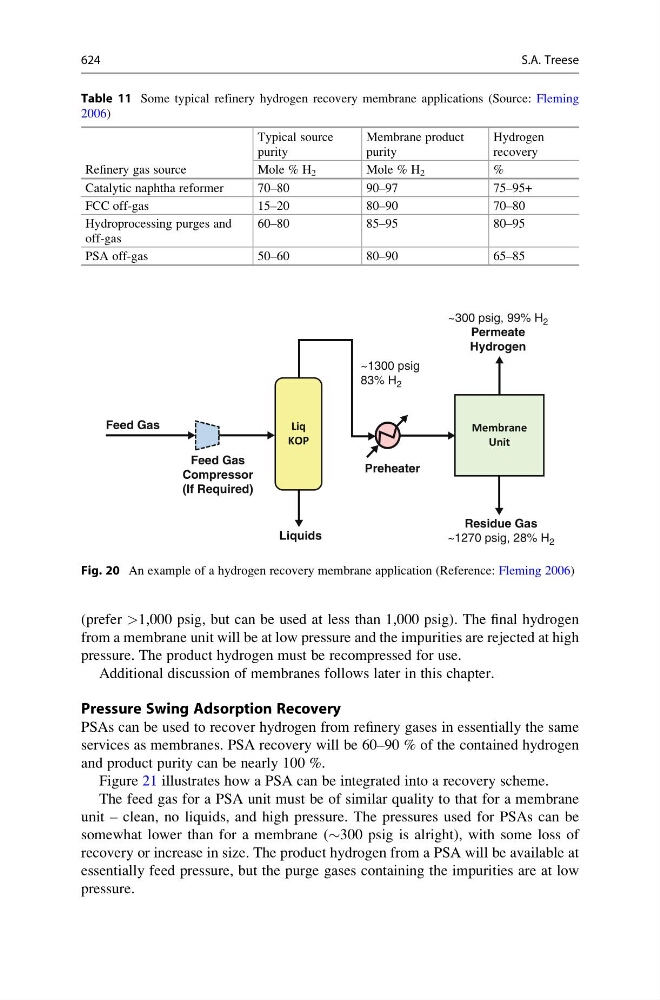
(prefer >1,000 psig, but can be used at less than 1,000 psig). The final hydrogen
from a membrane unit will be at low pressure and the impurities are rejected at high
pressure. The product hydrogen must be recompressed for use.
Additional discussion of membranes follows later in this chapter.
Pressure Swing Adsorption Recovery
PSAs can be used to recover hydrogen from refinery gases in essentially the same
services as membranes. PSA recovery will be 60–90 % of the contained hydrogen
and product purity can be nearly 100 %.
Figure 21 illustrates how a PSA can be integrated into a recovery scheme.
The feed gas for a PSA unit must be of similar quality to that for a membrane
unit – clean, no liquids, and high pressure. The pressures used for PSAs can be
somewhat lower than for a membrane ($300 psig is alright), with some loss of
recovery or increase in size. The product hydrogen from a PSA will be available at
essentially feed pressure, but the purge gases containing the impurities are at low
pressure.
Table 11 Some typical refinery hydrogen recovery membrane applications (Source: Fleming
2006)
Refinery gas source
Typical source
purity
Membrane product
purity
Hydrogen
recovery
Mole % H 2
Mole % H 2
%
Catalytic naphtha reformer
70–80
90–97
75–95+
FCC off-gas
15–20
80–90
70–80
Hydroprocessing purges and
off-gas
60–80
85–95
80–95
PSA off-gas
50–60
80–90
65–85
~1300 psig
83% H 2
Feed Gas
Feed Gas
Compressor
(If Required)
Liquids
~300 psig, 99% H 2
Permeate
Hydrogen
Preheater
Residue Gas
~1270 psig, 28% H 2
Liq
KOP
Membrane
Unit
Fig. 20 An example of a hydrogen recovery membrane application (Reference: Fleming 2006)
624
S.A. Treese