

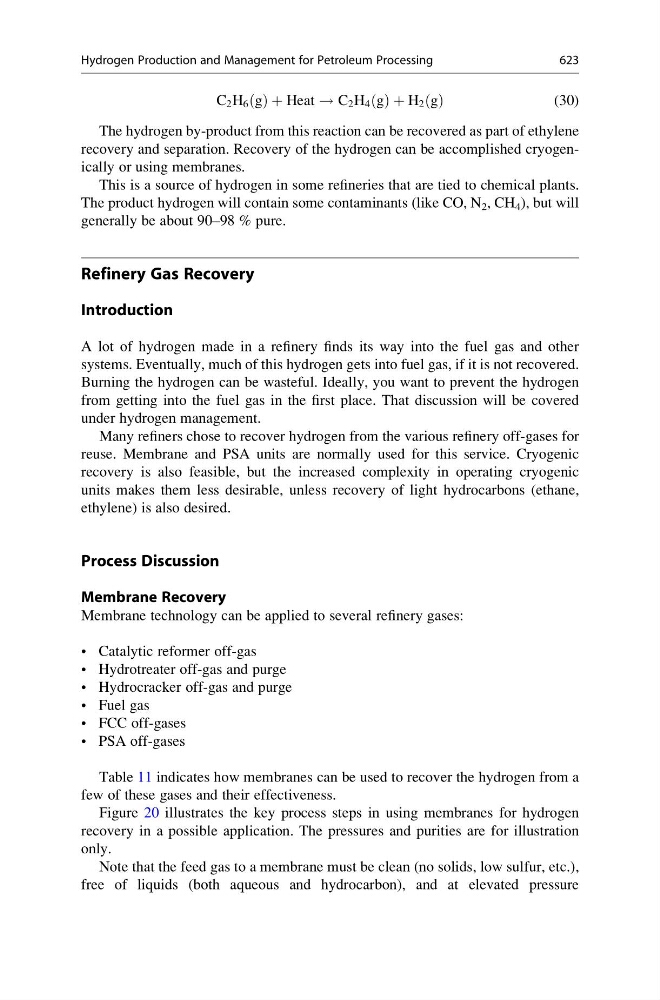
C 2 H 6 g
ð Þ þ Heat ! C 2 H 4 g
ð Þ þ H 2 g
ð Þ
(30)
The hydrogen by-product from this reaction can be recovered as part of ethylene
recovery and separation. Recovery of the hydrogen can be accomplished cryogenically or using membranes.
This is a source of hydrogen in some refineries that are tied to chemical plants.
The product hydrogen will contain some contaminants (like CO, N 2 , CH 4 ), but will
generally be about 90–98 % pure.
Refinery Gas Recovery
Introduction
A lot of hydrogen made in a refinery finds its way into the fuel gas and other
systems. Eventually, much of this hydrogen gets into fuel gas, if it is not recovered.
Burning the hydrogen can be wasteful. Ideally, you want to prevent the hydrogen
from getting into the fuel gas in the first place. That discussion will be covered
under hydrogen management.
Many refiners chose to recover hydrogen from the various refinery off-gases for
reuse. Membrane and PSA units are normally used for this service. Cryogenic
recovery is also feasible, but the increased complexity in operating cryogenic
units makes them less desirable, unless recovery of light hydrocarbons (ethane,
ethylene) is also desired.
Process Discussion
Membrane Recovery
Membrane technology can be applied to several refinery gases:
• Catalytic reformer off-gas
• Hydrotreater off-gas and purge
• Hydrocracker off-gas and purge
• Fuel gas
• FCC off-gases
• PSA off-gases
Table 11 indicates how membranes can be used to recover the hydrogen from a
few of these gases and their effectiveness.
Figure 20 illustrates the key process steps in using membranes for hydrogen
recovery in a possible application. The pressures and purities are for illustration
only.
Note that the feed gas to a membrane must be clean (no solids, low sulfur, etc.),
free of liquids (both aqueous and hydrocarbon), and at elevated pressure
Hydrogen Production and Management for Petroleum Processing
623