

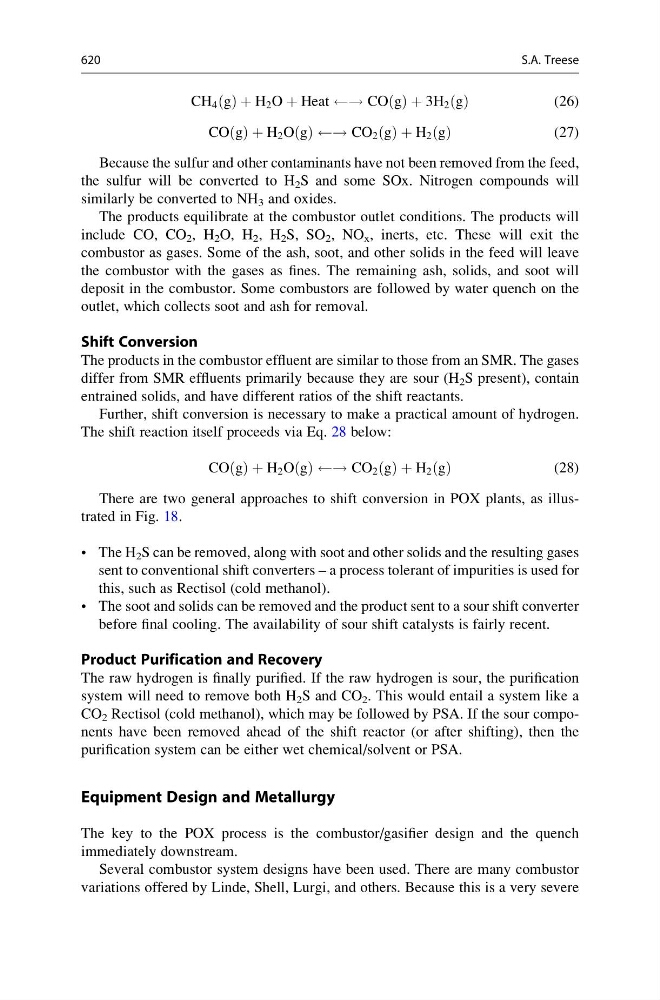
CH 4 g
ð Þ þ H 2 O þ Heat ! CO g
ð Þ þ 3H 2 g
ð Þ
(26)
CO g
ð Þ þ H 2 O g
ð Þ ! CO 2 g
ð Þ þ H 2 g
ð Þ
(27)
Because the sulfur and other contaminants have not been removed from the feed,
the sulfur will be converted to H 2 S and some SOx. Nitrogen compounds will
similarly be converted to NH 3 and oxides.
The products equilibrate at the combustor outlet conditions. The products will
include CO, CO 2 , H 2 O, H 2 , H 2 S, SO 2 , NO x , inerts, etc. These will exit the
combustor as gases. Some of the ash, soot, and other solids in the feed will leave
the combustor with the gases as fines. The remaining ash, solids, and soot will
deposit in the combustor. Some combustors are followed by water quench on the
outlet, which collects soot and ash for removal.
Shift Conversion
The products in the combustor effluent are similar to those from an SMR. The gases
differ from SMR effluents primarily because they are sour (H 2 S present), contain
entrained solids, and have different ratios of the shift reactants.
Further, shift conversion is necessary to make a practical amount of hydrogen.
The shift reaction itself proceeds via Eq. 28 below:
CO g
ð Þ þ H 2 O g
ð Þ ! CO 2 g
ð Þ þ H 2 g
ð Þ
(28)
There are two general approaches to shift conversion in POX plants, as illustrated in Fig. 18.
• The H 2 S can be removed, along with soot and other solids and the resulting gases
sent to conventional shift converters – a process tolerant of impurities is used for
this, such as Rectisol (cold methanol).
• The soot and solids can be removed and the product sent to a sour shift converter
before final cooling. The availability of sour shift catalysts is fairly recent.
Product Purification and Recovery
The raw hydrogen is finally purified. If the raw hydrogen is sour, the purification
system will need to remove both H 2 S and CO 2 . This would entail a system like a
CO 2 Rectisol (cold methanol), which may be followed by PSA. If the sour components have been removed ahead of the shift reactor (or after shifting), then the
purification system can be either wet chemical/solvent or PSA.
Equipment Design and Metallurgy
The key to the POX process is the combustor/gasifier design and the quench
immediately downstream.
Several combustor system designs have been used. There are many combustor
variations offered by Linde, Shell, Lurgi, and others. Because this is a very severe
620
S.A. Treese