

In this section of the plant, the hot, pretreated feed is mixed with steam in a
precise proportion based on the amount of carbon in the feed. This is the critical
steam/carbon ratio and is based on moles of steam per mole of carbon in the feed.
Steam/carbon ratio typically ranges from 2.0 to 5.0, depending on the hydrogen
plant design. Most new plants in refineries run 2.5–3.0 for gaseous feeds. The ratio
is increased for butane and heavier feeds and if additional heat is needed to cool the
shift effluent (to be discussed later).
The combined reformer charge is preheated further to 800–1,150
F by exchange
before entering the reforming furnace radiant tubes. It is a large firebox with rows of
catalyst-packed tubes surrounded by the burner flames. The SMR reactions occur in
the furnace at $1,350–1,740
F and $250–350 psig. There can be hundreds of tubes
in a typical furnace.
Flow distribution to the tubes is by pressure drop, so the inlet and outlet header
designs and catalyst loading are carefully controlled to ensure exactly the same
pressure drop exists through each tube – and hence the same flow. In practice, there
are some deviations and an allowable tolerance.
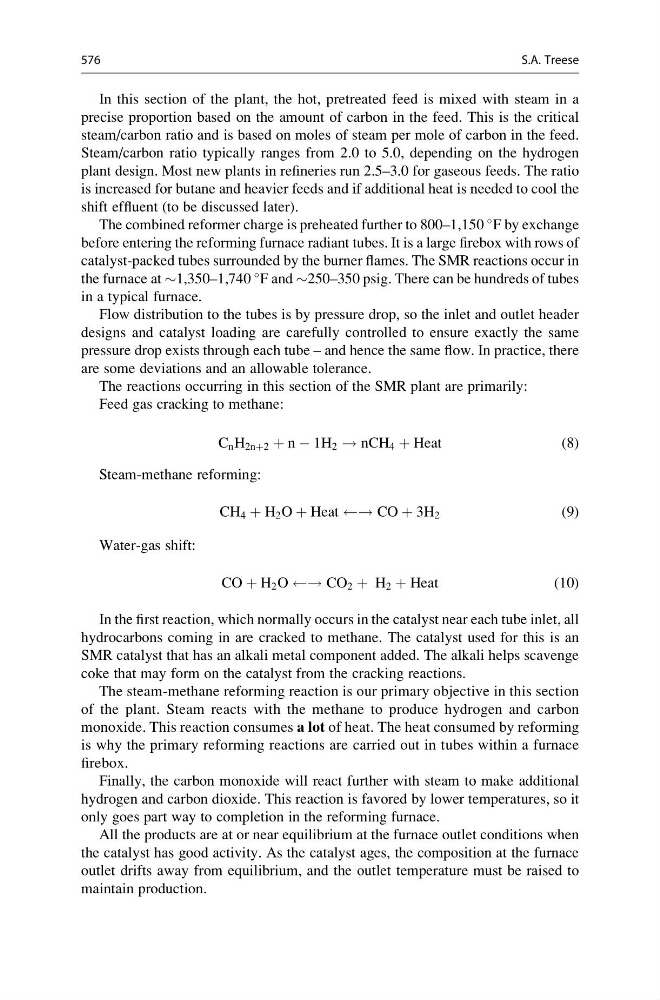
The reactions occurring in this section of the SMR plant are primarily:
Feed gas cracking to methane:
C n H 2nþ2 þ n À 1H 2 ! nCH 4 þ Heat
(8)
Steam-methane reforming:
CH 4 þ H 2 O þ Heat ! CO þ 3H 2
(9)
Water-gas shift:
CO þ H 2 O ! CO 2 þ H 2 þ Heat
(10)
In the first reaction, which normally occurs in the catalyst near each tube inlet, all
hydrocarbons coming in are cracked to methane. The catalyst used for this is an
SMR catalyst that has an alkali metal component added. The alkali helps scavenge
coke that may form on the catalyst from the cracking reactions.
The steam-methane reforming reaction is our primary objective in this section
of the plant. Steam reacts with the methane to produce hydrogen and carbon
monoxide. This reaction consumes a lot of heat. The heat consumed by reforming
is why the primary reforming reactions are carried out in tubes within a furnace
firebox.
Finally, the carbon monoxide will react further with steam to make additional
hydrogen and carbon dioxide. This reaction is favored by lower temperatures, so it
only goes part way to completion in the reforming furnace.
All the products are at or near equilibrium at the furnace outlet conditions when
the catalyst has good activity. As the catalyst ages, the composition at the furnace
outlet drifts away from equilibrium, and the outlet temperature must be raised to
maintain production.
576
S.A. Treese