

interesting to note the following test run data compared with that calculated using
SVF concept (Table 3).
It can be seen that the data calculated compare well with those actually observed
under test conditions. One interesting point in the test run data is the high coil outlet
temperature that was used. As this is slightly above the critical decomposition zone
for this type of crude, it would lend one to suspect that the cracked residue would be
unstable. There was no recorded evidence of this, however.
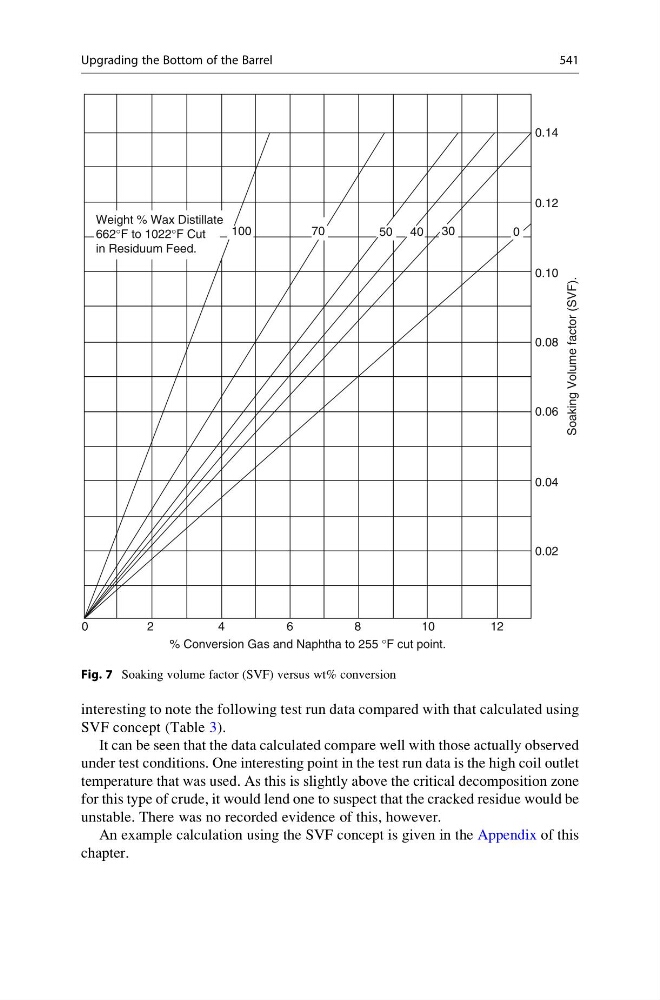
An example calculation using the SVF concept is given in the Appendix of this
chapter.
0.14
0.12
Weight % Wax Distillate
662°F to 1022°F Cut
in Residuum Feed.
0.10
0.08
0.06
Soaking Volume factor (SVF).
100
70
50 40
30
0
0.04
0.02
12
10
8
6
4
% Conversion Gas and Naphtha to 255 °F cut point.
2
0
Fig. 7 Soaking volume factor (SVF) versus wt% conversion
Upgrading the Bottom of the Barrel
541
SVF concept (Table 3).
It can be seen that the data calculated compare well with those actually observed
under test conditions. One interesting point in the test run data is the high coil outlet
temperature that was used. As this is slightly above the critical decomposition zone
for this type of crude, it would lend one to suspect that the cracked residue would be
unstable. There was no recorded evidence of this, however.
An example calculation using the SVF concept is given in the Appendix of this
chapter.
0.14
0.12
Weight % Wax Distillate
662°F to 1022°F Cut
in Residuum Feed.
0.10
0.08
0.06
Soaking Volume factor (SVF).
100
70
50 40
30
0
0.04
0.02
12
10
8
6
4
% Conversion Gas and Naphtha to 255 °F cut point.
2
0
Fig. 7 Soaking volume factor (SVF) versus wt% conversion
Upgrading the Bottom of the Barrel
541