

The Thermal Cracking Processes
Thermal cracking processes refer to those that convert the residuum feed (whether
atmospheric or vacuum residues) into higher-grade products such as naphtha and
middle distillates, by heat at high temperature alone. That is, no catalyst or
chemicals are used in the conversion. The processes themselves are:
• Visbreaking
• Thermal cracking
• Coking
Certain confusion exists in the definition of visbreaking and thermal cracking.
Differentiation is based on the type of feedstock, severity of cracking, or the final
result. Strictly speaking, the term visbreaking should refer only to the viscosity
reduction of heavy stock as the process’ main objective.
Applications of the Thermal Cracking Processes
In a simple refinery, without vacuum distillation facilities, the residue from the
crude oil atmospheric distillation, typically boiling above 650
F or 700
F, constitutes the bulk of the heavy fuel oil produced. In cases where incremental
production of light and middle distillates at the expense of fuel oil is desired,
one-stage thermal cracking of the residue is an easy and cost-effective solution.
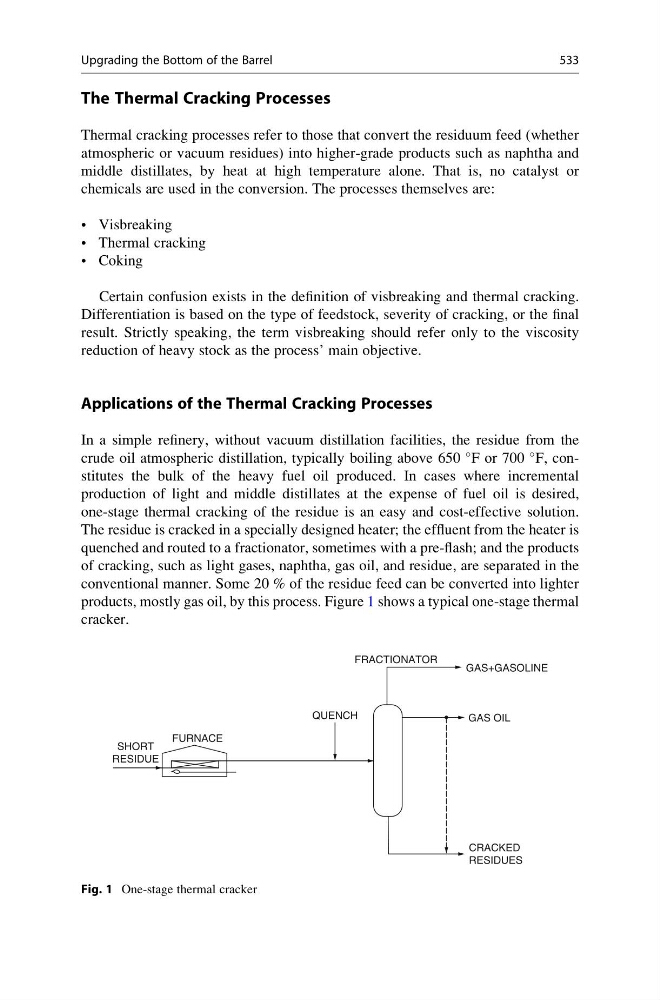
The residue is cracked in a specially designed heater; the effluent from the heater is
quenched and routed to a fractionator, sometimes with a pre-flash; and the products
of cracking, such as light gases, naphtha, gas oil, and residue, are separated in the
conventional manner. Some 20 % of the residue feed can be converted into lighter
products, mostly gas oil, by this process. Figure 1 shows a typical one-stage thermal
cracker.
FURNACE
QUENCH
FRACTIONATOR
GAS+GASOLINE
GAS OIL
CRACKED
RESIDUES
SHORT
RESIDUE
Fig. 1 One-stage thermal cracker
Upgrading the Bottom of the Barrel
533
Thermal cracking processes refer to those that convert the residuum feed (whether
atmospheric or vacuum residues) into higher-grade products such as naphtha and
middle distillates, by heat at high temperature alone. That is, no catalyst or
chemicals are used in the conversion. The processes themselves are:
• Visbreaking
• Thermal cracking
• Coking
Certain confusion exists in the definition of visbreaking and thermal cracking.
Differentiation is based on the type of feedstock, severity of cracking, or the final
result. Strictly speaking, the term visbreaking should refer only to the viscosity
reduction of heavy stock as the process’ main objective.
Applications of the Thermal Cracking Processes
In a simple refinery, without vacuum distillation facilities, the residue from the
crude oil atmospheric distillation, typically boiling above 650
F or 700
F, constitutes the bulk of the heavy fuel oil produced. In cases where incremental
production of light and middle distillates at the expense of fuel oil is desired,
one-stage thermal cracking of the residue is an easy and cost-effective solution.
The residue is cracked in a specially designed heater; the effluent from the heater is
quenched and routed to a fractionator, sometimes with a pre-flash; and the products
of cracking, such as light gases, naphtha, gas oil, and residue, are separated in the
conventional manner. Some 20 % of the residue feed can be converted into lighter
products, mostly gas oil, by this process. Figure 1 shows a typical one-stage thermal
cracker.
FURNACE
QUENCH
FRACTIONATOR
GAS+GASOLINE
GAS OIL
CRACKED
RESIDUES
SHORT
RESIDUE
Fig. 1 One-stage thermal cracker
Upgrading the Bottom of the Barrel
533