

Step 3. Calculate the amine circulation rate in mol/h amine, lb/h amine, and lb/h
solution (about 20 vol.%). Resolve to gal/h of solution.
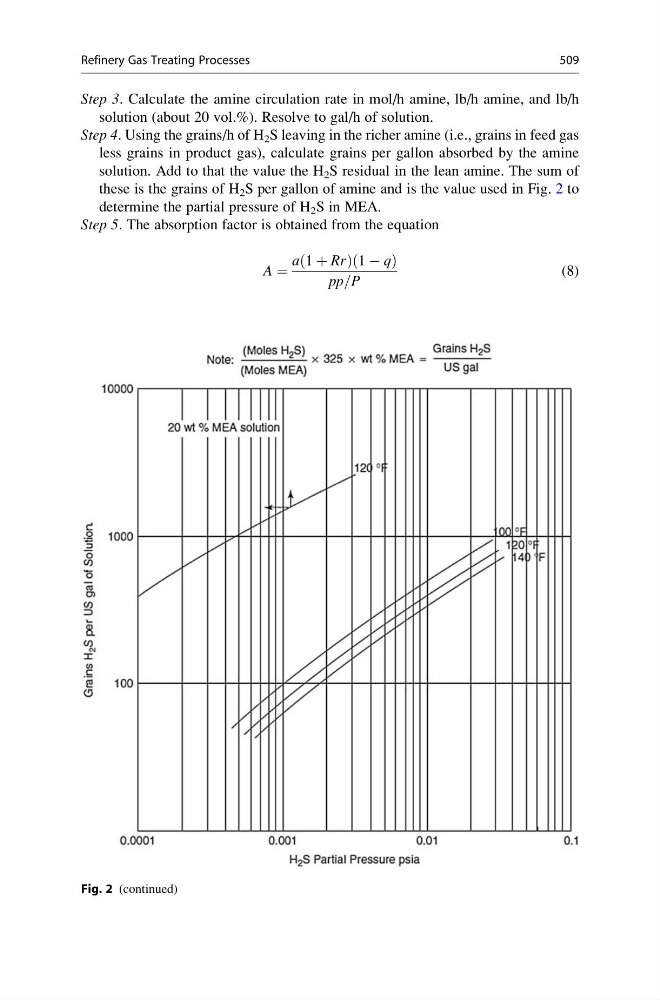
Step 4. Using the grains/h of H 2 S leaving in the richer amine (i.e., grains in feed gas
less grains in product gas), calculate grains per gallon absorbed by the amine
solution. Add to that the value the H 2 S residual in the lean amine. The sum of
these is the grains of H 2 S per gallon of amine and is the value used in Fig. 2 to
determine the partial pressure of H 2 S in MEA.
Step 5. The absorption factor is obtained from the equation
A ¼
a 1 þ Rr
ð
Þ 1 À q
ð
Þ
pp=P
(8)
Fig. 2 (continued)
Refinery Gas Treating Processes
509
solution (about 20 vol.%). Resolve to gal/h of solution.
Step 4. Using the grains/h of H 2 S leaving in the richer amine (i.e., grains in feed gas
less grains in product gas), calculate grains per gallon absorbed by the amine
solution. Add to that the value the H 2 S residual in the lean amine. The sum of
these is the grains of H 2 S per gallon of amine and is the value used in Fig. 2 to
determine the partial pressure of H 2 S in MEA.
Step 5. The absorption factor is obtained from the equation
A ¼
a 1 þ Rr
ð
Þ 1 À q
ð
Þ
pp=P
(8)
Fig. 2 (continued)
Refinery Gas Treating Processes
509