

Step 3. Fix the weight percent of amine in the recirculating amine solution. This will
be between 15 % and 20 % weight of DEA or MEA in water.
Step 4. Calculate the H 2 S in moles/h that is in the feed. This is done by converting
the volume flow of gas to moles and using lab data to provide moles/h of H 2 S.
Step 5. Calculate the amount of H 2 S to be left in the lean gas. This is usually
10 grains/100 scf with DEA as absorbent and 3 grains/100 scf with MEA as
absorbent (1 grain = 0.0648 g or 0.0022857 oz).
Step 6. Calculate H 2 S absorbed. This is the difference between Step 4 and Step 5.
Step 7. Using the ratio 3:1 fixed in Step 1, calculate the rate of DEA (or MEA) that
will be required.
Step 8. The mole weight of DEA is 105.1 and the mole weight of MEA is 61.1.
Calculate weight of the amine using percent weight of amine in solution;
calculate weight per unit time of solution.
Step 9. Using the data from step 2, calculate the solution flow rate in gallons
(or other volumetric unit) per hour or per minute.
Calculating the Number of Theoretical Trays in an Amine
Contactor
There are several accepted methods to calculate theoretical trays in amine
contactors. It is common today to use process simulation software (HYSYS,
Pro/II, and others) to perform the design calculations for amine contactors. This
allows case studies to optimize the process design. The details of the computer
simulations are beyond the scope of this handbook.
A manual approach to the calculations is described here. It is helpful to understand the manual approach to establish the background and limitations behind the
computerized calculations.
Among the manual approaches are the McCabe-Thiele graphical method and the
calculation method described by the following steps. The described calculation
method is considered by many to be the sounder and more accurate of the manual
methods available.
The following steps describe this calculation procedure:
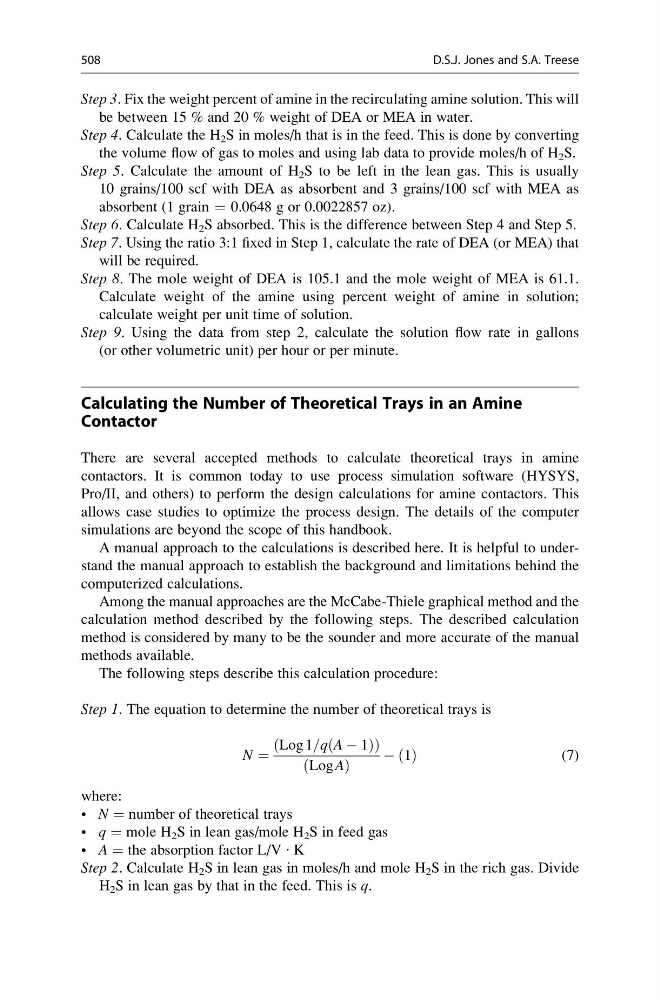
Step 1. The equation to determine the number of theoretical trays is
N ¼
Log 1=q A À 1
ð
Þ
ð
Þ
Log A
ð
Þ
À 1
ð Þ
(7)
where:
• N = number of theoretical trays
• q = mole H 2 S in lean gas/mole H 2 S in feed gas
• A = the absorption factor L/V ∙ K
Step 2. Calculate H 2 S in lean gas in moles/h and mole H 2 S in the rich gas. Divide
H 2 S in lean gas by that in the feed. This is q.
508
D.S.J. Jones and S.A. Treese
be between 15 % and 20 % weight of DEA or MEA in water.
Step 4. Calculate the H 2 S in moles/h that is in the feed. This is done by converting
the volume flow of gas to moles and using lab data to provide moles/h of H 2 S.
Step 5. Calculate the amount of H 2 S to be left in the lean gas. This is usually
10 grains/100 scf with DEA as absorbent and 3 grains/100 scf with MEA as
absorbent (1 grain = 0.0648 g or 0.0022857 oz).
Step 6. Calculate H 2 S absorbed. This is the difference between Step 4 and Step 5.
Step 7. Using the ratio 3:1 fixed in Step 1, calculate the rate of DEA (or MEA) that
will be required.
Step 8. The mole weight of DEA is 105.1 and the mole weight of MEA is 61.1.
Calculate weight of the amine using percent weight of amine in solution;
calculate weight per unit time of solution.
Step 9. Using the data from step 2, calculate the solution flow rate in gallons
(or other volumetric unit) per hour or per minute.
Calculating the Number of Theoretical Trays in an Amine
Contactor
There are several accepted methods to calculate theoretical trays in amine
contactors. It is common today to use process simulation software (HYSYS,
Pro/II, and others) to perform the design calculations for amine contactors. This
allows case studies to optimize the process design. The details of the computer
simulations are beyond the scope of this handbook.
A manual approach to the calculations is described here. It is helpful to understand the manual approach to establish the background and limitations behind the
computerized calculations.
Among the manual approaches are the McCabe-Thiele graphical method and the
calculation method described by the following steps. The described calculation
method is considered by many to be the sounder and more accurate of the manual
methods available.
The following steps describe this calculation procedure:
Step 1. The equation to determine the number of theoretical trays is
N ¼
Log 1=q A À 1
ð
Þ
ð
Þ
Log A
ð
Þ
À 1
ð Þ
(7)
where:
• N = number of theoretical trays
• q = mole H 2 S in lean gas/mole H 2 S in feed gas
• A = the absorption factor L/V ∙ K
Step 2. Calculate H 2 S in lean gas in moles/h and mole H 2 S in the rich gas. Divide
H 2 S in lean gas by that in the feed. This is q.
508
D.S.J. Jones and S.A. Treese