

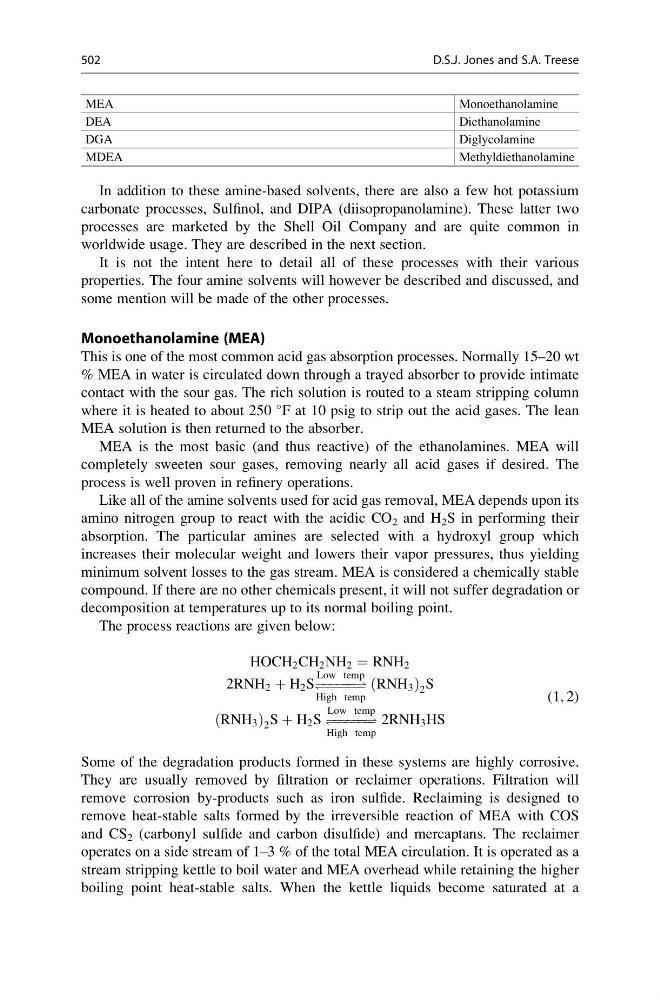
MEA
Monoethanolamine
DEA
Diethanolamine
DGA
Diglycolamine
MDEA
Methyldiethanolamine
In addition to these amine-based solvents, there are also a few hot potassium
carbonate processes, Sulfinol, and DIPA (diisopropanolamine). These latter two
processes are marketed by the Shell Oil Company and are quite common in
worldwide usage. They are described in the next section.
It is not the intent here to detail all of these processes with their various
properties. The four amine solvents will however be described and discussed, and
some mention will be made of the other processes.
Monoethanolamine (MEA)
This is one of the most common acid gas absorption processes. Normally 15–20 wt
% MEA in water is circulated down through a trayed absorber to provide intimate
contact with the sour gas. The rich solution is routed to a steam stripping column
where it is heated to about 250
F at 10 psig to strip out the acid gases. The lean
MEA solution is then returned to the absorber.
MEA is the most basic (and thus reactive) of the ethanolamines. MEA will
completely sweeten sour gases, removing nearly all acid gases if desired. The
process is well proven in refinery operations.
Like all of the amine solvents used for acid gas removal, MEA depends upon its
amino nitrogen group to react with the acidic CO 2 and H 2 S in performing their
absorption. The particular amines are selected with a hydroxyl group which
increases their molecular weight and lowers their vapor pressures, thus yielding
minimum solvent losses to the gas stream. MEA is considered a chemically stable
compound. If there are no other chemicals present, it will not suffer degradation or
decomposition at temperatures up to its normal boiling point.
The process reactions are given below:
HOCH 2 CH 2 NH 2 ¼ RNH 2
2RNH 2 þ H 2 SÀ À À À À À*
)À À À À À À
Low temp
High temp
RNH 3
ð
Þ 2 S
RNH 3
ð
Þ 2 S þ H 2 S À À À À À À*
)À À À À À À
Low temp
High temp
2RNH 3 HS
(1; 2)
Some of the degradation products formed in these systems are highly corrosive.
They are usually removed by filtration or reclaimer operations. Filtration will
remove corrosion by-products such as iron sulfide. Reclaiming is designed to
remove heat-stable salts formed by the irreversible reaction of MEA with COS
and CS 2 (carbonyl sulfide and carbon disulfide) and mercaptans. The reclaimer
operates on a side stream of 1–3 % of the total MEA circulation. It is operated as a
stream stripping kettle to boil water and MEA overhead while retaining the higher
boiling point heat-stable salts. When the kettle liquids become saturated at a
502
D.S.J. Jones and S.A. Treese
Monoethanolamine
DEA
Diethanolamine
DGA
Diglycolamine
MDEA
Methyldiethanolamine
In addition to these amine-based solvents, there are also a few hot potassium
carbonate processes, Sulfinol, and DIPA (diisopropanolamine). These latter two
processes are marketed by the Shell Oil Company and are quite common in
worldwide usage. They are described in the next section.
It is not the intent here to detail all of these processes with their various
properties. The four amine solvents will however be described and discussed, and
some mention will be made of the other processes.
Monoethanolamine (MEA)
This is one of the most common acid gas absorption processes. Normally 15–20 wt
% MEA in water is circulated down through a trayed absorber to provide intimate
contact with the sour gas. The rich solution is routed to a steam stripping column
where it is heated to about 250
F at 10 psig to strip out the acid gases. The lean
MEA solution is then returned to the absorber.
MEA is the most basic (and thus reactive) of the ethanolamines. MEA will
completely sweeten sour gases, removing nearly all acid gases if desired. The
process is well proven in refinery operations.
Like all of the amine solvents used for acid gas removal, MEA depends upon its
amino nitrogen group to react with the acidic CO 2 and H 2 S in performing their
absorption. The particular amines are selected with a hydroxyl group which
increases their molecular weight and lowers their vapor pressures, thus yielding
minimum solvent losses to the gas stream. MEA is considered a chemically stable
compound. If there are no other chemicals present, it will not suffer degradation or
decomposition at temperatures up to its normal boiling point.
The process reactions are given below:
HOCH 2 CH 2 NH 2 ¼ RNH 2
2RNH 2 þ H 2 SÀ À À À À À*
)À À À À À À
Low temp
High temp
RNH 3
ð
Þ 2 S
RNH 3
ð
Þ 2 S þ H 2 S À À À À À À*
)À À À À À À
Low temp
High temp
2RNH 3 HS
(1; 2)
Some of the degradation products formed in these systems are highly corrosive.
They are usually removed by filtration or reclaimer operations. Filtration will
remove corrosion by-products such as iron sulfide. Reclaiming is designed to
remove heat-stable salts formed by the irreversible reaction of MEA with COS
and CS 2 (carbonyl sulfide and carbon disulfide) and mercaptans. The reclaimer
operates on a side stream of 1–3 % of the total MEA circulation. It is operated as a
stream stripping kettle to boil water and MEA overhead while retaining the higher
boiling point heat-stable salts. When the kettle liquids become saturated at a
502
D.S.J. Jones and S.A. Treese