

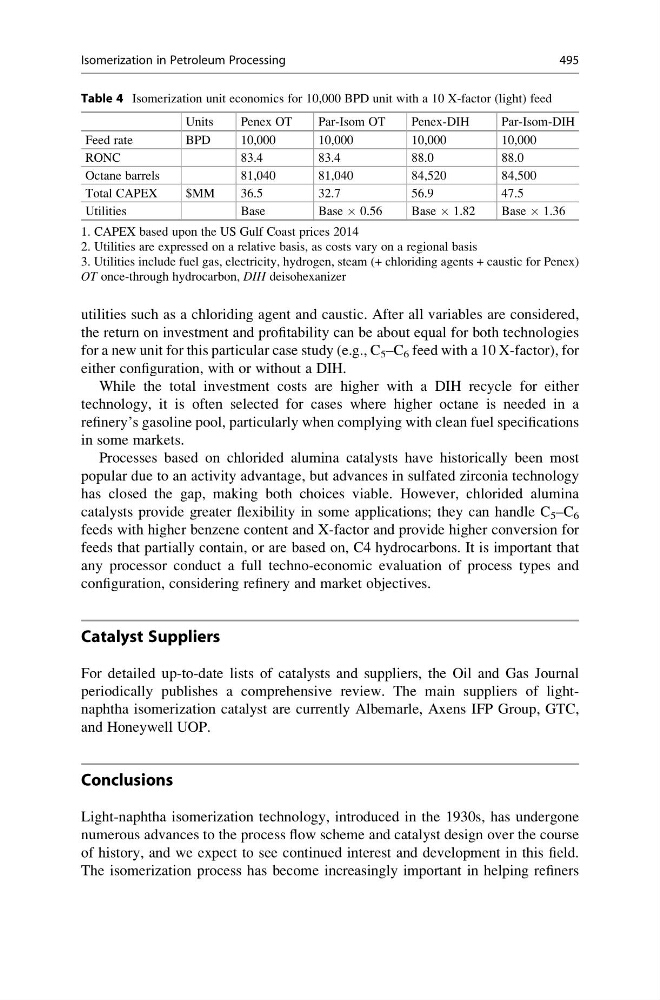
utilities such as a chloriding agent and caustic. After all variables are considered,
the return on investment and profitability can be about equal for both technologies
for a new unit for this particular case study (e.g., C 5 –C 6 feed with a 10 X-factor), for
either configuration, with or without a DIH.
While the total investment costs are higher with a DIH recycle for either
technology, it is often selected for cases where higher octane is needed in a
refinery’s gasoline pool, particularly when complying with clean fuel specifications
in some markets.
Processes based on chlorided alumina catalysts have historically been most
popular due to an activity advantage, but advances in sulfated zirconia technology
has closed the gap, making both choices viable. However, chlorided alumina
catalysts provide greater flexibility in some applications; they can handle C 5 –C 6
feeds with higher benzene content and X-factor and provide higher conversion for
feeds that partially contain, or are based on, C4 hydrocarbons. It is important that
any processor conduct a full techno-economic evaluation of process types and
configuration, considering refinery and market objectives.
Catalyst Suppliers
For detailed up-to-date lists of catalysts and suppliers, the Oil and Gas Journal
periodically publishes a comprehensive review. The main suppliers of lightnaphtha isomerization catalyst are currently Albemarle, Axens IFP Group, GTC,
and Honeywell UOP.
Conclusions
Light-naphtha isomerization technology, introduced in the 1930s, has undergone
numerous advances to the process flow scheme and catalyst design over the course
of history, and we expect to see continued interest and development in this field.
The isomerization process has become increasingly important in helping refiners
Table 4 Isomerization unit economics for 10,000 BPD unit with a 10 X-factor (light) feed
Units
Penex OT
Par-Isom OT
Penex-DIH
Par-Isom-DIH
Feed rate
BPD
10,000
10,000
10,000
10,000
RONC
83.4
83.4
88.0
88.0
Octane barrels
81,040
81,040
84,520
84,500
Total CAPEX
$MM
36.5
32.7
56.9
47.5
Utilities
Base
Base  0.56
Base  1.82
Base  1.36
1. CAPEX based upon the US Gulf Coast prices 2014
2. Utilities are expressed on a relative basis, as costs vary on a regional basis
3. Utilities include fuel gas, electricity, hydrogen, steam (+ chloriding agents + caustic for Penex)
OT once-through hydrocarbon, DIH deisohexanizer
Isomerization in Petroleum Processing
495
the return on investment and profitability can be about equal for both technologies
for a new unit for this particular case study (e.g., C 5 –C 6 feed with a 10 X-factor), for
either configuration, with or without a DIH.
While the total investment costs are higher with a DIH recycle for either
technology, it is often selected for cases where higher octane is needed in a
refinery’s gasoline pool, particularly when complying with clean fuel specifications
in some markets.
Processes based on chlorided alumina catalysts have historically been most
popular due to an activity advantage, but advances in sulfated zirconia technology
has closed the gap, making both choices viable. However, chlorided alumina
catalysts provide greater flexibility in some applications; they can handle C 5 –C 6
feeds with higher benzene content and X-factor and provide higher conversion for
feeds that partially contain, or are based on, C4 hydrocarbons. It is important that
any processor conduct a full techno-economic evaluation of process types and
configuration, considering refinery and market objectives.
Catalyst Suppliers
For detailed up-to-date lists of catalysts and suppliers, the Oil and Gas Journal
periodically publishes a comprehensive review. The main suppliers of lightnaphtha isomerization catalyst are currently Albemarle, Axens IFP Group, GTC,
and Honeywell UOP.
Conclusions
Light-naphtha isomerization technology, introduced in the 1930s, has undergone
numerous advances to the process flow scheme and catalyst design over the course
of history, and we expect to see continued interest and development in this field.
The isomerization process has become increasingly important in helping refiners
Table 4 Isomerization unit economics for 10,000 BPD unit with a 10 X-factor (light) feed
Units
Penex OT
Par-Isom OT
Penex-DIH
Par-Isom-DIH
Feed rate
BPD
10,000
10,000
10,000
10,000
RONC
83.4
83.4
88.0
88.0
Octane barrels
81,040
81,040
84,520
84,500
Total CAPEX
$MM
36.5
32.7
56.9
47.5
Utilities
Base
Base  0.56
Base  1.82
Base  1.36
1. CAPEX based upon the US Gulf Coast prices 2014
2. Utilities are expressed on a relative basis, as costs vary on a regional basis
3. Utilities include fuel gas, electricity, hydrogen, steam (+ chloriding agents + caustic for Penex)
OT once-through hydrocarbon, DIH deisohexanizer
Isomerization in Petroleum Processing
495