

with respect to octane number, yield, and octane barrels. A full techno-economic
assessment is required for final process selection, with one simple example
presented below as a case study.
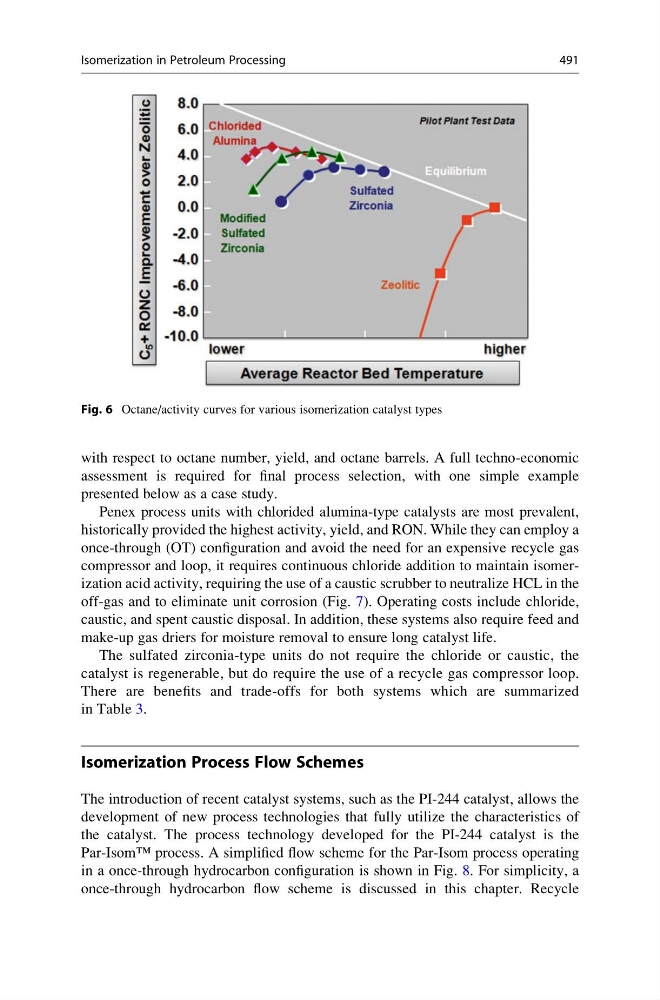
Penex process units with chlorided alumina-type catalysts are most prevalent,
historically provided the highest activity, yield, and RON. While they can employ a
once-through (OT) configuration and avoid the need for an expensive recycle gas
compressor and loop, it requires continuous chloride addition to maintain isomerization acid activity, requiring the use of a caustic scrubber to neutralize HCL in the
off-gas and to eliminate unit corrosion (Fig. 7). Operating costs include chloride,
caustic, and spent caustic disposal. In addition, these systems also require feed and
make-up gas driers for moisture removal to ensure long catalyst life.
The sulfated zirconia-type units do not require the chloride or caustic, the
catalyst is regenerable, but do require the use of a recycle gas compressor loop.
There are benefits and trade-offs for both systems which are summarized
in Table 3.
Isomerization Process Flow Schemes
The introduction of recent catalyst systems, such as the PI-244 catalyst, allows the
development of new process technologies that fully utilize the characteristics of
the catalyst. The process technology developed for the PI-244 catalyst is the
Par-Isom™ process. A simplified flow scheme for the Par-Isom process operating
in a once-through hydrocarbon configuration is shown in Fig. 8. For simplicity, a
once-through hydrocarbon flow scheme is discussed in this chapter. Recycle
Fig. 6 Octane/activity curves for various isomerization catalyst types
Isomerization in Petroleum Processing
491
assessment is required for final process selection, with one simple example
presented below as a case study.
Penex process units with chlorided alumina-type catalysts are most prevalent,
historically provided the highest activity, yield, and RON. While they can employ a
once-through (OT) configuration and avoid the need for an expensive recycle gas
compressor and loop, it requires continuous chloride addition to maintain isomerization acid activity, requiring the use of a caustic scrubber to neutralize HCL in the
off-gas and to eliminate unit corrosion (Fig. 7). Operating costs include chloride,
caustic, and spent caustic disposal. In addition, these systems also require feed and
make-up gas driers for moisture removal to ensure long catalyst life.
The sulfated zirconia-type units do not require the chloride or caustic, the
catalyst is regenerable, but do require the use of a recycle gas compressor loop.
There are benefits and trade-offs for both systems which are summarized
in Table 3.
Isomerization Process Flow Schemes
The introduction of recent catalyst systems, such as the PI-244 catalyst, allows the
development of new process technologies that fully utilize the characteristics of
the catalyst. The process technology developed for the PI-244 catalyst is the
Par-Isom™ process. A simplified flow scheme for the Par-Isom process operating
in a once-through hydrocarbon configuration is shown in Fig. 8. For simplicity, a
once-through hydrocarbon flow scheme is discussed in this chapter. Recycle
Fig. 6 Octane/activity curves for various isomerization catalyst types
Isomerization in Petroleum Processing
491