

additives such as ethanol, used to lower emissions via oxygenate addition, boost
octane, and consume a “biofuel” source, which is typically produced from corn and
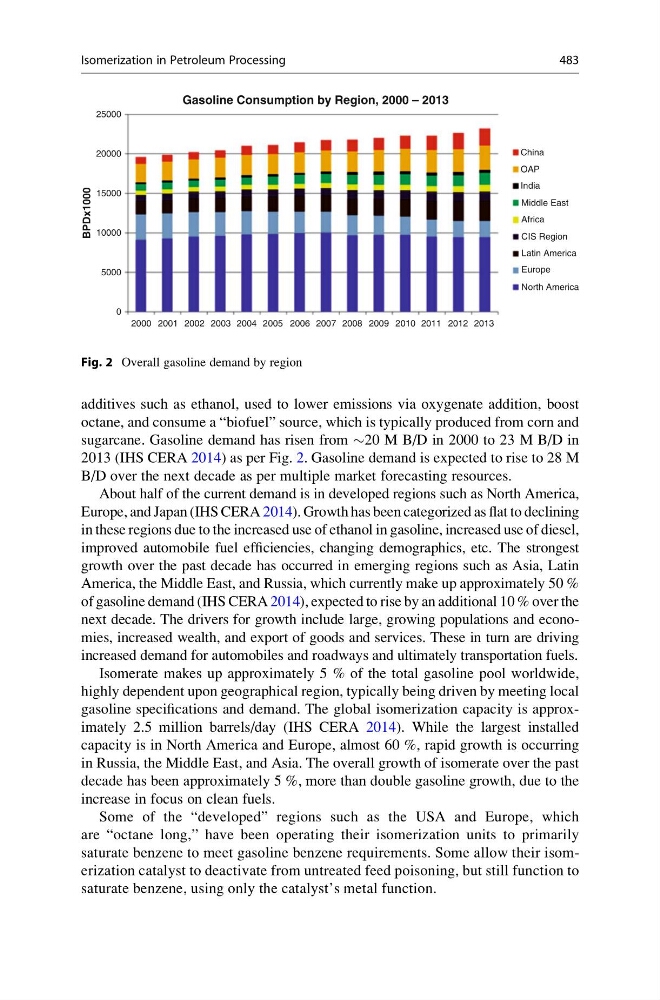
sugarcane. Gasoline demand has risen from $20 M B/D in 2000 to 23 M B/D in
2013 (IHS CERA 2014) as per Fig. 2. Gasoline demand is expected to rise to 28 M
B/D over the next decade as per multiple market forecasting resources.
About half of the current demand is in developed regions such as North America,
Europe, and Japan (IHS CERA 2014). Growth has been categorized as flat to declining
in these regions due to the increased use of ethanol in gasoline, increased use of diesel,
improved automobile fuel efficiencies, changing demographics, etc. The strongest
growth over the past decade has occurred in emerging regions such as Asia, Latin
America, the Middle East, and Russia, which currently make up approximately 50 %
of gasoline demand (IHS CERA 2014), expected to rise by an additional 10 % over the
next decade. The drivers for growth include large, growing populations and economies, increased wealth, and export of goods and services. These in turn are driving
increased demand for automobiles and roadways and ultimately transportation fuels.
Isomerate makes up approximately 5 % of the total gasoline pool worldwide,
highly dependent upon geographical region, typically being driven by meeting local
gasoline specifications and demand. The global isomerization capacity is approximately 2.5 million barrels/day (IHS CERA 2014). While the largest installed
capacity is in North America and Europe, almost 60 %, rapid growth is occurring
in Russia, the Middle East, and Asia. The overall growth of isomerate over the past
decade has been approximately 5 %, more than double gasoline growth, due to the
increase in focus on clean fuels.
Some of the “developed” regions such as the USA and Europe, which
are “octane long,” have been operating their isomerization units to primarily
saturate benzene to meet gasoline benzene requirements. Some allow their isomerization catalyst to deactivate from untreated feed poisoning, but still function to
saturate benzene, using only the catalyst’s metal function.
BPDx1000
25000
20000
15000
10000
5000
0
2000 2001 2002 2003 2004 2005 2006 2007 2008 2009 2010 2011 2012 2013
China
OAP
India
Middle East
Africa
CIS Region
Latin America
Europe
North America
Gasoline Consumption by Region, 2000 – 2013
Fig. 2 Overall gasoline demand by region
Isomerization in Petroleum Processing
483
octane, and consume a “biofuel” source, which is typically produced from corn and
sugarcane. Gasoline demand has risen from $20 M B/D in 2000 to 23 M B/D in
2013 (IHS CERA 2014) as per Fig. 2. Gasoline demand is expected to rise to 28 M
B/D over the next decade as per multiple market forecasting resources.
About half of the current demand is in developed regions such as North America,
Europe, and Japan (IHS CERA 2014). Growth has been categorized as flat to declining
in these regions due to the increased use of ethanol in gasoline, increased use of diesel,
improved automobile fuel efficiencies, changing demographics, etc. The strongest
growth over the past decade has occurred in emerging regions such as Asia, Latin
America, the Middle East, and Russia, which currently make up approximately 50 %
of gasoline demand (IHS CERA 2014), expected to rise by an additional 10 % over the
next decade. The drivers for growth include large, growing populations and economies, increased wealth, and export of goods and services. These in turn are driving
increased demand for automobiles and roadways and ultimately transportation fuels.
Isomerate makes up approximately 5 % of the total gasoline pool worldwide,
highly dependent upon geographical region, typically being driven by meeting local
gasoline specifications and demand. The global isomerization capacity is approximately 2.5 million barrels/day (IHS CERA 2014). While the largest installed
capacity is in North America and Europe, almost 60 %, rapid growth is occurring
in Russia, the Middle East, and Asia. The overall growth of isomerate over the past
decade has been approximately 5 %, more than double gasoline growth, due to the
increase in focus on clean fuels.
Some of the “developed” regions such as the USA and Europe, which
are “octane long,” have been operating their isomerization units to primarily
saturate benzene to meet gasoline benzene requirements. Some allow their isomerization catalyst to deactivate from untreated feed poisoning, but still function to
saturate benzene, using only the catalyst’s metal function.
BPDx1000
25000
20000
15000
10000
5000
0
2000 2001 2002 2003 2004 2005 2006 2007 2008 2009 2010 2011 2012 2013
China
OAP
India
Middle East
Africa
CIS Region
Latin America
Europe
North America
Gasoline Consumption by Region, 2000 – 2013
Fig. 2 Overall gasoline demand by region
Isomerization in Petroleum Processing
483