

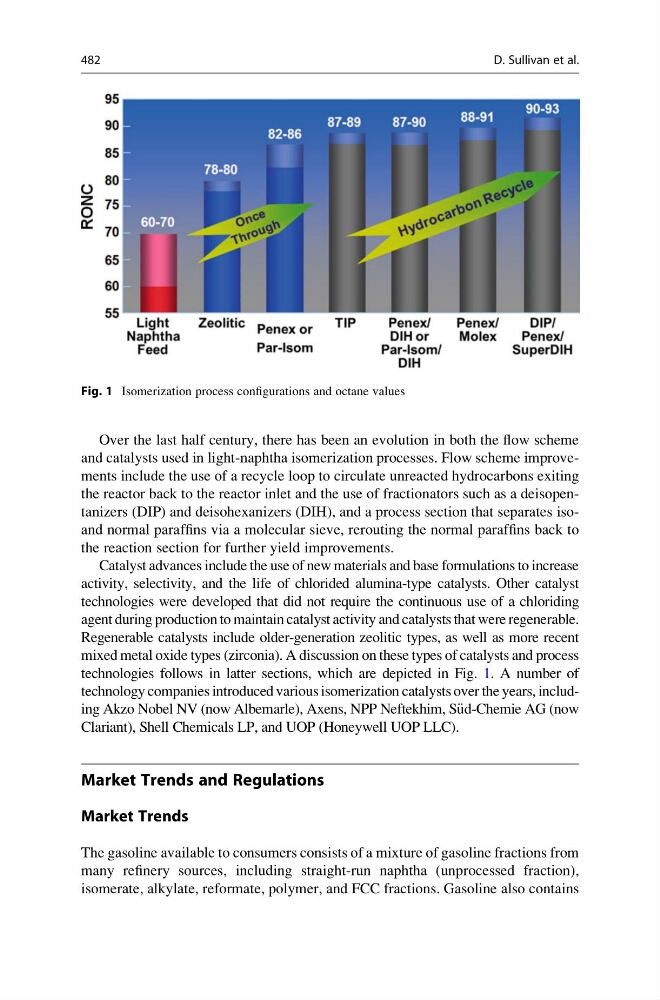
Over the last half century, there has been an evolution in both the flow scheme
and catalysts used in light-naphtha isomerization processes. Flow scheme improvements include the use of a recycle loop to circulate unreacted hydrocarbons exiting
the reactor back to the reactor inlet and the use of fractionators such as a deisopentanizers (DIP) and deisohexanizers (DIH), and a process section that separates isoand normal paraffins via a molecular sieve, rerouting the normal paraffins back to
the reaction section for further yield improvements.
Catalyst advances include the use of new materials and base formulations to increase
activity, selectivity, and the life of chlorided alumina-type catalysts. Other catalyst
technologies were developed that did not require the continuous use of a chloriding
agent during production to maintain catalyst activity and catalysts that were regenerable.
Regenerable catalysts include older-generation zeolitic types, as well as more recent
mixed metal oxide types (zirconia). A discussion on these types of catalysts and process
technologies follows in latter sections, which are depicted in Fig. 1. A number of
technology companies introduced various isomerization catalysts over the years, including Akzo Nobel NV (now Albemarle), Axens, NPP Neftekhim, S€ ud-Chemie AG (now
Clariant), Shell Chemicals LP, and UOP (Honeywell UOP LLC).
Market Trends and Regulations
Market Trends
The gasoline available to consumers consists of a mixture of gasoline fractions from
many refinery sources, including straight-run naphtha (unprocessed fraction),
isomerate, alkylate, reformate, polymer, and FCC fractions. Gasoline also contains
Fig. 1 Isomerization process configurations and octane values
482
D. Sullivan et al.
and catalysts used in light-naphtha isomerization processes. Flow scheme improvements include the use of a recycle loop to circulate unreacted hydrocarbons exiting
the reactor back to the reactor inlet and the use of fractionators such as a deisopentanizers (DIP) and deisohexanizers (DIH), and a process section that separates isoand normal paraffins via a molecular sieve, rerouting the normal paraffins back to
the reaction section for further yield improvements.
Catalyst advances include the use of new materials and base formulations to increase
activity, selectivity, and the life of chlorided alumina-type catalysts. Other catalyst
technologies were developed that did not require the continuous use of a chloriding
agent during production to maintain catalyst activity and catalysts that were regenerable.
Regenerable catalysts include older-generation zeolitic types, as well as more recent
mixed metal oxide types (zirconia). A discussion on these types of catalysts and process
technologies follows in latter sections, which are depicted in Fig. 1. A number of
technology companies introduced various isomerization catalysts over the years, including Akzo Nobel NV (now Albemarle), Axens, NPP Neftekhim, S€ ud-Chemie AG (now
Clariant), Shell Chemicals LP, and UOP (Honeywell UOP LLC).
Market Trends and Regulations
Market Trends
The gasoline available to consumers consists of a mixture of gasoline fractions from
many refinery sources, including straight-run naphtha (unprocessed fraction),
isomerate, alkylate, reformate, polymer, and FCC fractions. Gasoline also contains
Fig. 1 Isomerization process configurations and octane values
482
D. Sullivan et al.