

Petrochemical Operations
Because this chapter is confined to olefin condensation, mostly for motor fuel
applications, heptenes and nonenes will be discussed only briefly.
Petrochemical applications of catalytic olefin condensation center on the production of heptenes, nonenes, and dodecene (or propylene tetramer). These were
initially recovered by fractionation from polymer gasoline, but modern units are
specifically designed and operated to maximize the yield of the desired olefin
fractions. The by-products are still blended into the gasoline pool.
Heptenes and nonenes are the main products used for the production of octyl and
decyl alcohols via the “oxo” or hydroformylation process. Both these alcohols find end
use as esters in plasticizer applications, principally for PVC. Dodecene at one time was
a major product for the manufacture of dodecylbenzene sulfonates as active detergent
ingredients; however, their relatively poor biodegradability led to the discontinuance
of this operation. Dodecenes are still used in the production of tridecyl alcohols via the
oxo process. Some nonenes are also used in the production of nonylphenols.
Heptenes
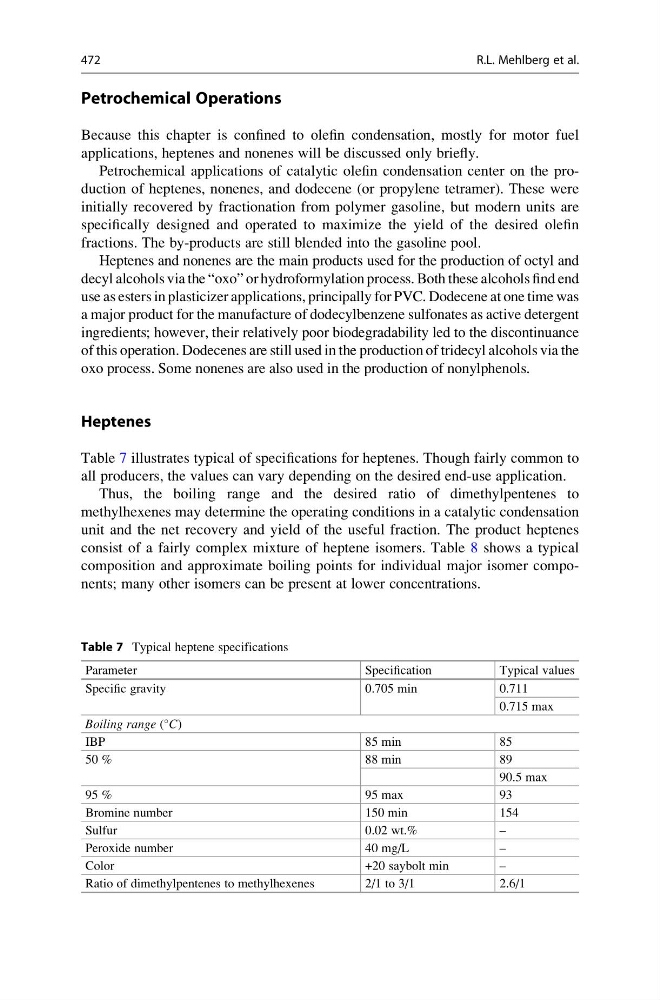
Table 7 illustrates typical of specifications for heptenes. Though fairly common to
all producers, the values can vary depending on the desired end-use application.
Thus, the boiling range and the desired ratio of dimethylpentenes to
methylhexenes may determine the operating conditions in a catalytic condensation
unit and the net recovery and yield of the useful fraction. The product heptenes
consist of a fairly complex mixture of heptene isomers. Table 8 shows a typical
composition and approximate boiling points for individual major isomer components; many other isomers can be present at lower concentrations.
Table 7 Typical heptene specifications
Parameter
Specification
Typical values
Specific gravity
0.705 min
0.711
0.715 max
Boiling range (
C)
IBP
85 min
85
50 %
88 min
89
90.5 max
95 %
95 max
93
Bromine number
150 min
154
Sulfur
0.02 wt.%
–
Peroxide number
40 mg/L
–
Color
+20 saybolt min
–
Ratio of dimethylpentenes to methylhexenes
2/1 to 3/1
2.6/1
472
R.L. Mehlberg et al.
Because this chapter is confined to olefin condensation, mostly for motor fuel
applications, heptenes and nonenes will be discussed only briefly.
Petrochemical applications of catalytic olefin condensation center on the production of heptenes, nonenes, and dodecene (or propylene tetramer). These were
initially recovered by fractionation from polymer gasoline, but modern units are
specifically designed and operated to maximize the yield of the desired olefin
fractions. The by-products are still blended into the gasoline pool.
Heptenes and nonenes are the main products used for the production of octyl and
decyl alcohols via the “oxo” or hydroformylation process. Both these alcohols find end
use as esters in plasticizer applications, principally for PVC. Dodecene at one time was
a major product for the manufacture of dodecylbenzene sulfonates as active detergent
ingredients; however, their relatively poor biodegradability led to the discontinuance
of this operation. Dodecenes are still used in the production of tridecyl alcohols via the
oxo process. Some nonenes are also used in the production of nonylphenols.
Heptenes
Table 7 illustrates typical of specifications for heptenes. Though fairly common to
all producers, the values can vary depending on the desired end-use application.
Thus, the boiling range and the desired ratio of dimethylpentenes to
methylhexenes may determine the operating conditions in a catalytic condensation
unit and the net recovery and yield of the useful fraction. The product heptenes
consist of a fairly complex mixture of heptene isomers. Table 8 shows a typical
composition and approximate boiling points for individual major isomer components; many other isomers can be present at lower concentrations.
Table 7 Typical heptene specifications
Parameter
Specification
Typical values
Specific gravity
0.705 min
0.711
0.715 max
Boiling range (
C)
IBP
85 min
85
50 %
88 min
89
90.5 max
95 %
95 max
93
Bromine number
150 min
154
Sulfur
0.02 wt.%
–
Peroxide number
40 mg/L
–
Color
+20 saybolt min
–
Ratio of dimethylpentenes to methylhexenes
2/1 to 3/1
2.6/1
472
R.L. Mehlberg et al.