

and C 12 fractions and has a very flat boiling range. The total product octanes were
99 RON and 82 MON before and 98 RON and 93 MON after hydrogenation. The C 8
fraction, obtained by fractionation, was 97 RON and 82 MON before and 99 RON
and 93 MON after hydrogenation. The À1 to +2 change in RON with saturation of
these highly branched olefins is very atypical of olefin saturation. As expected, the
specific gravity of the paraffinic products of hydrogenation is slightly lower than the
gravity of the olefinic material, but the boiling range remains virtually unchanged.
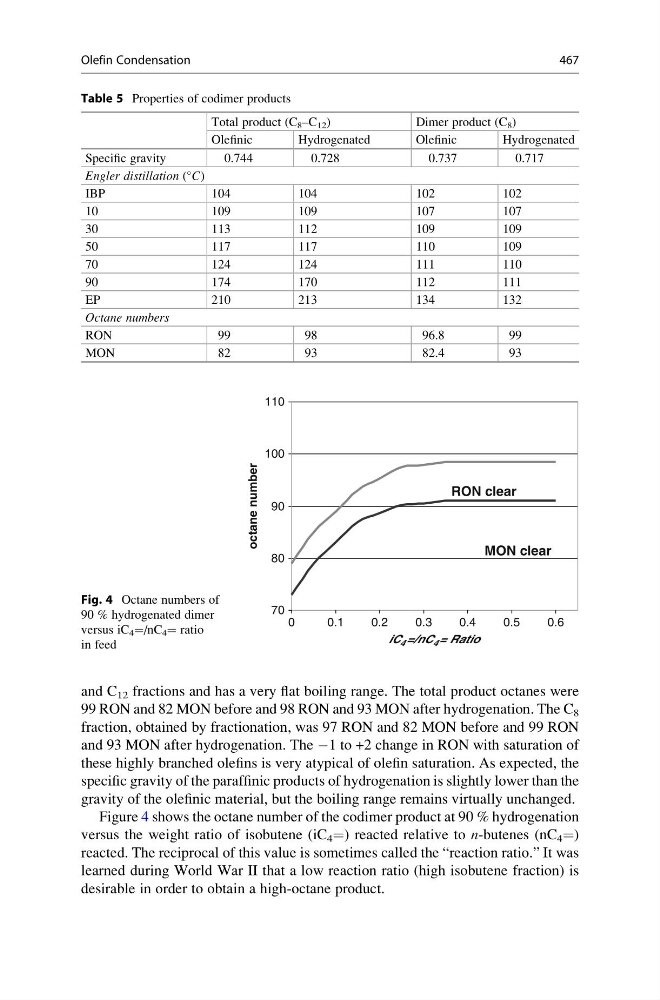
Figure 4 shows the octane number of the codimer product at 90 % hydrogenation
versus the weight ratio of isobutene (iC 4 =) reacted relative to n-butenes (nC 4 =)
reacted. The reciprocal of this value is sometimes called the “reaction ratio.” It was
learned during World War II that a low reaction ratio (high isobutene fraction) is
desirable in order to obtain a high-octane product.
Table 5 Properties of codimer products
Total product (C 8 –C 12 )
Dimer product (C 8 )
Olefinic
Hydrogenated
Olefinic
Hydrogenated
Specific gravity
0.744
0.728
0.737
0.717
Engler distillation (
C)
IBP
104
104
102
102
10
109
109
107
107
30
113
112
109
109
50
117
117
110
109
70
124
124
111
110
90
174
170
112
111
EP
210
213
134
132
Octane numbers
RON
99
98
96.8
99
MON
82
93
82.4
93
octane number
110
100
RON clear
90
MON clear
80
70
0
iC 4 =/nC 4 = Ratio
0.1
0.2
0.3
0.4
0.5
0.6
Fig. 4 Octane numbers of
90 % hydrogenated dimer
versus iC 4 =/nC 4 = ratio
in feed
Olefin Condensation
467
99 RON and 82 MON before and 98 RON and 93 MON after hydrogenation. The C 8
fraction, obtained by fractionation, was 97 RON and 82 MON before and 99 RON
and 93 MON after hydrogenation. The À1 to +2 change in RON with saturation of
these highly branched olefins is very atypical of olefin saturation. As expected, the
specific gravity of the paraffinic products of hydrogenation is slightly lower than the
gravity of the olefinic material, but the boiling range remains virtually unchanged.
Figure 4 shows the octane number of the codimer product at 90 % hydrogenation
versus the weight ratio of isobutene (iC 4 =) reacted relative to n-butenes (nC 4 =)
reacted. The reciprocal of this value is sometimes called the “reaction ratio.” It was
learned during World War II that a low reaction ratio (high isobutene fraction) is
desirable in order to obtain a high-octane product.
Table 5 Properties of codimer products
Total product (C 8 –C 12 )
Dimer product (C 8 )
Olefinic
Hydrogenated
Olefinic
Hydrogenated
Specific gravity
0.744
0.728
0.737
0.717
Engler distillation (
C)
IBP
104
104
102
102
10
109
109
107
107
30
113
112
109
109
50
117
117
110
109
70
124
124
111
110
90
174
170
112
111
EP
210
213
134
132
Octane numbers
RON
99
98
96.8
99
MON
82
93
82.4
93
octane number
110
100
RON clear
90
MON clear
80
70
0
iC 4 =/nC 4 = Ratio
0.1
0.2
0.3
0.4
0.5
0.6
Fig. 4 Octane numbers of
90 % hydrogenated dimer
versus iC 4 =/nC 4 = ratio
in feed
Olefin Condensation
467