

and either a “blending octane” or a blending formula that depends upon the
composition is used. Thus, the octane of the blend may be the same, lower, or
higher, depending on the synergism among the various components.
Table 4 shows the blending octanes of various polymer gasoline fractions when
blended into a base stock of approximately 60 % FCC gasoline and 40 % reformate,
having clear octanes of 93 RON and 80.8 MON. Blend stocks consisting of the various
polymer gasolines were added at 10 or 20 vol.% levels, and the blending octanes were
back calculated from the octanes measured in the resulting mixtures. It must be noted,
however, that small errors in the determination of the octane values can lead to
significant fluctuations in the estimation of the blending octanes.
RON of the hydrogenated product
100
90
80
70
60
50
40
−10 0
10 20 30 40 50 60 70 80 90 100
wt % propylene reacted relative to total gasoline
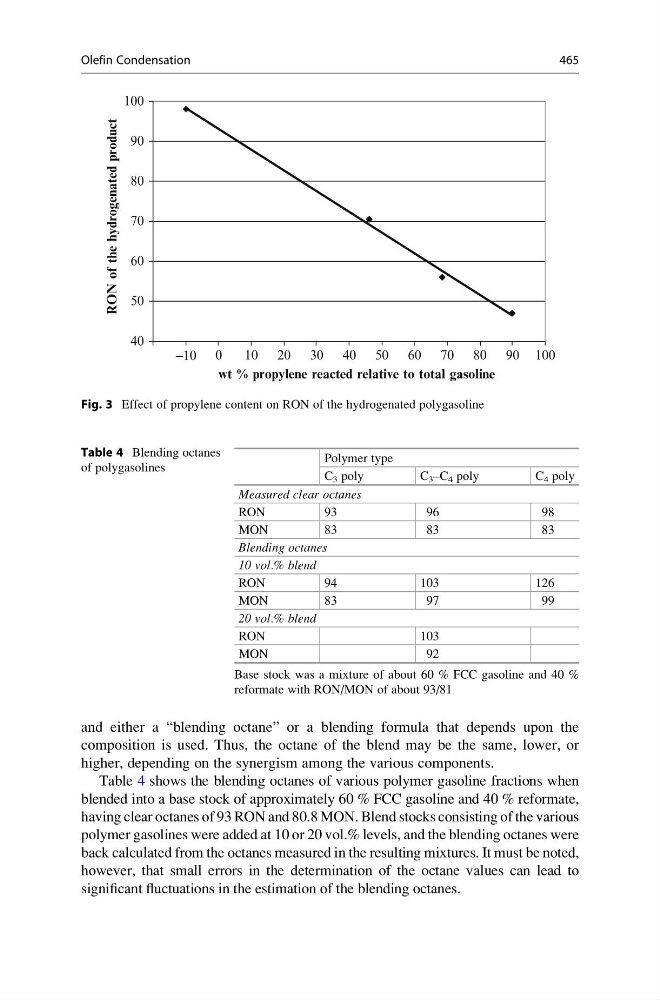
Fig. 3 Effect of propylene content on RON of the hydrogenated polygasoline
Table 4 Blending octanes
of polygasolines
Polymer type
C 3 poly
C 3 –C 4 poly
C 4 poly
Measured clear octanes
RON
93
96
98
MON
83
83
83
Blending octanes
10 vol.% blend
RON
94
103
126
MON
83
97
99
20 vol.% blend
RON
103
MON
92
Base stock was a mixture of about 60 % FCC gasoline and 40 %
reformate with RON/MON of about 93/81
Olefin Condensation
465
composition is used. Thus, the octane of the blend may be the same, lower, or
higher, depending on the synergism among the various components.
Table 4 shows the blending octanes of various polymer gasoline fractions when
blended into a base stock of approximately 60 % FCC gasoline and 40 % reformate,
having clear octanes of 93 RON and 80.8 MON. Blend stocks consisting of the various
polymer gasolines were added at 10 or 20 vol.% levels, and the blending octanes were
back calculated from the octanes measured in the resulting mixtures. It must be noted,
however, that small errors in the determination of the octane values can lead to
significant fluctuations in the estimation of the blending octanes.
RON of the hydrogenated product
100
90
80
70
60
50
40
−10 0
10 20 30 40 50 60 70 80 90 100
wt % propylene reacted relative to total gasoline
Fig. 3 Effect of propylene content on RON of the hydrogenated polygasoline
Table 4 Blending octanes
of polygasolines
Polymer type
C 3 poly
C 3 –C 4 poly
C 4 poly
Measured clear octanes
RON
93
96
98
MON
83
83
83
Blending octanes
10 vol.% blend
RON
94
103
126
MON
83
97
99
20 vol.% blend
RON
103
MON
92
Base stock was a mixture of about 60 % FCC gasoline and 40 %
reformate with RON/MON of about 93/81
Olefin Condensation
465