

produce a tight emulsion. After the final reaction zone, the emulsion is allowed to
settle. The settler acid phase is pumped back to the lead zone, and the hydrocarbon
phase effluent is pumped to effluent treating.
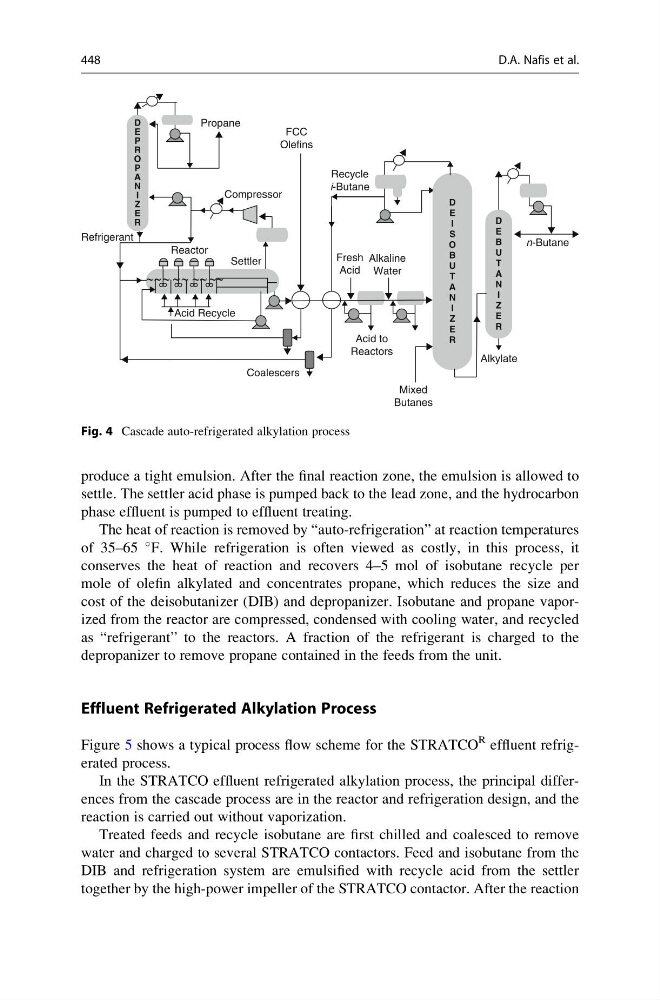
The heat of reaction is removed by “auto-refrigeration” at reaction temperatures
of 35–65
F. While refrigeration is often viewed as costly, in this process, it
conserves the heat of reaction and recovers 4–5 mol of isobutane recycle per
mole of olefin alkylated and concentrates propane, which reduces the size and
cost of the deisobutanizer (DIB) and depropanizer. Isobutane and propane vaporized from the reactor are compressed, condensed with cooling water, and recycled
as “refrigerant” to the reactors. A fraction of the refrigerant is charged to the
depropanizer to remove propane contained in the feeds from the unit.
Effluent Refrigerated Alkylation Process
Figure 5 shows a typical process flow scheme for the STRATCO
R effluent refrigerated process.
In the STRATCO effluent refrigerated alkylation process, the principal differences from the cascade process are in the reactor and refrigeration design, and the
reaction is carried out without vaporization.
Treated feeds and recycle isobutane are first chilled and coalesced to remove
water and charged to several STRATCO contactors. Feed and isobutane from the
DIB and refrigeration system are emulsified with recycle acid from the settler
together by the high-power impeller of the STRATCO contactor. After the reaction
Propane
Compressor
Refrigerant
Reactor
Settler
Acid Recycle
Coalescers
Acid to
Reactors
Alkaline
Water
n-Butane
Fresh
Acid
Mixed
Butanes
Alkylate
D
E
B
U
T
A
N
I
Z
E
R
D
E
P
R
O
P
A
N
I
Z
E
R
D
E
I
S
O
B
U
T
A
N
I
Z
E
R
FCC
Olefins
Recycle
i-Butane
Fig. 4 Cascade auto-refrigerated alkylation process
448
D.A. Nafis et al.
settle. The settler acid phase is pumped back to the lead zone, and the hydrocarbon
phase effluent is pumped to effluent treating.
The heat of reaction is removed by “auto-refrigeration” at reaction temperatures
of 35–65
F. While refrigeration is often viewed as costly, in this process, it
conserves the heat of reaction and recovers 4–5 mol of isobutane recycle per
mole of olefin alkylated and concentrates propane, which reduces the size and
cost of the deisobutanizer (DIB) and depropanizer. Isobutane and propane vaporized from the reactor are compressed, condensed with cooling water, and recycled
as “refrigerant” to the reactors. A fraction of the refrigerant is charged to the
depropanizer to remove propane contained in the feeds from the unit.
Effluent Refrigerated Alkylation Process
Figure 5 shows a typical process flow scheme for the STRATCO
R effluent refrigerated process.
In the STRATCO effluent refrigerated alkylation process, the principal differences from the cascade process are in the reactor and refrigeration design, and the
reaction is carried out without vaporization.
Treated feeds and recycle isobutane are first chilled and coalesced to remove
water and charged to several STRATCO contactors. Feed and isobutane from the
DIB and refrigeration system are emulsified with recycle acid from the settler
together by the high-power impeller of the STRATCO contactor. After the reaction
Propane
Compressor
Refrigerant
Reactor
Settler
Acid Recycle
Coalescers
Acid to
Reactors
Alkaline
Water
n-Butane
Fresh
Acid
Mixed
Butanes
Alkylate
D
E
B
U
T
A
N
I
Z
E
R
D
E
P
R
O
P
A
N
I
Z
E
R
D
E
I
S
O
B
U
T
A
N
I
Z
E
R
FCC
Olefins
Recycle
i-Butane
Fig. 4 Cascade auto-refrigerated alkylation process
448
D.A. Nafis et al.