

modified HF, provides a passive means of leak mitigation, which requires no action
by operator personnel or equipment to be effective. Each system is compatible with
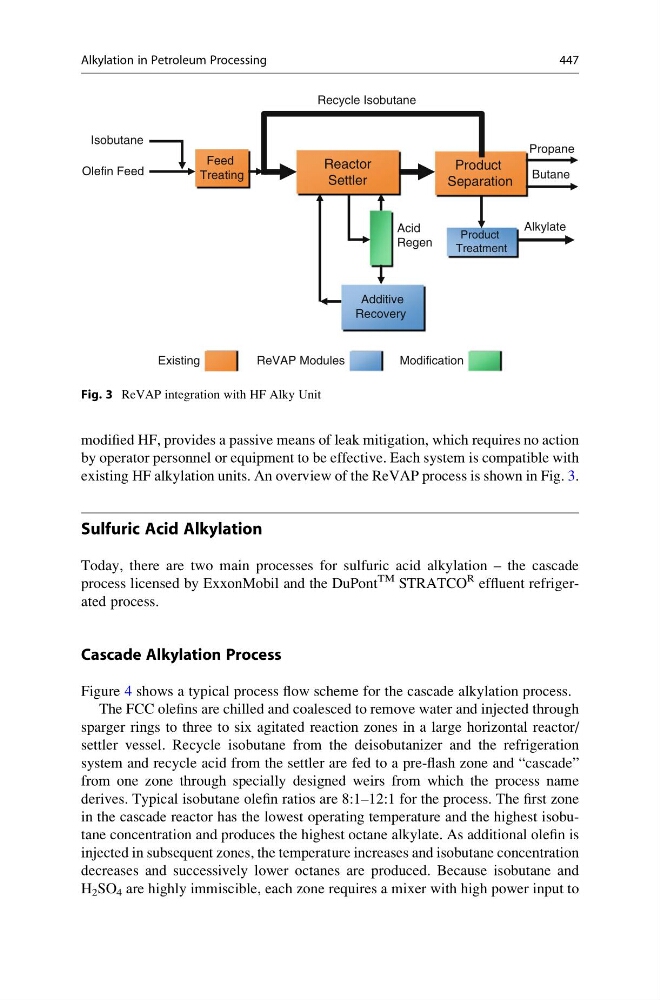
existing HF alkylation units. An overview of the ReVAP process is shown in Fig. 3.
Sulfuric Acid Alkylation
Today, there are two main processes for sulfuric acid alkylation – the cascade
process licensed by ExxonMobil and the DuPont
TM STRATCO
R effluent refrigerated process.
Cascade Alkylation Process
Figure 4 shows a typical process flow scheme for the cascade alkylation process.
The FCC olefins are chilled and coalesced to remove water and injected through
sparger rings to three to six agitated reaction zones in a large horizontal reactor/
settler vessel. Recycle isobutane from the deisobutanizer and the refrigeration
system and recycle acid from the settler are fed to a pre-flash zone and “cascade”
from one zone through specially designed weirs from which the process name
derives. Typical isobutane olefin ratios are 8:1–12:1 for the process. The first zone
in the cascade reactor has the lowest operating temperature and the highest isobutane concentration and produces the highest octane alkylate. As additional olefin is
injected in subsequent zones, the temperature increases and isobutane concentration
decreases and successively lower octanes are produced. Because isobutane and
H 2 SO 4 are highly immiscible, each zone requires a mixer with high power input to
Existing
ReVAP Modules
Modification
Alkylate
Feed
Treating
Olefin Feed
Isobutane
Reactor
Settler
Product
Separation
Acid
Regen
Additive
Recovery
Propane
Butane
Product
Treatment
Recycle Isobutane
Fig. 3 ReVAP integration with HF Alky Unit
Alkylation in Petroleum Processing
447
by operator personnel or equipment to be effective. Each system is compatible with
existing HF alkylation units. An overview of the ReVAP process is shown in Fig. 3.
Sulfuric Acid Alkylation
Today, there are two main processes for sulfuric acid alkylation – the cascade
process licensed by ExxonMobil and the DuPont
TM STRATCO
R effluent refrigerated process.
Cascade Alkylation Process
Figure 4 shows a typical process flow scheme for the cascade alkylation process.
The FCC olefins are chilled and coalesced to remove water and injected through
sparger rings to three to six agitated reaction zones in a large horizontal reactor/
settler vessel. Recycle isobutane from the deisobutanizer and the refrigeration
system and recycle acid from the settler are fed to a pre-flash zone and “cascade”
from one zone through specially designed weirs from which the process name
derives. Typical isobutane olefin ratios are 8:1–12:1 for the process. The first zone
in the cascade reactor has the lowest operating temperature and the highest isobutane concentration and produces the highest octane alkylate. As additional olefin is
injected in subsequent zones, the temperature increases and isobutane concentration
decreases and successively lower octanes are produced. Because isobutane and
H 2 SO 4 are highly immiscible, each zone requires a mixer with high power input to
Existing
ReVAP Modules
Modification
Alkylate
Feed
Treating
Olefin Feed
Isobutane
Reactor
Settler
Product
Separation
Acid
Regen
Additive
Recovery
Propane
Butane
Product
Treatment
Recycle Isobutane
Fig. 3 ReVAP integration with HF Alky Unit
Alkylation in Petroleum Processing
447