

alkylate critical to the production of quality environmental gasolines. Alkylate
typically makes up about 15 % of the gasoline blending pool but can reach as
much as 60 % of the low-sulfur reformulated premium pool. Following the phaseout of MTBE from gasoline in 2004 and mandates established in the Energy Policy
Act of 2005 and Energy Independence and Security Act of 2007, ethanol is blended
into most US gasoline at average levels of about 10 vol%. The low RVP of alkylate
is important for offsetting the high vapor pressure of the added ethanol while
maintaining high octane.
Licensors of commercially proven H 2 SO 4 alkylation processes are ExxonMobil
and DuPont
TM STRATCO
R . Following its acquisition of the Conoco Phillips HF
Alkylation technology in 2007, UOP LLC is now the sole licensor of motor fuel HF
Alkylation.
Process Chemistry
The reactions taking place in the alkylation reactor are many and relatively
complex, proceeding by a t-butyl carbenium ion chain mechanism (Jernigan
et al. 1965). The principal overall reactions are described below.
Primary Alkylation Reactions
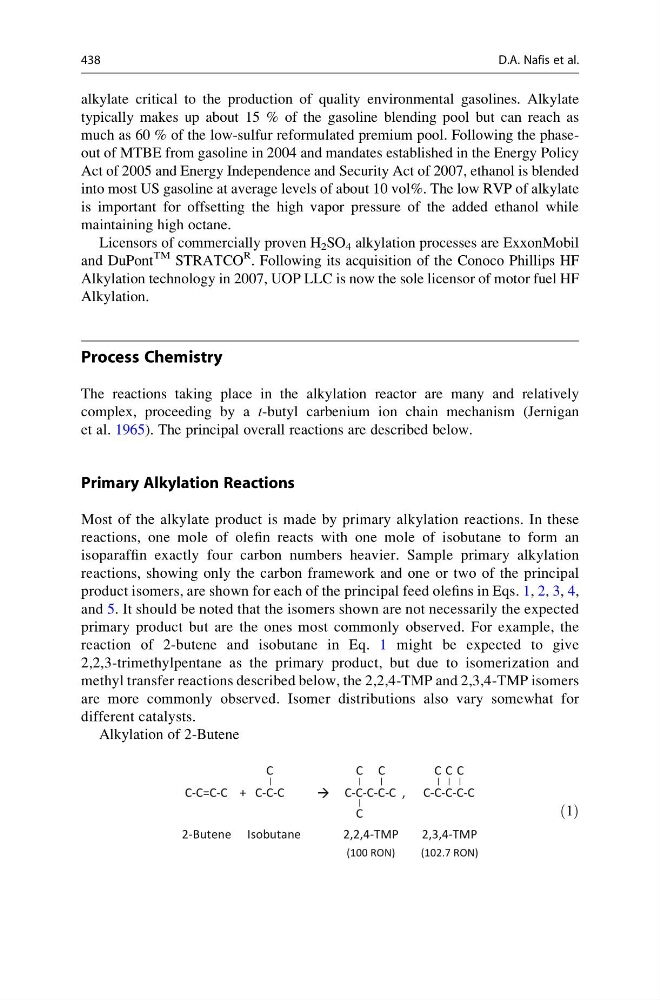
Most of the alkylate product is made by primary alkylation reactions. In these
reactions, one mole of olefin reacts with one mole of isobutane to form an
isoparaffin exactly four carbon numbers heavier. Sample primary alkylation
reactions, showing only the carbon framework and one or two of the principal
product isomers, are shown for each of the principal feed olefins in Eqs. 1, 2, 3, 4,
and 5. It should be noted that the isomers shown are not necessarily the expected
primary product but are the ones most commonly observed. For example, the
reaction of 2-butene and isobutane in Eq. 1 might be expected to give
2,2,3-trimethylpentane as the primary product, but due to isomerization and
methyl transfer reactions described below, the 2,2,4-TMP and 2,3,4-TMP isomers
are more commonly observed. Isomer distributions also vary somewhat for
different catalysts.
Alkylation of 2-Butene
C-C=C-C + C-C-C
|
C
2-Butene Isobutane
C-C-C-C-C , C-C-C-C-C
|
C
|
|
| | |
C C
C
2,2,4-TMP
(100 RON)
2,3,4-TMP
(102.7 RON)
C C
ð1Þ
438
D.A. Nafis et al.
typically makes up about 15 % of the gasoline blending pool but can reach as
much as 60 % of the low-sulfur reformulated premium pool. Following the phaseout of MTBE from gasoline in 2004 and mandates established in the Energy Policy
Act of 2005 and Energy Independence and Security Act of 2007, ethanol is blended
into most US gasoline at average levels of about 10 vol%. The low RVP of alkylate
is important for offsetting the high vapor pressure of the added ethanol while
maintaining high octane.
Licensors of commercially proven H 2 SO 4 alkylation processes are ExxonMobil
and DuPont
TM STRATCO
R . Following its acquisition of the Conoco Phillips HF
Alkylation technology in 2007, UOP LLC is now the sole licensor of motor fuel HF
Alkylation.
Process Chemistry
The reactions taking place in the alkylation reactor are many and relatively
complex, proceeding by a t-butyl carbenium ion chain mechanism (Jernigan
et al. 1965). The principal overall reactions are described below.
Primary Alkylation Reactions
Most of the alkylate product is made by primary alkylation reactions. In these
reactions, one mole of olefin reacts with one mole of isobutane to form an
isoparaffin exactly four carbon numbers heavier. Sample primary alkylation
reactions, showing only the carbon framework and one or two of the principal
product isomers, are shown for each of the principal feed olefins in Eqs. 1, 2, 3, 4,
and 5. It should be noted that the isomers shown are not necessarily the expected
primary product but are the ones most commonly observed. For example, the
reaction of 2-butene and isobutane in Eq. 1 might be expected to give
2,2,3-trimethylpentane as the primary product, but due to isomerization and
methyl transfer reactions described below, the 2,2,4-TMP and 2,3,4-TMP isomers
are more commonly observed. Isomer distributions also vary somewhat for
different catalysts.
Alkylation of 2-Butene
C-C=C-C + C-C-C
|
C
2-Butene Isobutane
C-C-C-C-C , C-C-C-C-C
|
C
|
|
| | |
C C
C
2,2,4-TMP
(100 RON)
2,3,4-TMP
(102.7 RON)
C C
ð1Þ
438
D.A. Nafis et al.