

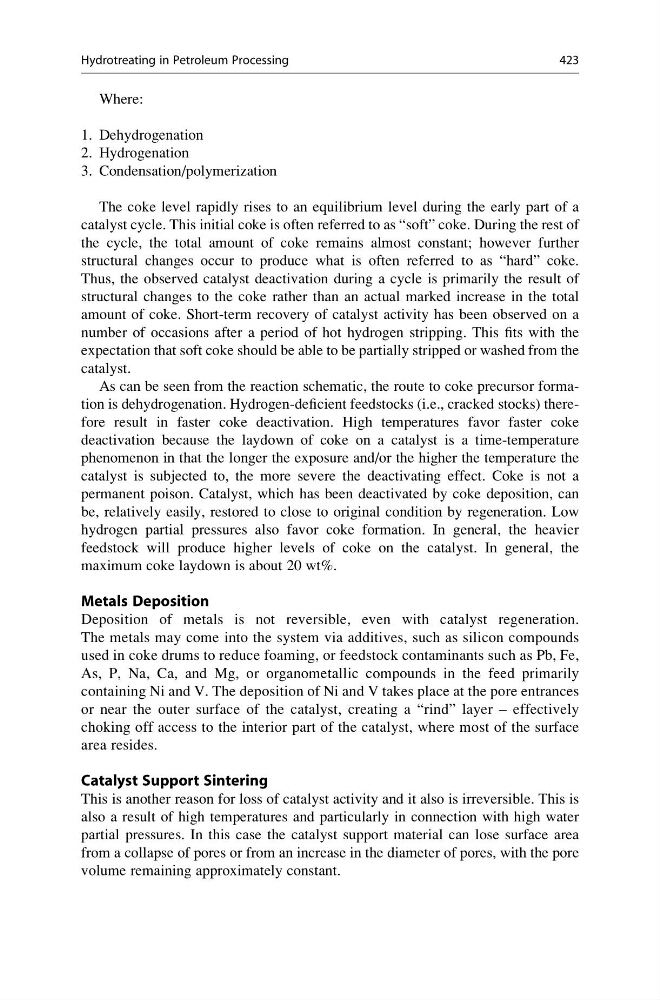
Where:
1. Dehydrogenation
2. Hydrogenation
3. Condensation/polymerization
The coke level rapidly rises to an equilibrium level during the early part of a
catalyst cycle. This initial coke is often referred to as “soft” coke. During the rest of
the cycle, the total amount of coke remains almost constant; however further
structural changes occur to produce what is often referred to as “hard” coke.
Thus, the observed catalyst deactivation during a cycle is primarily the result of
structural changes to the coke rather than an actual marked increase in the total
amount of coke. Short-term recovery of catalyst activity has been observed on a
number of occasions after a period of hot hydrogen stripping. This fits with the
expectation that soft coke should be able to be partially stripped or washed from the
catalyst.
As can be seen from the reaction schematic, the route to coke precursor formation is dehydrogenation. Hydrogen-deficient feedstocks (i.e., cracked stocks) therefore result in faster coke deactivation. High temperatures favor faster coke
deactivation because the laydown of coke on a catalyst is a time-temperature
phenomenon in that the longer the exposure and/or the higher the temperature the
catalyst is subjected to, the more severe the deactivating effect. Coke is not a
permanent poison. Catalyst, which has been deactivated by coke deposition, can
be, relatively easily, restored to close to original condition by regeneration. Low
hydrogen partial pressures also favor coke formation. In general, the heavier
feedstock will produce higher levels of coke on the catalyst. In general, the
maximum coke laydown is about 20 wt%.
Metals Deposition
Deposition of metals is not reversible, even with catalyst regeneration.
The metals may come into the system via additives, such as silicon compounds
used in coke drums to reduce foaming, or feedstock contaminants such as Pb, Fe,
As, P, Na, Ca, and Mg, or organometallic compounds in the feed primarily
containing Ni and V. The deposition of Ni and V takes place at the pore entrances
or near the outer surface of the catalyst, creating a “rind” layer – effectively
choking off access to the interior part of the catalyst, where most of the surface
area resides.
Catalyst Support Sintering
This is another reason for loss of catalyst activity and it also is irreversible. This is
also a result of high temperatures and particularly in connection with high water
partial pressures. In this case the catalyst support material can lose surface area
from a collapse of pores or from an increase in the diameter of pores, with the pore
volume remaining approximately constant.
Hydrotreating in Petroleum Processing
423
1. Dehydrogenation
2. Hydrogenation
3. Condensation/polymerization
The coke level rapidly rises to an equilibrium level during the early part of a
catalyst cycle. This initial coke is often referred to as “soft” coke. During the rest of
the cycle, the total amount of coke remains almost constant; however further
structural changes occur to produce what is often referred to as “hard” coke.
Thus, the observed catalyst deactivation during a cycle is primarily the result of
structural changes to the coke rather than an actual marked increase in the total
amount of coke. Short-term recovery of catalyst activity has been observed on a
number of occasions after a period of hot hydrogen stripping. This fits with the
expectation that soft coke should be able to be partially stripped or washed from the
catalyst.
As can be seen from the reaction schematic, the route to coke precursor formation is dehydrogenation. Hydrogen-deficient feedstocks (i.e., cracked stocks) therefore result in faster coke deactivation. High temperatures favor faster coke
deactivation because the laydown of coke on a catalyst is a time-temperature
phenomenon in that the longer the exposure and/or the higher the temperature the
catalyst is subjected to, the more severe the deactivating effect. Coke is not a
permanent poison. Catalyst, which has been deactivated by coke deposition, can
be, relatively easily, restored to close to original condition by regeneration. Low
hydrogen partial pressures also favor coke formation. In general, the heavier
feedstock will produce higher levels of coke on the catalyst. In general, the
maximum coke laydown is about 20 wt%.
Metals Deposition
Deposition of metals is not reversible, even with catalyst regeneration.
The metals may come into the system via additives, such as silicon compounds
used in coke drums to reduce foaming, or feedstock contaminants such as Pb, Fe,
As, P, Na, Ca, and Mg, or organometallic compounds in the feed primarily
containing Ni and V. The deposition of Ni and V takes place at the pore entrances
or near the outer surface of the catalyst, creating a “rind” layer – effectively
choking off access to the interior part of the catalyst, where most of the surface
area resides.
Catalyst Support Sintering
This is another reason for loss of catalyst activity and it also is irreversible. This is
also a result of high temperatures and particularly in connection with high water
partial pressures. In this case the catalyst support material can lose surface area
from a collapse of pores or from an increase in the diameter of pores, with the pore
volume remaining approximately constant.
Hydrotreating in Petroleum Processing
423