

sulfiding procedure in the industry is liquid phase with a sulfur-containing component
added to the feed (generally a form of DMDS or a polysulfide). It results in savings of
time when compared to either vapor phase or liquid phase without these agents. In
addition to the time savings, liquid phase sulfiding is desirable because the liquid
phase provides a heat sink for the exothermic sulfiding reactions which helps prevent
high catalyst temperatures and temperature excursions which could otherwise result
in sintering and metals reduction. The active phase in Type II hydrotreating catalysts,
orders of magnitude more active than Type I at start of run, is especially susceptible
to such damage during the sulfiding process. Another advantage of liquid phase over
gas phase sulfiding is that by having all the catalyst particles wet from the very
beginning, there is very little chance of catalyst bed channeling which can occur if the
catalyst particles are allowed to dry out. The in situ sulfiding occurs at temperatures
between 450
F and 650
F (230–345
C) regardless of the method used. Some
catalyst manufacturers recommend that the sulfiding be conducted at full operating
pressure, while others prefer it be done at pressures lower than the normal operating
pressure. It is also very typically recommended that cracked feedstocks should be
introduced very gradually, over a period of 3–7 days. Cracked feedstocks are
composed of relatively more olefins and aromatics, and so introducing these during
the start of run period would lead to excessive heat release, leading to catalyst damage
via sintering of the active phase.
In the case of ex situ presulfurization of the catalyst, sulfur compounds are
loaded onto the catalyst. The activation occurs when the catalyst, which has been
loaded in the reactor, is heated up in the presence of hydrogen and the sulfur
compounds decompose to H 2 S. During this period, the H2S scrubber is off-line
so that the H2S can accumulate in the recycle gas circuit.
Catalyst Deactivation, Regeneration, and Rejuvenation
Catalyst deactivation is the gradual loss of the catalyst’s ability to produce the
desired specification product unless reactor temperatures are increased (or feed rate
is decreased). The catalyst activity determination is shown under the “Catalysts”
section of this chapter. Typically, as the run progresses, the catalyst loses activity.
Catalysts will lose activity in several ways described below.
Coke Deposition
Coke is the term used to describe the formation of hydrogen-deficient carbonaceous
materials, most particularly on the catalyst surface. Coke is generally formed by
thermal condensation, catalytic dehydrogenation, and polymerization reactions.
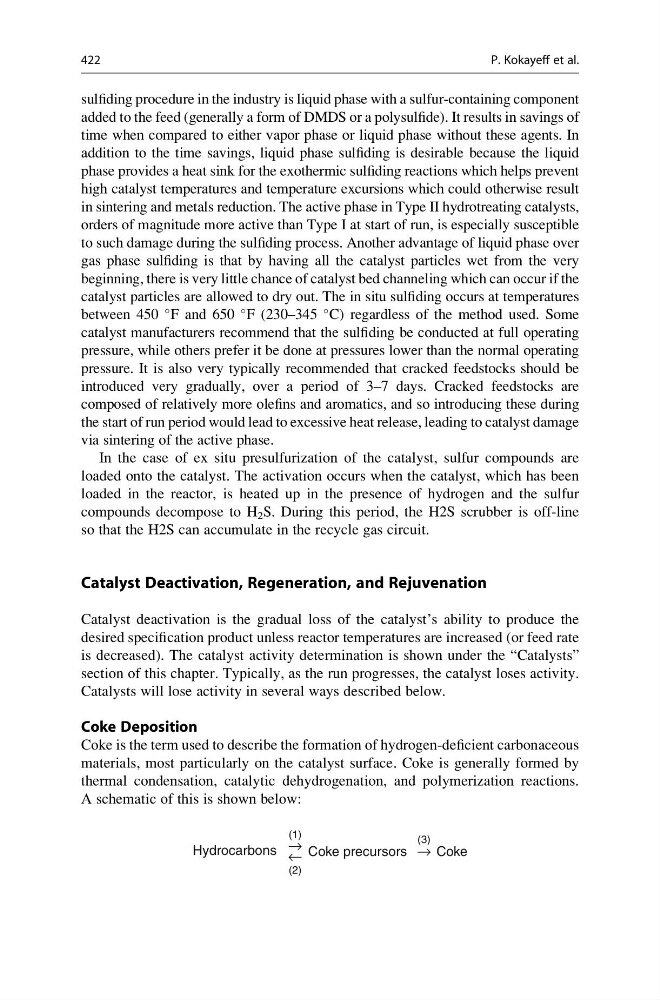
A schematic of this is shown below:
Hydrocarbons
Coke precursors
→
→
←
(1)
(2)
(3)
Coke
422
P. Kokayeff et al.
added to the feed (generally a form of DMDS or a polysulfide). It results in savings of
time when compared to either vapor phase or liquid phase without these agents. In
addition to the time savings, liquid phase sulfiding is desirable because the liquid
phase provides a heat sink for the exothermic sulfiding reactions which helps prevent
high catalyst temperatures and temperature excursions which could otherwise result
in sintering and metals reduction. The active phase in Type II hydrotreating catalysts,
orders of magnitude more active than Type I at start of run, is especially susceptible
to such damage during the sulfiding process. Another advantage of liquid phase over
gas phase sulfiding is that by having all the catalyst particles wet from the very
beginning, there is very little chance of catalyst bed channeling which can occur if the
catalyst particles are allowed to dry out. The in situ sulfiding occurs at temperatures
between 450
F and 650
F (230–345
C) regardless of the method used. Some
catalyst manufacturers recommend that the sulfiding be conducted at full operating
pressure, while others prefer it be done at pressures lower than the normal operating
pressure. It is also very typically recommended that cracked feedstocks should be
introduced very gradually, over a period of 3–7 days. Cracked feedstocks are
composed of relatively more olefins and aromatics, and so introducing these during
the start of run period would lead to excessive heat release, leading to catalyst damage
via sintering of the active phase.
In the case of ex situ presulfurization of the catalyst, sulfur compounds are
loaded onto the catalyst. The activation occurs when the catalyst, which has been
loaded in the reactor, is heated up in the presence of hydrogen and the sulfur
compounds decompose to H 2 S. During this period, the H2S scrubber is off-line
so that the H2S can accumulate in the recycle gas circuit.
Catalyst Deactivation, Regeneration, and Rejuvenation
Catalyst deactivation is the gradual loss of the catalyst’s ability to produce the
desired specification product unless reactor temperatures are increased (or feed rate
is decreased). The catalyst activity determination is shown under the “Catalysts”
section of this chapter. Typically, as the run progresses, the catalyst loses activity.
Catalysts will lose activity in several ways described below.
Coke Deposition
Coke is the term used to describe the formation of hydrogen-deficient carbonaceous
materials, most particularly on the catalyst surface. Coke is generally formed by
thermal condensation, catalytic dehydrogenation, and polymerization reactions.
A schematic of this is shown below:
Hydrocarbons
Coke precursors
→
→
←
(1)
(2)
(3)
Coke
422
P. Kokayeff et al.