

Such catalysts are comprised almost entirely of metals, as in NiMoW. Their HDS
and HDN hydrotreating activities (RVAs) can exceed those of the contemporary
Type II supported catalyst by 50–100 %. It is for this reason that unsupported
catalysts are typically loaded in addition to supported catalysts, since the hydrogen
consumption and heat release of a full reload with an unsupported catalyst could
exceed process design allowances. The active phase appears to take many forms.
One might observe active phase structures similar to those seen on Type II
supported catalysts as well some others. In general, these catalysts are prepared
via precipitation of the oxidic precursor followed by the sulfidation of the precipitate or based on the direct precipitation of the (mixed) sulfide (Chianelli
et al. 2009).
Measuring Catalyst Performance
Catalyst performance is measured by several criteria shown below, which are more
or less self-explanatory:
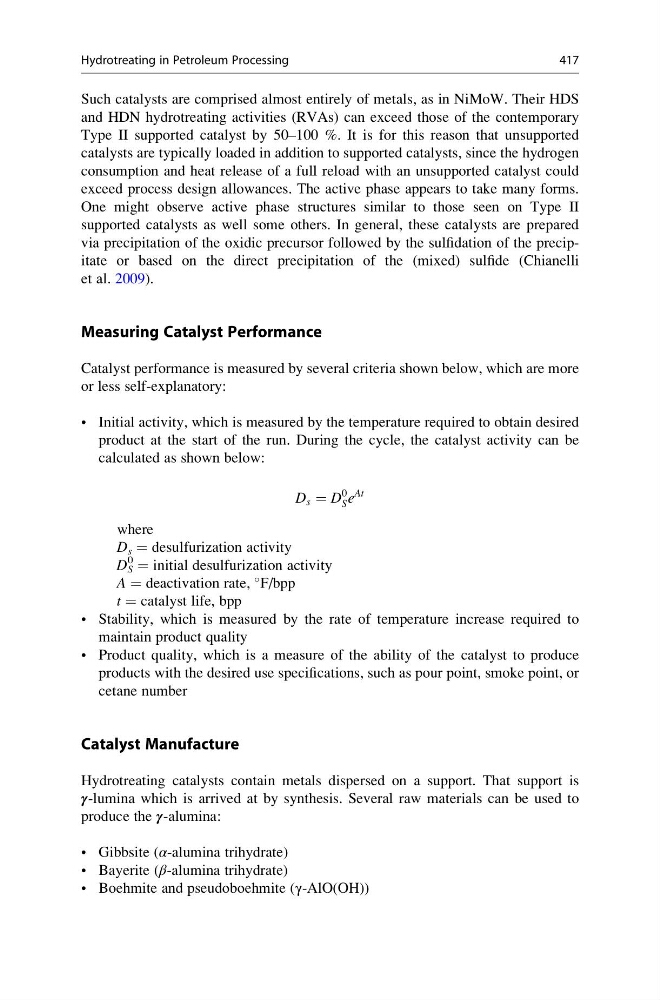
• Initial activity, which is measured by the temperature required to obtain desired
product at the start of the run. During the cycle, the catalyst activity can be
calculated as shown below:
D s ¼ D
0
S e
At
where
D s = desulfurization activity
D S
0
= initial desulfurization activity
A = deactivation rate,
F/bpp
t = catalyst life, bpp
• Stability, which is measured by the rate of temperature increase required to
maintain product quality
• Product quality, which is a measure of the ability of the catalyst to produce
products with the desired use specifications, such as pour point, smoke point, or
cetane number
Catalyst Manufacture
Hydrotreating catalysts contain metals dispersed on a support. That support is
γ-lumina which is arrived at by synthesis. Several raw materials can be used to
produce the γ-alumina:
• Gibbsite (α-alumina trihydrate)
• Bayerite (β-alumina trihydrate)
• Boehmite and pseudoboehmite (γ-AlO(OH))
Hydrotreating in Petroleum Processing
417
and HDN hydrotreating activities (RVAs) can exceed those of the contemporary
Type II supported catalyst by 50–100 %. It is for this reason that unsupported
catalysts are typically loaded in addition to supported catalysts, since the hydrogen
consumption and heat release of a full reload with an unsupported catalyst could
exceed process design allowances. The active phase appears to take many forms.
One might observe active phase structures similar to those seen on Type II
supported catalysts as well some others. In general, these catalysts are prepared
via precipitation of the oxidic precursor followed by the sulfidation of the precipitate or based on the direct precipitation of the (mixed) sulfide (Chianelli
et al. 2009).
Measuring Catalyst Performance
Catalyst performance is measured by several criteria shown below, which are more
or less self-explanatory:
• Initial activity, which is measured by the temperature required to obtain desired
product at the start of the run. During the cycle, the catalyst activity can be
calculated as shown below:
D s ¼ D
0
S e
At
where
D s = desulfurization activity
D S
0
= initial desulfurization activity
A = deactivation rate,
F/bpp
t = catalyst life, bpp
• Stability, which is measured by the rate of temperature increase required to
maintain product quality
• Product quality, which is a measure of the ability of the catalyst to produce
products with the desired use specifications, such as pour point, smoke point, or
cetane number
Catalyst Manufacture
Hydrotreating catalysts contain metals dispersed on a support. That support is
γ-lumina which is arrived at by synthesis. Several raw materials can be used to
produce the γ-alumina:
• Gibbsite (α-alumina trihydrate)
• Bayerite (β-alumina trihydrate)
• Boehmite and pseudoboehmite (γ-AlO(OH))
Hydrotreating in Petroleum Processing
417