

Hydrocracker Pretreat
Introduction
Hydrotreating and hydrocracking share many common elements. Both processes
catalytically upgrade the feedstock by adding hydrogen under moderate to high
operating pressures and elevated reactor temperatures. However, a key differentiator
is that hydrocracking catalysts have a stronger acid function compared to that of
hydrotreating catalysts, which allows the hydrocracking catalysts to facilitate deeper
cracking reactions as well as naphthenic ring-opening reactions.
A hydrocracking unit requires the use of both hydrotreating and hydrocracking
catalysts to obtain the desired product qualities in the naphtha, jet, and diesel
products as well as the desired operating cycle length. This section briefly touches
upon the hydrotreating reactor section in the context of a hydrocracking unit.
Feedstock Types
A hydrocracking unit can be designed to handle a wide range of feedstock types.
Ultimately, unit design is constrained by the economic return of processing the
most severe feedstock in comparison to the associated capital expenditure and
operating expense.
Vacuum gas oil (VGO) and heavy coker gas oil (HCGO) are more commonplace
feedstocks for a hydrocracking unit, but as the product quality specifications for
clean fuel become more stringent and the demand for transportation fuel continues
to increase in lockstep with the ever-growing global population, refiners have
increasingly found interest in processing feeds such as light cycle oil (LCO) from
the FCC and DAO (deasphalted oil) from solvent deasphalting (SDA) units to
produce high-quality fuel, such as diesel.
All four of these feedstock types will have an appreciable amount of organic
sulfur (1–3 wt%) and nitrogen (500–3,500 wppm) that will need to be nearly
completely removed in the hydrotreating section to protect the downstream hydrocracking catalyst from these poisons.
Light cycle oil is a highly aromatic diesel boiling range stream produced in the
FCC unit. Due to the high concentration of two- and three-ring aromatics, LCO has
a low cetane value, which makes it a poor blend stock for the refinery’s diesel pool.
Conventional hydrotreating pressure is frequently inadequate to completely remove
the native sulfur species in LCO to meet ULSD specifications. Therefore,
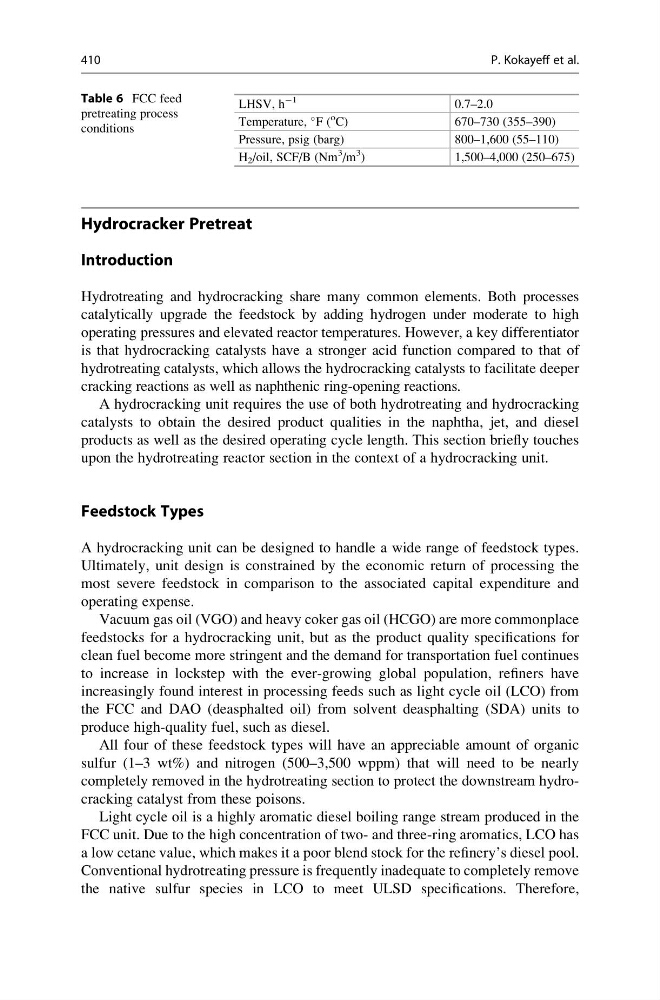
Table 6 FCC feed
pretreating process
conditions
LHSV, h
À1
0.7–2.0
Temperature,
F (
o
C)
670–730 (355–390)
Pressure, psig (barg)
800–1,600 (55–110)
H 2 /oil, SCF/B (Nm
3
/m
3
)
1,500–4,000 (250–675)
410
P. Kokayeff et al.
Introduction
Hydrotreating and hydrocracking share many common elements. Both processes
catalytically upgrade the feedstock by adding hydrogen under moderate to high
operating pressures and elevated reactor temperatures. However, a key differentiator
is that hydrocracking catalysts have a stronger acid function compared to that of
hydrotreating catalysts, which allows the hydrocracking catalysts to facilitate deeper
cracking reactions as well as naphthenic ring-opening reactions.
A hydrocracking unit requires the use of both hydrotreating and hydrocracking
catalysts to obtain the desired product qualities in the naphtha, jet, and diesel
products as well as the desired operating cycle length. This section briefly touches
upon the hydrotreating reactor section in the context of a hydrocracking unit.
Feedstock Types
A hydrocracking unit can be designed to handle a wide range of feedstock types.
Ultimately, unit design is constrained by the economic return of processing the
most severe feedstock in comparison to the associated capital expenditure and
operating expense.
Vacuum gas oil (VGO) and heavy coker gas oil (HCGO) are more commonplace
feedstocks for a hydrocracking unit, but as the product quality specifications for
clean fuel become more stringent and the demand for transportation fuel continues
to increase in lockstep with the ever-growing global population, refiners have
increasingly found interest in processing feeds such as light cycle oil (LCO) from
the FCC and DAO (deasphalted oil) from solvent deasphalting (SDA) units to
produce high-quality fuel, such as diesel.
All four of these feedstock types will have an appreciable amount of organic
sulfur (1–3 wt%) and nitrogen (500–3,500 wppm) that will need to be nearly
completely removed in the hydrotreating section to protect the downstream hydrocracking catalyst from these poisons.
Light cycle oil is a highly aromatic diesel boiling range stream produced in the
FCC unit. Due to the high concentration of two- and three-ring aromatics, LCO has
a low cetane value, which makes it a poor blend stock for the refinery’s diesel pool.
Conventional hydrotreating pressure is frequently inadequate to completely remove
the native sulfur species in LCO to meet ULSD specifications. Therefore,
Table 6 FCC feed
pretreating process
conditions
LHSV, h
À1
0.7–2.0
Temperature,
F (
o
C)
670–730 (355–390)
Pressure, psig (barg)
800–1,600 (55–110)
H 2 /oil, SCF/B (Nm
3
/m
3
)
1,500–4,000 (250–675)
410
P. Kokayeff et al.