

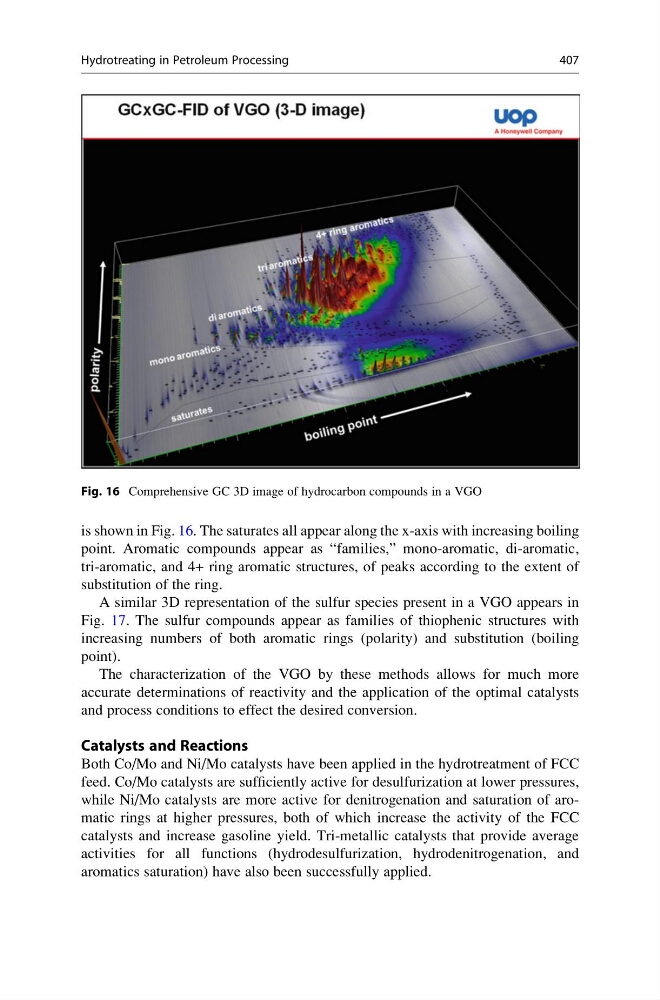
is shown in Fig. 16. The saturates all appear along the x-axis with increasing boiling
point. Aromatic compounds appear as “families,” mono-aromatic, di-aromatic,
tri-aromatic, and 4+ ring aromatic structures, of peaks according to the extent of
substitution of the ring.
A similar 3D representation of the sulfur species present in a VGO appears in
Fig. 17. The sulfur compounds appear as families of thiophenic structures with
increasing numbers of both aromatic rings (polarity) and substitution (boiling
point).
The characterization of the VGO by these methods allows for much more
accurate determinations of reactivity and the application of the optimal catalysts
and process conditions to effect the desired conversion.
Catalysts and Reactions
Both Co/Mo and Ni/Mo catalysts have been applied in the hydrotreatment of FCC
feed. Co/Mo catalysts are sufficiently active for desulfurization at lower pressures,
while Ni/Mo catalysts are more active for denitrogenation and saturation of aromatic rings at higher pressures, both of which increase the activity of the FCC
catalysts and increase gasoline yield. Tri-metallic catalysts that provide average
activities for all functions (hydrodesulfurization, hydrodenitrogenation, and
aromatics saturation) have also been successfully applied.
Fig. 16 Comprehensive GC 3D image of hydrocarbon compounds in a VGO
Hydrotreating in Petroleum Processing
407
point. Aromatic compounds appear as “families,” mono-aromatic, di-aromatic,
tri-aromatic, and 4+ ring aromatic structures, of peaks according to the extent of
substitution of the ring.
A similar 3D representation of the sulfur species present in a VGO appears in
Fig. 17. The sulfur compounds appear as families of thiophenic structures with
increasing numbers of both aromatic rings (polarity) and substitution (boiling
point).
The characterization of the VGO by these methods allows for much more
accurate determinations of reactivity and the application of the optimal catalysts
and process conditions to effect the desired conversion.
Catalysts and Reactions
Both Co/Mo and Ni/Mo catalysts have been applied in the hydrotreatment of FCC
feed. Co/Mo catalysts are sufficiently active for desulfurization at lower pressures,
while Ni/Mo catalysts are more active for denitrogenation and saturation of aromatic rings at higher pressures, both of which increase the activity of the FCC
catalysts and increase gasoline yield. Tri-metallic catalysts that provide average
activities for all functions (hydrodesulfurization, hydrodenitrogenation, and
aromatics saturation) have also been successfully applied.
Fig. 16 Comprehensive GC 3D image of hydrocarbon compounds in a VGO
Hydrotreating in Petroleum Processing
407